
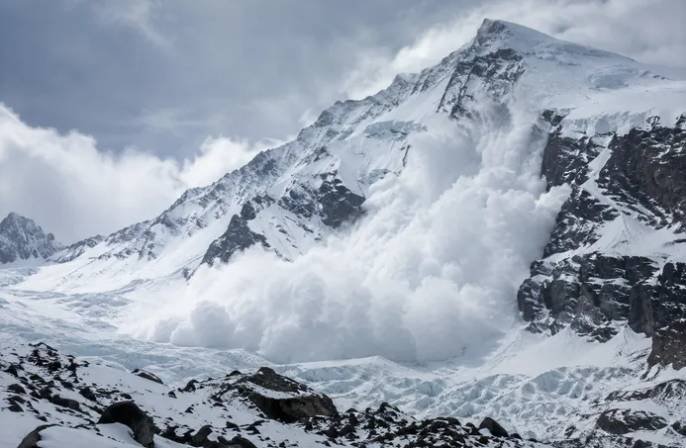

A powerful avalanche struck the base camp of Himlung Himal in Nepal’s Manang district, leaving four people dead and 12 others missing.
The avalanche hit the mountain area on Sunday morning after several days of heavy snowfall.
Himlung Himal rises to 7,126 metres and is located near Nepal’s border with Tibet.
The disaster struck an expedition camp where Nepali guides and support workers were preparing for upcoming climbing activities.
Initial reports said 10 local climbers and guides were missing.
Later updates indicated that the number of missing people had risen to 14, while four bodies were subsequently recovered.
The remaining 12 people are still missing.
Avalanche Hits Expedition Base Camp
The avalanche struck the Himlung Himal base camp after several days of snowfall in the region.
The heavy snow created dangerous conditions on the mountain slopes.
The avalanche swept through parts of the expedition camp and buried tents and other equipment under snow.
Most of those affected were Nepali mountain workers.
They were supporting climbing expeditions and preparing the route before foreign climbers arrived.
The disaster has raised fresh concerns about the dangers faced by mountain guides and expedition workers during Nepal’s climbing seasons.
Local guides often reach high-altitude camps before international climbers.
They prepare accommodation, equipment, climbing routes and other facilities needed for successful expeditions.
This work places them directly in exposed mountain areas where avalanches and sudden weather changes can occur.
Four People Confirmed Dead
Rescue authorities later recovered four bodies from the avalanche-affected area.
The deceased were identified as Chhebi Bhote, Pasang Bhote, Birendra Gurung and Ghanshyam Rai.
All four were Nepali mountain workers.
Their deaths have highlighted the serious risks faced by people working in Nepal’s high-altitude tourism industry.
Mountain guides and support staff are essential to Nepal’s climbing sector.
They often work in difficult conditions while carrying equipment, establishing camps and preparing routes for climbers.
The Himlung disaster shows that the risks begin even before climbers attempt to reach the summit.
12 People Remain Missing
Twelve people remain missing following the avalanche.
The missing workers were associated with expedition teams operating around the mountain.
Initial information from expedition organisers indicated that eight people from one expedition team and two people from another company were missing.
All those initially reported missing were Nepali.
As authorities gathered more information from the affected area, the number of missing people was revised.
The changing figures reflected the difficulty of establishing contact with workers after the avalanche struck the remote base camp.
The missing people include guides and support personnel who were helping prepare the mountain for the climbing season.
Their families are now waiting for further information from authorities and expedition organisers.
Poor Weather Complicated the Response
The avalanche occurred after several days of heavy snowfall.
Poor weather also made access to the mountain difficult.
According to expedition organiser Bibhuti Chand Thakur of Himalaya Holidays Trekking, two helicopters and a search-and-rescue team had been placed on standby.
However, bad weather prevented an immediate move to the affected area.
High-altitude rescue operations are heavily dependent on visibility and weather conditions.
Cloud cover, snowfall and strong winds can prevent helicopters from reaching remote mountain camps.
The difficult terrain creates additional challenges for ground teams.
Himlung Himal is located far from major urban centres, making emergency access more complicated than in lower-altitude areas.
Why Avalanches Are Dangerous in the Himalayas
Avalanches are among the biggest dangers faced by people climbing or working in the Himalayas.
They can occur when large amounts of snow become unstable on steep mountain slopes.
Fresh snowfall can add significant weight to an existing snowpack.
Changes in temperature, wind and snow conditions can also affect the stability of mountain slopes.
Once an avalanche begins, huge quantities of snow can move downhill at high speed.
People caught in an avalanche may be buried within seconds.
The force of moving snow can also destroy tents, equipment and other structures located along its path.
At high altitudes, survival becomes even more difficult because temperatures are extremely low and access to medical care is limited.
The Himlung avalanche demonstrates how quickly conditions can change in a high-altitude environment.
Himlung Himal Is a Major Climbing Destination
Himlung Himal stands at 7,126 metres above sea level.
The mountain is located in Nepal’s Manang district, close to the Tibetan border.
It has become an important destination for climbers seeking high-altitude Himalayan expeditions.
Although it is lower than Mount Everest, the mountain presents serious technical and environmental challenges.
Climbers must deal with extreme cold, thin air, steep terrain and unpredictable weather.
Expedition teams also need extensive logistical support.
Local guides play a critical role in preparing routes and camps.
Their knowledge of the terrain can be essential for navigating difficult sections of the mountain.
The latest avalanche has once again highlighted the risks faced by those working in this demanding environment.
Nepali Guides Play a Central Role
Nepal’s mountaineering industry depends heavily on local guides and support workers.
These workers often perform tasks that begin weeks before foreign climbers arrive.
They transport equipment to high-altitude camps.
They prepare tents and other facilities.
They help establish climbing routes and fix ropes.
They also monitor changing conditions and assist climbers during difficult sections of expeditions.
Many foreign climbers rely on the knowledge and experience of Nepali mountain professionals.
However, the people providing this support are themselves exposed to the same hazards.
They may spend long periods at high altitude while carrying out preparation work.
The Himlung avalanche has brought renewed attention to these risks.
Heavy Snowfall Raised Concerns Before the Avalanche
The Himlung region had already experienced several days of heavy snowfall before the avalanche.
Such conditions can increase the risk of unstable snow accumulation.
When large amounts of fresh snow build up on steep slopes, mountain authorities and expedition operators must closely monitor conditions.
The danger can become particularly serious when snowfall continues over several days.
High-altitude weather can also change rapidly.
A mountain that appears relatively stable in the morning can become dangerous later in the day.
This unpredictability makes weather monitoring an essential part of every Himalayan expedition.
The Himlung incident demonstrates why climbing teams must continuously assess snow and weather conditions.
Remote Location Adds to the Challenge
The location of Himlung Himal creates additional difficulties during emergencies.
Remote Himalayan mountains often have limited road access.
Helicopters therefore play an important role in transporting people and equipment during emergencies.
However, helicopters cannot always operate in severe weather.
Cloud cover and poor visibility can prevent pilots from reaching high-altitude locations.
Ground access can also be slow because rescuers have to travel across steep and difficult terrain.
This makes emergency planning particularly important for expedition operators.
Mountain teams must be prepared for situations in which outside assistance cannot arrive immediately.
The Himlung avalanche illustrates how geographical isolation can increase the impact of a mountain disaster.
Risks Beyond the Summit
Mountaineering accidents are not limited to summit attempts.
Dangerous conditions can affect people working at base camps, climbing routes and supply areas.
Avalanches can reach areas where climbers may consider themselves relatively safe.
Heavy snowfall can also trigger landslides and block access routes.
Extreme cold creates additional risks for people who become stranded or injured.
Altitude sickness is another major concern.
At elevations above 7,000 metres, oxygen levels are significantly lower than at sea level.
The human body requires time to adapt to reduced oxygen.
Long exposure to extreme altitude can affect physical performance and decision-making.
For guides and support workers who spend extended periods in mountain environments, these risks can become particularly serious.
Nepal’s Mountaineering Industry Faces Growing Pressure
Mountaineering is a major part of Nepal’s tourism industry.
The country is home to some of the world’s highest mountains.
Thousands of climbers and trekkers visit Nepal each year.
The industry provides employment for guides, porters, cooks, transport workers and other local communities.
Revenue from mountaineering also supports businesses operating in mountain regions.
However, the economic benefits come with significant safety challenges.
Mountain workers often have to operate in difficult weather and dangerous terrain.
As climbing activity increases, expedition operators face growing pressure to maintain safety standards.
Weather forecasting, route assessment and emergency planning are therefore increasingly important.
Climate and Weather Concerns
Changing weather patterns have also increased concerns about safety in Himalayan regions.
Mountain environments are highly sensitive to temperature and precipitation changes.
Heavy snowfall in a short period can create unstable conditions.
Sudden temperature changes can also affect snow and ice conditions.
Scientists and mountain experts have increasingly studied the effects of changing climate conditions on Himalayan glaciers and slopes.
The relationship between climate change and individual avalanche events can be complex.
Not every avalanche can be directly linked to climate change.
However, changing temperatures, precipitation patterns and snow conditions can influence the stability of mountain environments.
For expedition operators, this makes accurate weather information more important than ever.
Foreign Climbers Were Not Initially Among the Missing
The people reported missing in the Himlung incident were Nepali workers associated with the expedition operations.
Foreign climbers had not yet reached the main climbing area when the avalanche struck.
This distinction is important because international climbing expeditions often depend on local teams to prepare routes and camps ahead of their arrival.
Nepali workers therefore face significant risks even before the main climbing groups begin their summit attempts.
Their early arrival at high altitude allows expedition companies to prepare the mountain infrastructure.
But it also means they can be exposed to dangerous conditions before foreign climbers arrive.
Families Await Information
The disappearance of the workers has created uncertainty for their families.
Mountain workers often come from communities with long traditions of guiding and trekking.
For many families, income from mountaineering provides an important source of financial support.
The disappearance of a guide or support worker can therefore affect an entire household.
Families are now waiting for authorities and expedition organisers to establish the fate of those still missing.
The recovery of four bodies has confirmed the seriousness of the disaster.
However, the search for the remaining missing workers continues.
Safety Questions Raised After the Disaster
The avalanche is likely to raise questions about expedition safety and weather assessment.
Mountain operators routinely monitor weather forecasts and snow conditions before sending teams into high-altitude areas.
However, Himalayan weather can change rapidly.
An accurate forecast does not always eliminate the risk of a sudden avalanche.
Expedition teams must therefore make decisions based on several factors.
These include snowfall, wind conditions, slope stability, temperature and recent avalanche activity.
Communication between guides, expedition organisers and authorities is also important.
Early warnings can allow teams to move away from exposed areas before conditions deteriorate.
A Difficult Period for Himalayan Expeditions
The Himlung disaster comes during a challenging period for Himalayan expeditions.
Heavy snowfall and poor weather have affected activities in several mountain regions.
Such conditions can delay climbing schedules and make transportation difficult.
Expedition operators may also have to postpone activities when mountain conditions become unsafe.
For climbers, delays can mean additional costs and logistical problems.
For local workers, however, dangerous weather can have much more serious consequences.
They may already be stationed at high-altitude camps when conditions suddenly deteriorate.
The Himlung avalanche shows the importance of prioritising safety over expedition schedules.
Search for Missing Workers Remains the Priority
The immediate focus remains on the 12 people who are still missing.
Rescue teams are working in the avalanche-affected area to locate those who have not yet been accounted for.
The operation is being carried out under difficult mountain and weather conditions.
Authorities and expedition organisers are continuing to assess the situation as more information becomes available.
The recovery of four bodies has already confirmed that the avalanche caused significant loss of life.
For the families of those still missing, the search remains critical.
Officials are expected to provide further information as the operation progresses and the identities of those affected are confirmed.
Himlung Disaster Highlights Himalayan Dangers
The Himlung Himal avalanche is a stark reminder of the risks associated with high-altitude mountaineering.
The disaster struck a base camp rather than a summit route.
It affected Nepali guides and support workers who were preparing for upcoming expeditions.
Four people have been confirmed dead, while 12 remain missing.
The incident has highlighted the vulnerability of mountain workers who provide essential support to Nepal’s growing climbing industry.
It has also demonstrated how heavy snowfall and difficult weather can quickly transform a mountain environment into a life-threatening zone.
As authorities continue dealing with the aftermath, the tragedy is likely to renew discussions about expedition safety, weather monitoring and emergency preparedness in Nepal’s high-altitude regions.

