

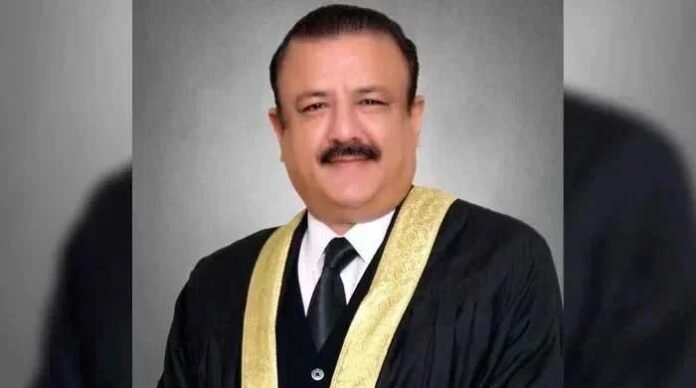

The Higher Education Commission (HEC) has supported Karachi University’s (KU) findings regarding the LLB degree of Justice Tariq Mehmood Jahangiri, stating in a detailed report to the Islamabad High Court (IHC) that the degree was obtained through unfair means.
While endorsing KU’s conclusions, the HEC clarified that it had never verified the judge’s law degree, nor had Justice Jahangiri ever contacted the commission for authentication.
The report was submitted in compliance with directions from an IHC bench comprising Chief Justice Sardar Mohammad Sarfraz Dogar and Justice Mohammad Azam Khan, which sought the judge’s complete academic record as part of proceedings examining his eligibility to hold judicial office.
During the hearing, the court was urged to summon original records from Karachi University, whose earlier cancellation of the LLB degree was suspended by the Sindh High Court.
Chief Justice Dogar noted that the allegations were serious and required scrutiny strictly on the basis of documentary evidence. He added that, as the national regulatory body for higher education, the HEC’s findings would be evaluated before considering whether to issue a notice to KU.
The HEC’s submission included KU’s inquiry report, which identified major discrepancies in Justice Jahangiri’s academic history. According to KU, a candidate named ‘Tariq Mehmood’ obtained an LLB degree in 1991 under enrolment number 5968, though records showed that another student, Imtiaz Ahmed, had been assigned the same number years earlier.
In addition, the transcript for LLB Part-I was issued under the name ‘Tariq Jahangiri’. The judge had also enrolled under a second enrolment number, 7124, in violation of university rules allowing only one enrolment number for a degree programme.
The inquiry committee avoided terming the degree ‘bogus’ but declared it invalid due to conflicting identities and records. KU further alleged the use of false identities and impersonation of other students, leading to cancellation of the degree and a three-year examination ban in 1992.
The matter has remained contentious since September, when the IHC temporarily barred Justice Jahangiri from performing judicial duties. The Supreme Court later set aside the order, ruling that a high court cannot suspend a sitting judge through an interim directive, and asked the IHC to proceed according to law.
