

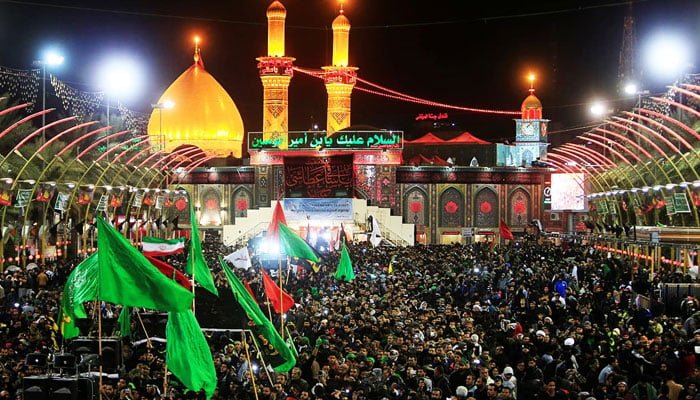

Arbaeen Pilgrims
In a significant move aimed at ensuring the safety of Pakistani pilgrims, the federal government has decided to bar all road travel to Iraq and Iran for this year’s Arbaeen pilgrimage. The announcement was made by Federal Minister for Interior Affairs, Mohsin Naqvi, through a statement posted on X (formerly Twitter) on Sunday.
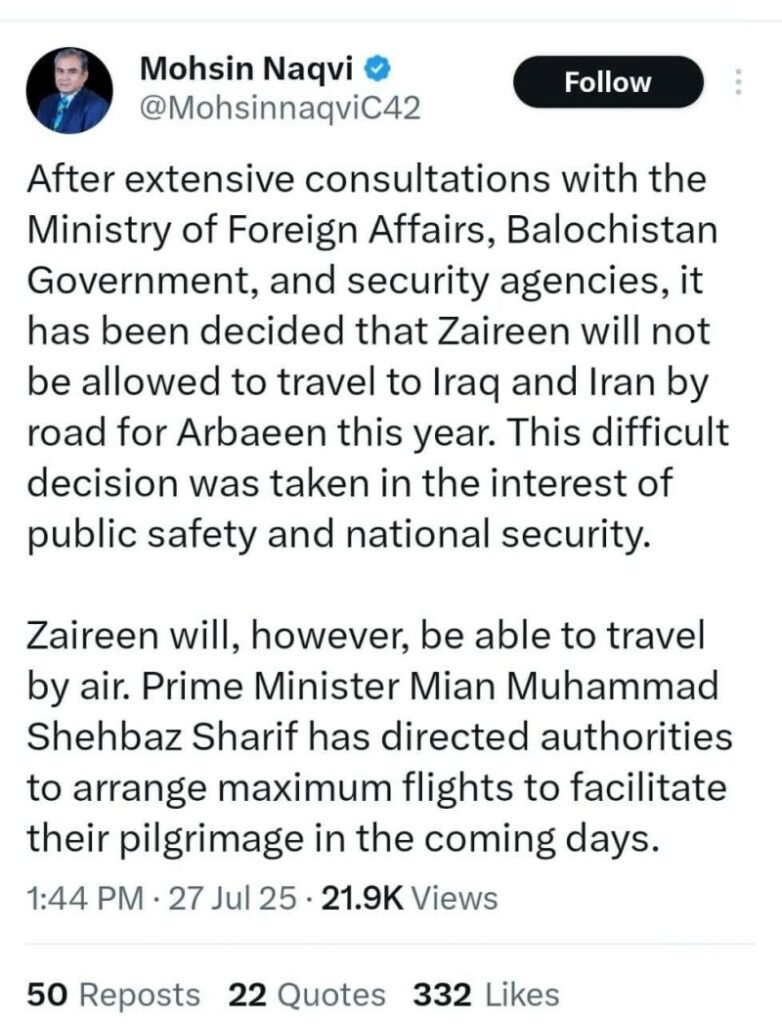
According to the interior minister, the decision was taken after detailed deliberations and consultations among key government stakeholders, including the Ministry of Foreign Affairs, the Balochistan provincial government, and various law enforcement and intelligence agencies.
The primary motivation behind this move, he said, was to address increasing security threats along land routes and to protect the lives of pilgrims travelling to the sacred cities of Najaf and Karbala via Iran.
“Zaireen will not be allowed to travel to Iraq and Iran by road for Arbaeen this year,” Naqvi stated in his tweet. “Pilgrims will only be permitted to travel via air.” He acknowledged that the restriction may cause inconvenience to many but described it as a “difficult but necessary step in the national interest.”
The minister stressed that the government could not afford to take risks with the lives of its citizens and that recent security assessments had highlighted growing risks on the overland routes to Iran and Iraq, especially through the Balochistan border. In light of these concerns, road access will remain suspended until further notice.
To mitigate the impact of this decision and facilitate the spiritual journey of thousands of Pakistani pilgrims, Prime Minister Shehbaz Sharif has directed aviation authorities to increase the number of available flights to Iraq and Iran. The goal is to provide maximum convenience to the zaireen through well-coordinated and timely air travel arrangements.
Each year, tens of thousands of Pakistani Shia Muslims make the pilgrimage to Karbala to observe Arbaeen, one of the world’s largest religious gatherings held 40 days after Ashura, to commemorate the martyrdom of Imam Hussain (RA). Most traditionally travel by road through Iran, which is often considered cost-effective and culturally significant.
However, in recent years, the land route—especially through restive areas of Balochistan—has become increasingly volatile due to threats from militant groups, smuggling networks, and criminal gangs. The government’s decision, while unprecedented, reflects the urgency to prioritize safety in a sensitive region.
Authorities have assured pilgrims that every effort will be made to accommodate their religious commitments with minimum disruption. Special coordination cells are also being established to help pilgrims with bookings and flight schedules.
More updates on travel guidelines and flight arrangements are expected to be announced in the coming days.
