
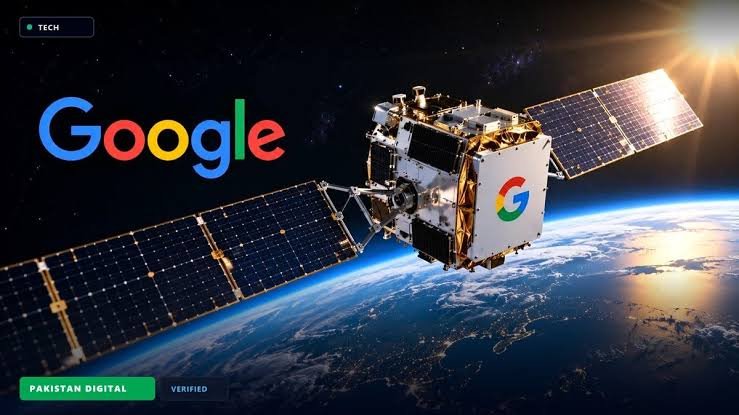

Google has successfully operated an artificial intelligence model on a satellite and received its first response back on Earth. The achievement marks an important step towards developing space-based AI computing infrastructure.
The experiment forms part of Project Suncatcher, a research initiative exploring whether satellites could eventually host powerful AI data centres. Google announced the successful test on October 30, 2026.
Google AI Sends First Message From Space
During the experiment, Google sent a request to its satellite, asking the onboard Gemma 4 AI model to write a short poem about space.
The model processed the request using Google’s Tensor Processing Unit (TPU), a specialised chip designed for artificial intelligence workloads. As the satellite passed over Svalbard, Norway, it successfully transmitted the response back to Earth.
The AI generated a three-line poem describing Earth, data streams and starlight. Google called the achievement its first successful AI response from a data centre-class TPU operating in orbit.
Google Plans More Advanced Space Experiments
Project Suncatcher aims to explore whether solar-powered satellites could eventually support large-scale AI computing. This approach could reduce dependence on traditional data centres and their electricity requirements.
However, operating computer hardware in space presents several challenges. Satellites must withstand extreme temperatures, radiation exposure and other harsh environmental conditions.
Google plans to conduct further tests to evaluate its processors under these conditions. The company also aims to test two interconnected satellites in 2027 to explore shared computing capabilities.
For now, Project Suncatcher remains an experimental research project rather than a commercial service. Nevertheless, the successful demonstration provides an important foundation for Google’s future space-based computing ambitions.
For the latest updates, visit and follow The Truth International website (www.thetruthinternational.com) and subscribe to the YouTube Channel.

