

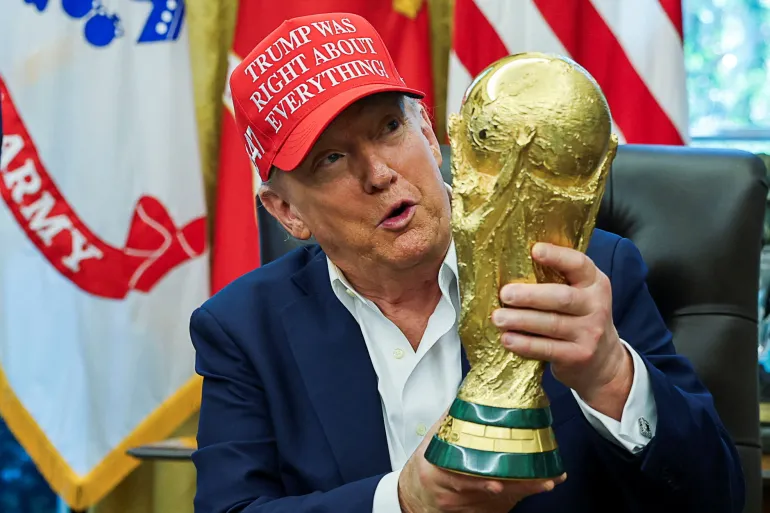

German Football Leader Urges Serious Boycott Discussion
A senior German football official has called for a boycott of the 2026 FIFA World Cup, which will be jointly hosted by the United States, Canada, and Mexico. The tournament is scheduled to take place from June 11 to July 19. The call comes amid renewed political controversy linked to U.S. President Donald Trump’s push to acquire Greenland, a semi-autonomous territory within the Kingdom of Denmark.
The remarks were made by Oke Göttlich, a member of the German Football Federation’s executive committee and the president of Bundesliga club St. Pauli. Speaking on Friday, Göttlich said the time had come to seriously consider and openly discuss the idea of a boycott. He questioned football’s claim of political neutrality and expressed frustration over what he described as inconsistent standards within the sport.
Göttlich stated that football had previously taken strong political positions, particularly during debates surrounding the Qatar World Cup. He said that abandoning political engagement now appeared contradictory. According to him, Europe has failed to defend its values and set clear boundaries in response to current global developments.
Comparisons Drawn With Historic Olympic Boycotts
Göttlich, who is well known for openly mixing sports and politics, compared the current situation to the boycott of the 1980 Olympic Games in Moscow. Those Games were held during the Cold War and were boycotted after the Soviet Union invaded Afghanistan. The United States led that boycott, which resulted in the participation of only 81 countries, while around 60 nations stayed away.
He argued that the political risks today are even greater than they were in 1980. In his view, ignoring major geopolitical actions sets a dangerous precedent. He stressed that silence from sporting institutions can be interpreted as acceptance. Göttlich believes football should play a role in defending democratic values rather than avoiding uncomfortable discussions.
His comments reflect a broader debate in European sport about where to draw the line between politics and competition. Critics argue that sport cannot exist in isolation from global events. Supporters of neutrality, however, warn that politicising tournaments could divide fans and players.
World Cup 2026 Faces Growing Political Scrutiny
The 2026 FIFA World Cup is expected to be the largest in history. It will feature an expanded format and matches across North America. While preparations are ongoing, political tensions now risk overshadowing the sporting spectacle.
President Trump’s interest in gaining control of Greenland has drawn strong reactions in Europe. Denmark has repeatedly rejected the idea, and the issue has strained diplomatic relations. Greenland’s strategic importance has further intensified the debate.
Göttlich’s call adds pressure on FIFA, which has traditionally promoted political neutrality. So far, FIFA has not responded to the boycott suggestion. No national football association has officially supported the idea either.
Despite this, the discussion continues to gain attention. As the tournament approaches, political concerns may become harder to ignore. The 2026 World Cup could once again highlight the complex relationship between global politics and international sport.
