

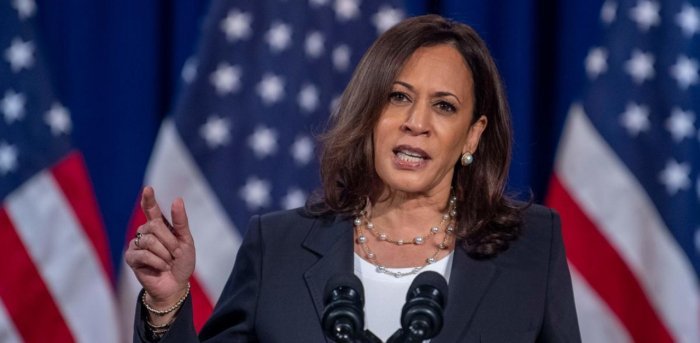

With US President Joe Biden now out of the race for a second term, attention has shifted to his vice president, Kamala Harris, who has received Biden’s full support.
Within 30 hours of Biden’s announcement, 186 Democratic House members, 43 senators, and 23 governors had endorsed Kamala Harris. She quickly secured enough delegates to become the official Democratic nominee for the upcoming Democratic National Convention.
Harris’s campaign has also made history, breaking fundraising records by raising more than $100 million in 48 hours, with $81 million raised in the 24 hours following Biden’s announcement.
While Harris’s nomination has injected renewed energy into the Democratic party and its voter base, there are concerns that former President Donald Trump’s campaign and his supporters might use Harris’s race and gender against her.
Interviews with more than a dozen Black women revealed both excitement and concern about Vice President Harris’s ability to win at a time when racism and sexism are prevalent.
Despite facing challenges as the first Black, South Asian female presidential nominee, Harris is nearly 20 years younger than Trump, shifting the spotlight from Biden’s age to the oldest person to run for the presidency.
Harris’s choice of vice president will also impact the Democrats’ chances in November, with some suggesting that a white male candidate could mitigate the impact of racism and sexism on her candidacy.
Gaza Policy
In addition to age, Biden’s campaign faced challenges due to his Gaza policy. More than half a million voters chose to vote uncommitted or left the top of their ballots blank during the Democratic primary to express dissatisfaction with his approach to Israel’s war following the October 7 attacks.
Israel’s response is currently under investigation by the International Court of Justice (ICJ) for genocide.
Biden’s stance on Gaza was particularly damaging in Michigan, a swing state with the largest Arab and Muslim American populations in the US. Voters across the political spectrum criticized Biden, with some rejecting unconditional US support for Israel and others feeling he did not support Israel enough.
In contrast, Harris is viewed as more empathetic to the suffering of Palestinians in Gaza while also advocating for the immediate release of hostages. In a speech in Selma, Alabama, on March 4, Harris described the situation in Gaza as “a humanitarian crisis” and called for “an immediate ceasefire.” She also criticized Israel for not allowing sufficient humanitarian aid into Gaza and emphasized the need for Israel to restore basic services to allow more food, water, and fuel to reach those in need.
However, Harris’s past record raises questions about her future actions. In a 2017 speech to pro-Israeli lobby group AIPAC, she endorsed providing billions of dollars in military support to Israel. More recently, in November, she expressed sympathy for innocent lives lost in Gaza but maintained that the US was not dictating how Israel should conduct the war. She also reaffirmed her and Biden’s unwavering commitment to Israel’s security.
Kamala Harris needs to navigate these complex issues to regain the support of voters who felt alienated by Biden’s policies while maintaining the backing of pro-Israel Democratic lawmakers and donors.
First Test
As the presidential nominee, Harris’s first test on this issue has come early. Israeli Prime Minister Netanyahu is in Washington, DC, this week to address a joint session of Congress. His visit has sparked protests from anti-war activists and Israeli hostage families calling for a ceasefire and the return of their loved ones.
Several Democrats have decided not to attend Netanyahu’s speech. Harris’s team announced she would not be present at the speech due to previously scheduled plans, but she is expected to meet with Netanyahu separately at the White House.
Anti-war voters will be closely watching Harris’s next moves on Israel and Gaza, recognizing her potential to re-engage communities disenfranchised by Biden’s policies.
