

BY HUMAIRA MOTALA
KARACHI: In Lyari, a 48-year-old tailor ignored a small shoe-bite for 15 days. By the time he reached Civil Hospital, his foot was black — gangrene.
For a diabetic, a shoe-bite is never just a shoe-bite.
Pakistan now lives with the world’s highest diabetes prevalence — 31.4%, or 34.5 million adults, as per IDF Atlas 2025. And every third patient walking into OPDs in Karachi has uncontrolled sugar.
What most don’t see is the next stage.
“The foot is the mirror of diabetes — what happens in the foot tells you what is happening in the heart, kidney and eye,” is a common teaching in diabetology.
Every day, nearly 1,000 Pakistanis undergo an amputation due to a diabetic foot ulcer — in every 20 second, a limb is amputated, out of which 80 percent can be saved. At least 3.4 million are currently at risk, because once a foot wound gets infected, time runs fast.
This is why foot clinics matter.
At Civil Hospital Karachi, the diabetic foot centre sees 60-70 such cases daily — labourers, housewives, drivers — who thought “zakham toh sookh jayega” until it didn’t.
A State-of-the-Art Limb-Saving Unit in a Public Hospital
During my recent visit to Dr. Ruth K. M. Pfau Civil Hospital Karachi, AMS Dr. Muhammad Shah especially took me to this dedicated diabetic foot care and wound unit.
“This is one of the state-of-the-art diabetic foot care centres in Sindh. What you see here is not just a clinic — it is a limb-saving unit,” he said, introducing me to the team.
And Dr Shah was right. In a public hospital where thousands walk in daily with uncontrolled diabetes, this centre stands out. From advanced Doppler screening to detect blood flow blockages, to custom off-loading footwear to relieve pressure on wounds, to multidisciplinary care by diabetologists, vascular surgeons and wound-care nurses under one roof — it is designed to stop an ulcer from becoming an amputation.
As Dr. Elliott P. Joslin, Father of Modern Diabetes Care, said: “Diabetes is the only disease where the patient can be his own doctor.”
In a country where 26 percent of diabetics remain undiagnosed, a small centre inside Civil Hospital is quietly saving limbs and lives — completely free of cost.
Sindh government and 78 Dowites Unique Initiative; Foot Care and Wound Unit
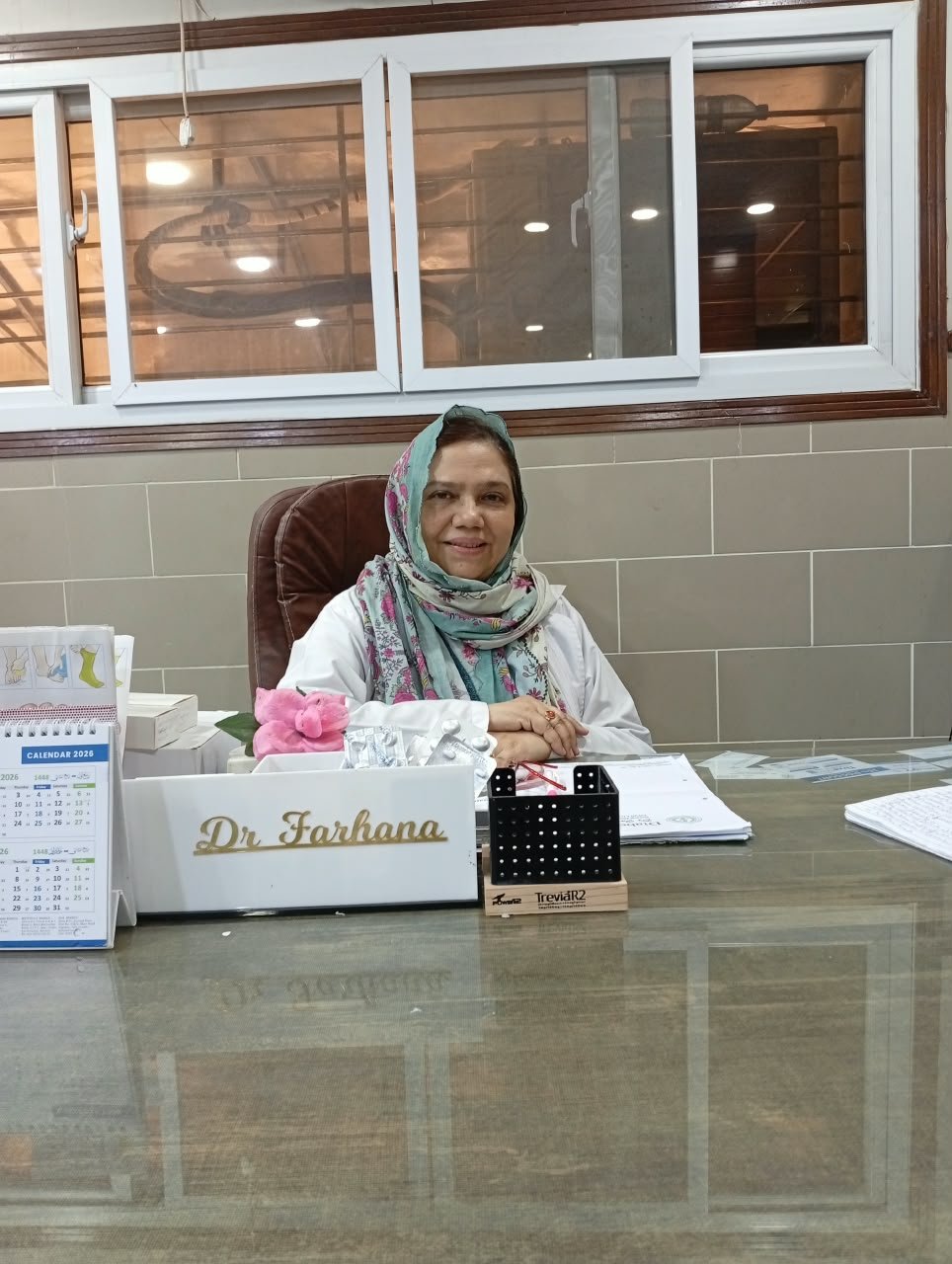
At its helm is Dr. Farhana Rasheed, in charge of the Diabetic Foot and Wound Care Centre, with over 30 years of experience. Holding an MSc in Diabetes, she joined Civil Hospital Karachi in 2016 as Head of the Diabetes Department and took charge of the dedicated Foot Care Centre two years ago.
Acknowledging institutional support, she credited Medical Superintendent Dr. Khalid Bukhari for his keen interest.
“MS Civil Dr. Khalid Bukhari has taken every measure to keep this centre state-of-the-art and ensure all facilities are provided to patients. It was he who appointed me as head two years ago, understanding the growing burden of diabetic foot cases,” she said.
Dr. Farhana said it was the only dedicated diabetic foot care centre in Sindh that is completely free of cost. “It was established in 2019 in collaboration with the Government of Sindh and Dowites 78 — the alumni association of Dow Medical College Batch of 1978,” she said.
The facility is directly supervised by its Chief Executive, Prof. Surgeon Shafiq-ur-Rehman, who regularly visits and treats patients every Monday.
The centre runs with a 20-member multidisciplinary team comprising Consultant Orthopedic Surgeon Dr. Shazaib, General Surgeon Dr. Jawad, Podiatrist Dr. Sawera Arif — a specialized foot doctor trained to diagnose deformities, prevent ulcers and design custom off-loading footwear — and other seasoned physicians, supported by 13 OT technicians.
From Examination to Advanced Dressings — All Free
Elaborating on patient flow, she said every patient first undergoes a detailed foot examination by the podiatrist and orthopedic surgeon, and is then referred to the chief diabetologist for diabetes control.
“In case a minor surgical procedure is required, it is carried out right here in the centre. However, if major surgery or admission is needed, we refer the patient to the concerned department. We bear the entire cost of treatment and post-surgical care,” she said.
“Patients are not just given dressings while they are in the centre. We also provide medicines, including expensive antibiotics, free of cost to the needy patients.”
Vascular surgeons are also available on-call, as poor blood supply is a major reason for non-healing wounds.
According to her, free-of-cost dressing is available, including advanced and expensive options like VAC (Vacuum Assisted Closure) and Aquacel dressings, which otherwise cost thousands per day. Our technicians are also available for home visits at very minimal charges to facilitate elderly and post-surgery patients.
80% Limbs Saved, But Neuropathy Cases Surging
Stressing her personal affiliation, Dr. Farhana said her commitment is deeply personal.
“My own father died due to complications of diabetes. This centre is not just my duty, it is personal for me,” she said.
She noted that cases of diabetic neuropathy — which creates numbness — have alarmingly increased over the last five years.
“Most people come to us when their wound is already in a very bad condition. Despite late presentation, we save around 80 percent of limbs through timely intervention,” she said.
Globally, around 18.6 million diabetic patients suffer from foot ulcers annually.
The Unseen Crisis: Undiagnosed, Unaware, Untreated
Pointing to the lack of awareness, Dr. Farhana said 26 percent of diabetics in Pakistan remain undiagnosed.
“There is a huge need to run aggressive awareness campaigns through screening camps, especially in rural areas. There is an urgent need to build small foot care centres all over Sindh. If we catch the wound early, we can save the foot. If we catch diabetes early, we can save the life,” she stressed.
Patients are referred from all classes, rich and poor alike, but for the poor and needy, separate charitable funds have been arranged.
Diabetes Beyond Sugar: Mind, Money and Marriage
Describing diabetes as more than a physical disease, she said:
“It is not just a physical disease, it is a syndrome which affects your entire body and organs, including mental health. On the economic front, it creates financial stress not only on low-income but also on the middle class.”
“Women often skip their own medicine to manage the household budget and most people keep searching for venues where they can get free or discounted diabetes drugs,” she noted.
Dr Farhana also updated that due to junk food and a less active lifestyle, youth under 25 were also getting diabetes, where genetics also plays an important role. Owing to societal pressures, young girls hide their disease so they can get married, which leads to dangerous complications later.
What Needs To Be Done: The NICVD Model
“Diabetes may not kill you immediately, but it takes your leg, your eyesight, and your kidney — piece by piece,” Prof. Javed Akram, President, Pakistan Society of Internal Medicine, had emphasized at the Karachi Diabetic Foot Conference 2025.
Giving her recommendation, Dr. Farhana said the NICVD model should be replicated.
“Just the way NICVD has created small chest pain units for early cardiac issues in every district, similar walk-in setups should be built for diabetes where patients can easily walk in to check and get early diagnosis. An early diagnosis can lead to reversal of the disease,” she said.
A Heartbeat That Refused to Die
Recalling a lifetime moment she cherishes, Dr. Farhana shared an incident from 2016.
“A pregnant woman was brought to the emergency and was almost declared dead on arrival. But before declaring her dead, I conducted a full check-up and found the child was still alive. I rushed her to the operation theatre and the child was saved.”
“That is one of the finest moments of my medical life. That is what medicine is all about — never giving up till the last heartbeat,” she said.
About the Writer:
The writer is a senior journalist and columnist covering crime, law, social issues, governance, energy, health, literature, and women and children’s rights across Pakistan’s leading English media houses.
Feedback: mediawomen2014@gmail.com
For the latest updates, visit and follow The Truth International website (www.thetruthinternational.com) and subscribe/follow the TTI YouTube Channel, Instagram, and Facebook

