

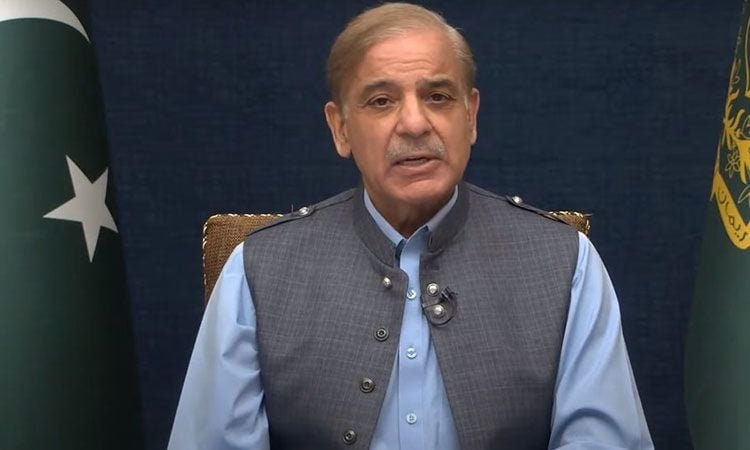

Former Chief Justice of Pakistan, Jawwad S. Khawaja, has filed a petition seeking contempt proceedings against Prime Minister Shehbaz Sharif for failing to comply with a Supreme Court directive issued on May 7, 2024. The order had mandated the establishment of an independent appellate forum within 45 days to allow civilians convicted by military courts to appeal their convictions in High Courts.
The petition, filed through senior advocate Khwaja Ahmad Hosain, argues that the federal government’s inaction amounts to willful disobedience of the Supreme Court’s ruling. Justice Khawaja had also been a petitioner in the Intra-Court Appeal (ICA) that was adjudicated by a five-member constitutional bench, which delivered the now-contested order.
Citing Article 204 of the Constitution, along with sections 3 to 6 of the Contempt of Court Ordinance, 2003, and Order XXVII of the Supreme Court Rules, 1980, the petition insists that the federal government’s failure to legislate within the prescribed period has rendered all subsequent court martial proceedings against civilians unconstitutional.
The May 7 decision had instructed the federal government and Parliament to amend the Pakistan Army Act and related legal frameworks to establish an independent appellate forum. This step was deemed essential to uphold the constitutional right to a fair trial and comply with international human rights standards outlined in the International Covenant on Civil and Political Rights (ICCPR).
According to the petition, no such appellate mechanism was created within the 45-day deadline. As a result, the previously allowed appeals under the ICA now stand dismissed, and any actions taken under the provisions struck down in the Supreme Court’s earlier judgment dated October 23, 2023, lack legal validity.
The lapse of the legally mandated timeframe is portrayed as a clear act of contempt, with the petition emphasizing that governance cannot function effectively when judicial orders are disregarded. Under Article 90 of the Constitution, and in light of the Rules of Business and relevant Supreme Court judgments, the prime minister, as the head of the federal executive, is held directly responsible for the failure to act.
Therefore, the petition claims that Prime Minister Shehbaz Sharif is personally liable for contempt of court, asserting that such disobedience undermines not only judicial authority but also the constitutional order.
The petition further underscores the significance of this case, noting it pertains to fundamental rights chiefly, the right to due process and a fair trial. It states that the Supreme Court had explicitly called for legislative reform to bring Pakistan’s military justice system in line with constitutional and international human rights obligations.
The former chief justice concluded his plea by stressing that the May 7 short order was unequivocal. The federal government had no discretion, it was a mandatory directive to enact legislation granting civilians convicted by military tribunals the right to appeal before civilian courts. The failure to fulfill this obligation, the petition asserts, warrants contempt proceedings to uphold constitutional governance and safeguard citizens’ rights.
