

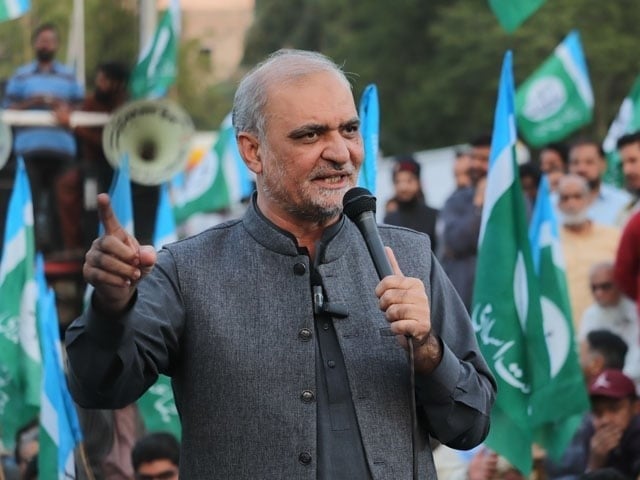

Jamaat-e-Islami (JI) chief Hafiz Naeemur Rehman has strongly criticized the Sindh government’s e-challan system, calling it a burden on citizens rather than a genuine effort to improve Karachi’s infrastructure.
Speaking at an event in Karachi, he described the initiative as a “drama” designed to collect fines instead of addressing the city’s deteriorating transport conditions. According to him, the government has failed to provide efficient and affordable public transport options for millions of commuters.
High Fines and Lack of Transport Facilities
Hafiz Naeem highlighted the disparity between traffic fines in Karachi and other major cities. He questioned why a challan costing Rs200 in Lahore was as high as Rs5,000 or even Rs25,000 in Karachi. “Isn’t criticism of the ruling party justified when such unequal fines exist?” he asked.
He pointed out that while authorities issue heavy fines, they have not delivered on promises to expand the public transport network. Referring to World Bank data, he said Karachi requires at least 15,000 buses, yet the Sindh government has introduced only around 400.
According to the 2023 census, Karachi’s population exceeds 20 million, but inadequate transport services have forced citizens to rely heavily on motorcycles and Qingqi rickshaws. The number of motorbikes in the city, he noted, has now surpassed five million.
Accusations of Neglect and Mismanagement
The JI chief accused the Pakistan People’s Party (PPP) of engaging in “qabza siyasat,” or politics of control, claiming it has wasted decades of Karachi’s potential. He said the party’s long rule has brought little progress, leaving the city’s infrastructure in ruins.
He also criticized delays and mismanagement in several large-scale urban projects, including the S-III sewerage scheme, Karachi Circular Railway (KCR), and various bus rapid transit lines such as the Green, Red, and Orange lines.
“The KCR has been inaugurated several times by different governments but still hasn’t been completed,” Hafiz Naeem remarked. “The Green Line was left unfinished, and the Red Line project has damaged University Road.”
JI’s Local Efforts to Address Urban Challenges
Despite limited resources, Hafiz Naeem praised JI’s local town leadership for taking on civic challenges neglected by the authorities. He said the party’s representatives had begun a “new journey” in nine towns to address sewerage, sanitation, and garbage management issues.
He cited examples from North Nazimabad, where local JI teams resolved long-standing sewerage problems by connecting drainage lines to the Gujjar Nullah. According to him, these are tasks that fall under the responsibility of the Karachi Water and Sewerage Corporation (KWSC) and the city administration, yet local volunteers and JI council members have stepped in to help.
Call for Accountability and Urban Reform
Hafiz Naeem emphasized that Karachi’s problems stem from government inaction and misplaced priorities. He urged the provincial leadership to shift focus from revenue collection to real governance reforms that improve transportation, drainage, and waste management systems.
He reiterated that genuine progress requires transparency, accountability, and planning that reflects the needs of Karachi’s massive and growing population. Until then, he said, citizens would continue to suffer under systems that prioritize fines over functional infrastructure.
