

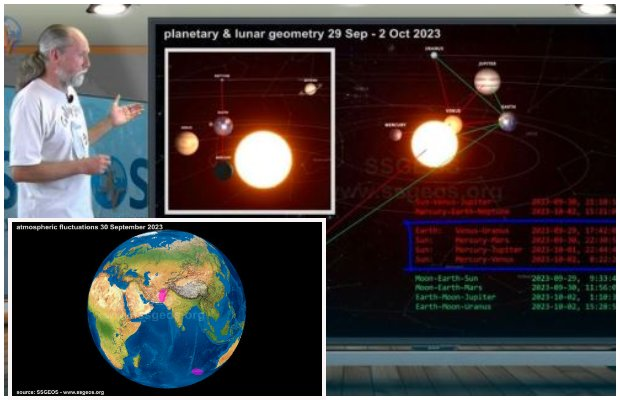

The Solar System Geometry Survey (SSGEOS), an organization based in the Netherlands renowned for its seismic predictions, has gained attention by forecasting a major earthquake in Pakistan.
SSGEOS predicts that this seismic event will occur in Pakistan within the next 48 hours.
SSGEOS specializes in monitoring fluctuations of electric charge in the atmosphere near sea level, which they assert can indicate regions where stronger seismic activity might happen, typically within a range of 1 to 9 days. While they acknowledge that the regions they identify as potentially affected are approximations, their insights are valuable for assessing earthquake-prone areas.
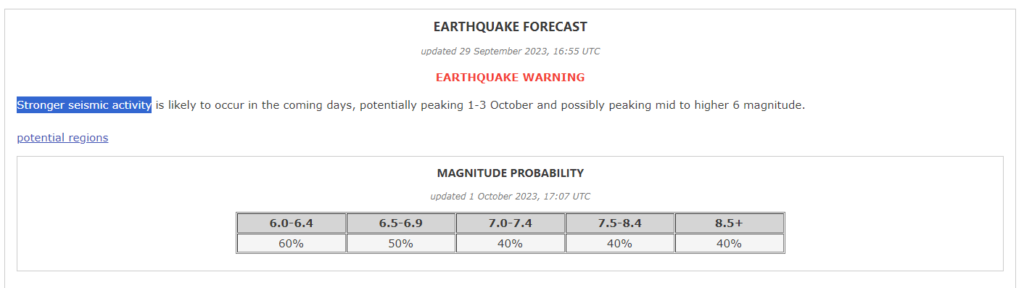
In a recent prediction, a Dutch scientist collaborating with SSGEOS reported a significant increase in electric activity along the Chaman fault lines in Pakistan. This surge has raised concerns about a powerful earthquake potentially occurring within the next 48 hours, causing anxiety among the local population.
It’s worth noting that this Dutch scientist has a track record of accurately predicting earthquakes, notably forecasting the devastating earthquake in Turkey earlier this year, which tragically resulted in the loss of over 47,000 lives.
In the past, the Pakistan Meteorological Department (PMD) has consistently dismissed such predictions, citing a lack of scientific basis for earthquake forecasts.
Pakistan is situated in a seismically active region due to the convergence of the Indian Plate and the Eurasian Plate, making it susceptible to earthquakes. Throughout its history, the country has experienced numerous significant earthquakes, and the threat of seismic events remains a constant concern.
Expert’s Opinion
Experts worldwide stress the inherent challenges in accurately predicting earthquakes. While it’s possible to estimate the likelihood of earthquakes occurring in certain areas due to high seismic activity, pinpointing exact locations and timings remains a formidable challenge. Therefore, experts emphasize that one should approach earthquake forecasts, even those made by well-intentioned scientists, with caution.
