
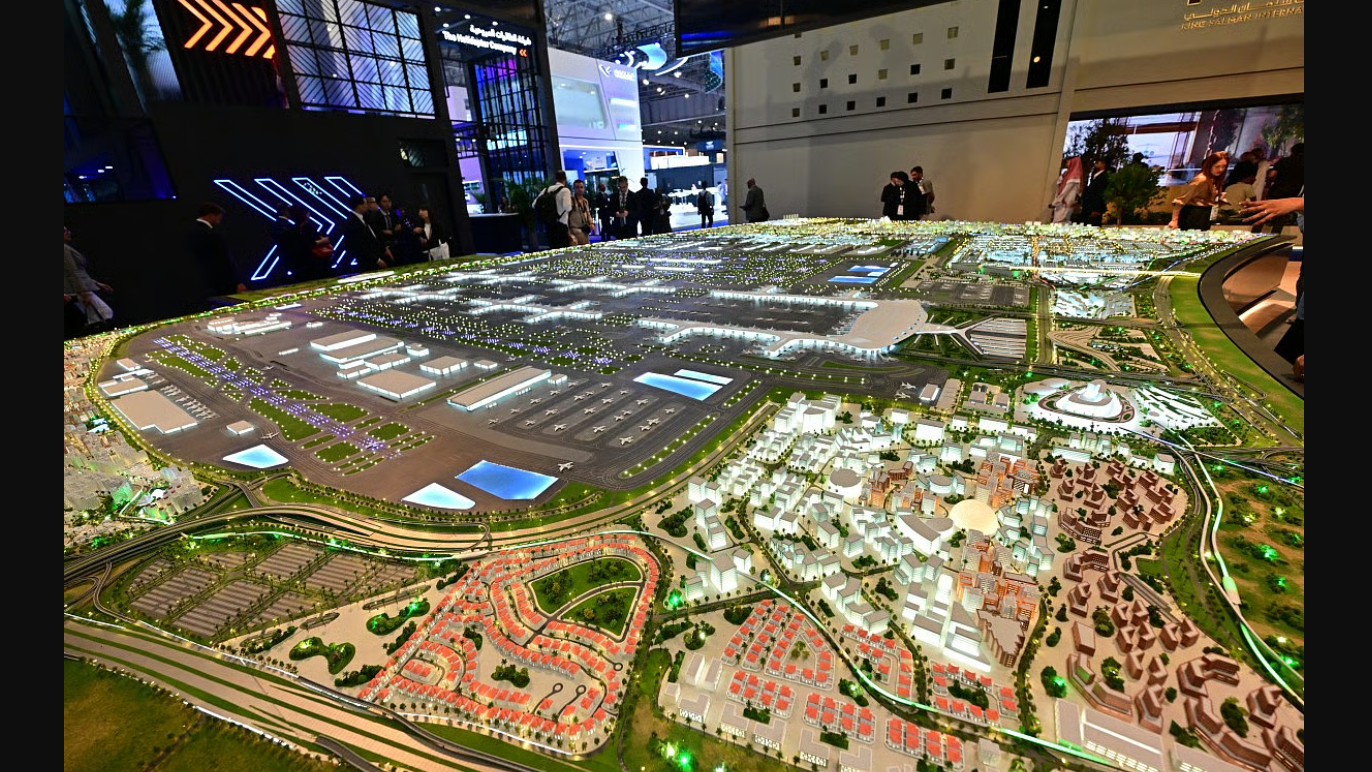

Dubai Airports CEO Paul Griffiths confirmed the project’s progress on Tuesday. He said construction teams had started major groundwork and piling operations. Meanwhile, procurement activities and discussions over significant construction contracts were also moving forward.
“The budget is something like $35 billion, and I know major contracts are being discussed and let as I speak,” Griffiths said, adding that piling had started and groundwork was well underway.
Construction Gains Momentum at Al Maktoum International Airport
The airport expansion has entered an important phase involving extensive civil engineering and infrastructure development. Authorities are working towards opening the first phase in 2032.
In June, Dubai Aviation Engineering Projects reported significant progress on the construction site. More than 17,000 concrete piles had been installed, while excavation work exceeded 45 million cubic metres of earth.
The developer also expected the construction workforce to reach approximately 120,000 workers at its peak.
Furthermore, officials announced plans earlier this year to award additional contracts worth more than Dh55 billion during 2026. These agreements cover terminal buildings, concourses and supporting infrastructure.
Griffiths’ latest comments confirm that large-scale construction continues. However, he did not reveal the updated value of awarded contracts or details about individual construction packages.
Dubai Plans to Build a 260 Million-Passenger Airport
Sheikh Mohammed bin Rashid Al Maktoum approved the latest expansion plan on April 28, 2024. He serves as the UAE’s Vice-President and Prime Minister, as well as Dubai’s Ruler.
The Dh128 billion development aims to establish Al Maktoum International Airport as Dubai’s main international gateway. Eventually, the new facility will replace Dubai International Airport (DXB).
The long-term master plan includes five runways and hundreds of aircraft stands. Moreover, the airport will accommodate up to 260 million passengers and handle 12 million tonnes of cargo annually.
The first phase is scheduled to become operational in 2032. Subsequently, authorities expect capacity to increase gradually as demand for air travel grows.
Moving Dubai’s Entire Airport Operation Presents a Major Challenge
The development involves much more than constructing new terminals and runways. Dubai Airports must maintain growth at DXB while preparing to transfer operations to Al Maktoum International Airport.
Also known as DWC, the new airport stands approximately 70 kilometres away from the existing facility.
Griffiths described the relocation as a major logistical challenge. The transition will involve moving an entire airport operation from one part of Dubai to another.
“Our real measure of success is: can we keep growth going in the city without constraining the supply of capacity? And can we seamlessly manage the transition?” he said.
The relocation will also require additional residential communities and supporting infrastructure for airport employees. Currently, many workers live in northern Dubai or neighbouring emirates.
Therefore, authorities must consider housing and essential facilities closer to the new airport. Griffiths highlighted the wider impact of this transformation, saying, “The whole city has got to move.”
New Airport Will Undergo a Year of Testing Before Opening
Dubai Airports is preparing for the operational demands of the transition through recruitment, staff training and technology testing.
Griffiths said the company plans to operate the new airport without passengers for at least one year before its public opening. This preparation period will allow teams to examine essential systems and identify potential problems.
These tests will cover baggage handling, passenger check-in facilities, Wi-Fi and other airport operations.
“We can test the baggage systems. We can test the check-in. We can test the Wi-Fi. We can test all of the systems,” he said.
Additionally, Dubai International Airport will serve as a testing ground for new technologies. Authorities plan to evaluate these systems before introducing them at the larger facility.
Griffiths stressed that the company cannot afford delays when preparing the new airport for operations.
Dubai Wants to Minimise Disruption During the Airport Transfer
Another major priority involves reducing the period during which both airports handle significant operations simultaneously.
However, the final relocation schedule and the future of the existing DXB site will depend on government decisions.
Griffiths described the planned transfer as unprecedented in scale. He compared it with Hong Kong’s airport relocation during the 1990s, which involved approximately 20 million passengers.
Dubai’s planned transition involves an operation several times larger than that earlier relocation.
“That’s never been done on that scale,” he said.
The expansion therefore represents more than a major construction project for Dubai. It also involves extensive operational planning, workforce preparation and infrastructure development. With the first phase expected in 2032, the coming years will determine how smoothly Dubai can establish its next major international aviation gateway.
For the latest updates, visit and follow The Truth International website (www.thetruthinternational.com) and subscribe to the YouTube Channel.

