
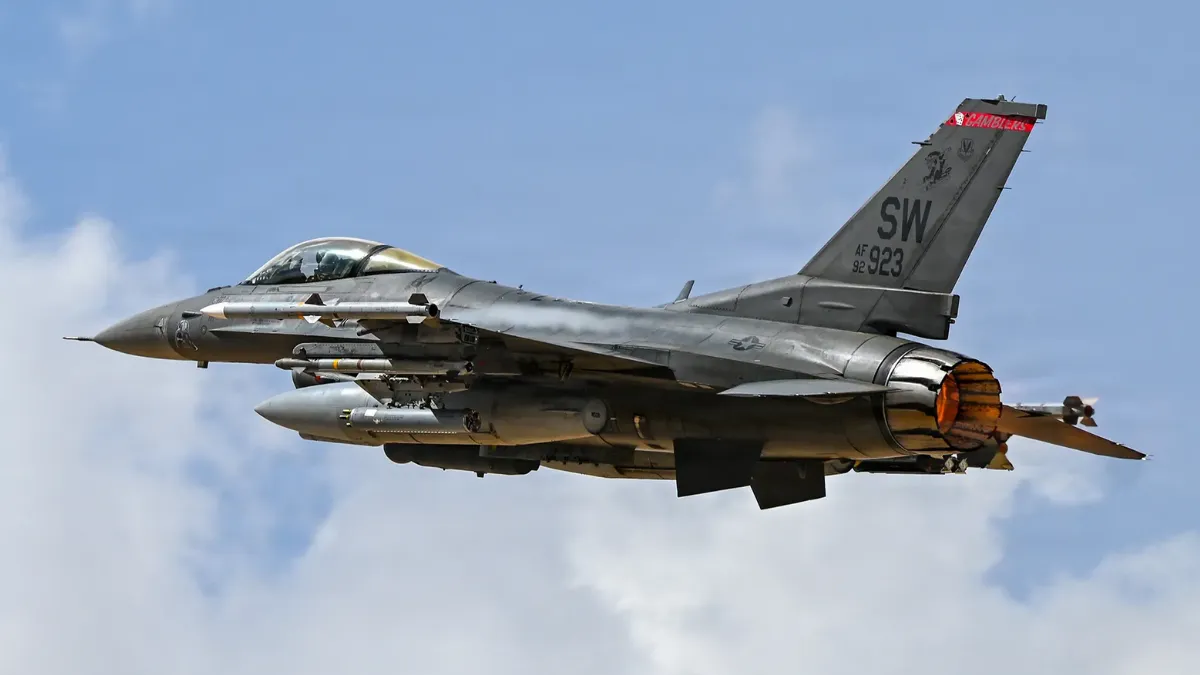

A fresh military controversy has emerged in the Middle East after Iran claimed its air defence systems damaged an American F-16 fighter jet over the Persian Gulf. The United States has strongly rejected the claim, raising questions about what actually happened in the region’s increasingly dangerous airspace.
The conflicting statements came on Saturday, November 21, 2026, as tensions between Washington and Tehran continued to intensify. The incident has attracted international attention because it involves one of the United States military’s most widely used fighter aircraft.
Iranian military officials claimed their air defence systems targeted an American F-16 on Friday evening. According to the Iranian account, a surface-to-air missile exploded close to the aircraft as it approached Iranian airspace over the Persian Gulf.
Iran claimed the explosion damaged the fighter jet and forced its pilot to abandon the mission. The aircraft reportedly made an emergency landing at an airport in the United Arab Emirates.
However, US Central Command (CENTCOM) immediately disputed the account.
The American military stated that Iran had not attacked an F-16 fighter jet on Friday. It also confirmed that all US military fighter aircraft deployed in the Middle East were safe and accounted for.
The statement directly contradicted Tehran’s version of events and rejected suggestions that an American fighter jet had been damaged during the alleged encounter.
The controversy became more complicated after flight-tracking reports suggested that a US F-16 had transmitted an emergency signal.
According to those reports, the aircraft broadcast squawk code 7700, an international aviation signal used to indicate a general emergency.
The reported signal appeared before the aircraft descended toward the United Arab Emirates.
However, an emergency code does not automatically confirm that an aircraft has been attacked. Pilots may use the signal for mechanical problems, medical emergencies or other situations requiring urgent assistance.
The available flight-tracking information has not independently established that the aircraft was struck by an Iranian missile.
Neither side has publicly presented independently verified evidence proving that a US fighter jet sustained damage in the alleged incident.
As a result, Iran’s claim and Washington’s denial remain conflicting official accounts.
The reported incident comes during a particularly sensitive period in the Middle East.
Earlier in the week, American fighter jets carried out strikes against an Iranian missile launch site on Qeshm Island, near the Strait of Hormuz.
The military action followed renewed Iranian attacks targeting American positions in the Gulf region.
On November 17, Iran launched drones toward a US radar installation in Bahrain. American forces subsequently struck an Iranian missile site on Qeshm Island.
The exchange of attacks increased concerns that the conflict could expand despite diplomatic efforts to reduce tensions.
Regional governments have warned that further military escalation could threaten civilian populations, strategic infrastructure and international shipping routes.
Meanwhile, the situation in the Strait of Hormuz has become increasingly dangerous.
On Saturday, the United Kingdom Maritime Trade Operations (UKMTO) reported that two tankers had been struck by unidentified projectiles while travelling through the strategic waterway.
One tanker was reportedly hit near its stern. Another vessel sustained damage to its engine room.
The maritime monitoring organization said no casualties had been reported in the first incident.
However, the identities of those responsible for the attacks were not immediately established.
Iranian military officials separately claimed that an oil tanker had caught fire after striking a naval mine near a restricted area east of the Strait of Hormuz.
According to Tehran, the vessel had entered the restricted zone after disabling its identification and navigation systems.
Iran claimed that the ship ignored maritime warnings before the incident.
These allegations have not been independently verified.
The US military has previously stated that it cleared naval mines from the main shipping routes through the strait.
Washington has also responded to Iranian shipping restrictions by imposing a blockade on Iranian ports and providing naval escorts for tankers travelling through the region. The Strait of Hormuz is one of the world’s most strategically important maritime routes.
A significant share of internationally traded oil and liquefied natural gas normally passes through the narrow waterway.
Any prolonged disruption can affect global energy supplies, transportation costs and international trade.
The latest tanker incidents have therefore increased concerns about maritime security.
Shipping companies must consider the risk of attacks, delays and higher insurance costs when planning journeys through the region.
Rising tensions could also create uncertainty in global oil markets, although the immediate financial impact depends on the scale and duration of any disruption.
Iran also claimed on Saturday that its forces had shot down an American drone over Qeshm Island.
However, independent confirmation of that claim was not available in the reports reviewed.
The latest announcements add to a series of disputed military claims exchanged between Iran and the United States.
During the wider conflict, Tehran has previously reported damaging or destroying American military aircraft. Washington has rejected several such claims.
These disagreements make it difficult to establish the precise outcome of individual military incidents without verified evidence.
The growing confrontation has also increased diplomatic pressure on regional governments.
Gulf countries have expressed concerns about the possibility of renewed large-scale hostilities and their consequences for economic stability.
On November 20, US President Donald Trump discussed the prospects for reaching an agreement with Iran. However, major differences remained between the two countries.
Diplomatic uncertainty has added to fears that additional military incidents could undermine efforts to prevent a wider conflict. For the United States, the reported F-16 incident has become another test of its military communication strategy.
CENTCOM’s immediate response appears intended to counter Iran’s allegation and reassure regional partners about the condition of American aircraft.
For Iran, the claim highlights its stated ability to challenge American military operations near its territory.
However, neither country’s statements alone can establish the complete circumstances of the alleged encounter.
Independent evidence, including verified aircraft information or an official investigation, would be necessary to determine whether an F-16 experienced an emergency and what caused it.
The dispute also demonstrates how quickly unverified battlefield claims can spread during periods of military tension.

