
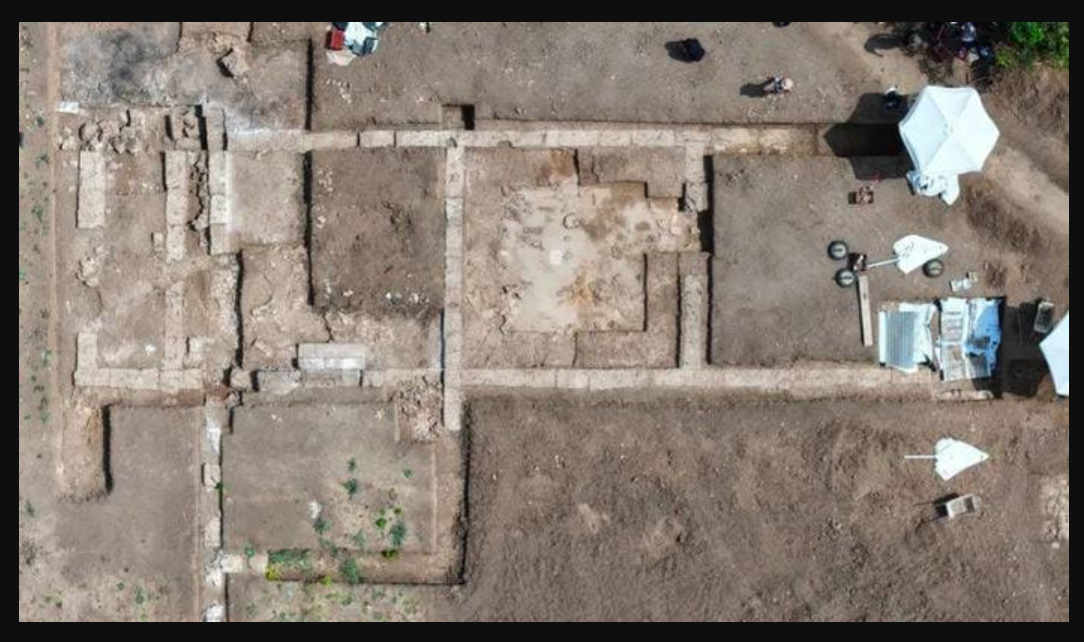

Archaeologists in Greece believe they may have identified the ancient school where Aristotle taught Alexander the Great.
The sprawling site lies at ancient Mieza in northern Greece and dates to the fourth century BC. It was built during the reign of Alexander’s father, Philip II of Macedon.
Rather than revealing a simple classroom, excavations have uncovered a large educational and athletic complex. The discovery includes several features that point to its role as an important learning centre.
Ancient Complex Reveals Lecture Hall and Sports Facilities
Archaeologists discovered a lecture hall equipped with stone desks at the site. They also uncovered a stadium, sporting arena and covered walkway.
The complex additionally contained two banquet halls with colorful mosaic floors. These rooms also featured raised areas where couches were once positioned.
Researchers found several objects that provide further clues about the site’s educational use. These included coins, pottery and four writing styluses that students may have used.
Angeliki Kottaridi, who leads the excavations, believes the site represents the Royal Gymnasium. She says Aristotle taught Alexander and other young members of Macedonia’s elite there.
Ancient Sources Link Aristotle’s School to Mieza
Historical sources had previously connected Aristotle’s school with Mieza. Around 343 BC, Philip II invited the Greek philosopher to educate his teenage son.
Alexander later became king of Macedonia and established an empire extending from Greece to Egypt and India. He died at the age of 32.
The newly discovered complex also contains architectural features resembling those at the royal palace in Aigai. Alexander and his father lived at the palace.
These similarities provide another connection between the site and Macedonia’s royal court. However, archaeologists have yet to find direct evidence confirming Aristotle taught in a particular room.
Evidence Points Towards a Royal Educational Centre
Researchers have also not established that Alexander personally used any of the four writing styluses found during the excavations.
Nevertheless, several features strengthen the possibility that the complex was the school associated with Aristotle. Its age, location and substantial size all fit the historical description of the educational centre.
Its architectural links to the Macedonian royal court also add weight to the identification. However, the absence of a direct inscription means researchers have not conclusively confirmed Aristotle’s teaching location.
The discoveries at Mieza therefore offer significant clues about the place where Alexander the Great may have received his education. Further evidence could help determine whether the complex was indeed the Royal Gymnasium linked to Aristotle.
For the latest updates, visit and follow The Truth International website (www.thetruthinternational.com) and subscribe to the YouTube Channel.

