
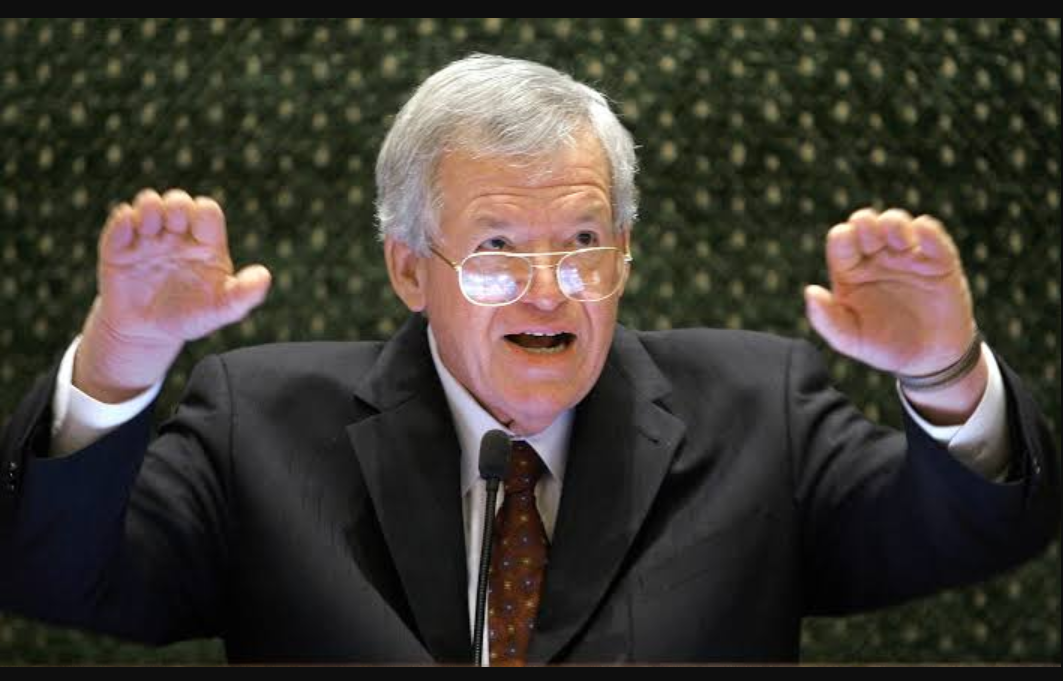

Former US House Speaker Dennis Hastert has died at the age of 84, but his name remains part of Washington’s political vocabulary.
Hastert died of natural causes on Saturday at his home in Yorkville, Illinois, where he had received hospice care over the weekend. He served as speaker from 1999 to 2007, becoming the longest-serving Republican to hold the position.
However, his political legacy extends beyond his time leading the House. The informal principle known as the “Hastert Rule” continues to influence debates over how congressional leaders decide which legislation reaches the House floor.
What Is the Hastert Rule?
The Hastert Rule was never formally adopted as a House rule. Instead, it describes an informal political practice associated with Hastert’s leadership.
The principle generally holds that House leaders should avoid bringing legislation to the floor unless most members of their own party support it.
Hastert referred to this approach as the “Majority of the Majority.” He believed a speaker should first secure sufficient support within their own party before depending on opposition lawmakers.
The idea became particularly significant during debates over legislation that attracted broad bipartisan support. However, such measures sometimes lacked enough backing from members of the party controlling the House.
Hastert Rejected the Name Himself
Despite the widespread use of the term, Hastert repeatedly rejected the idea that he had created an official “Hastert Rule.”
When asked about the term in 2013, he said there was “no Hastert Rule.” Instead, he described the concept as a governing philosophy.
Hastert later explained his position during an oral history interview with NPR. He stated, “If you begin bringing up bills that you do not have support for within your own party, you cease being a leader.”
Consequently, the phrase continued to circulate in Washington even though no formal congressional rule carries Hastert’s name.
From Teacher to House Speaker
Before entering national politics, Hastert worked as a high school teacher and wrestling coach in Illinois.
He later entered politics and gradually rose through the Republican ranks. Eventually, he became one of the most influential figures in the US political system.
Hastert served as House speaker for eight years between 1999 and 2007. During that period, his approach emphasized maintaining support among Republican lawmakers before moving legislation forward.
That strategy later became closely associated with his name, particularly during discussions about party unity in Congress.
Hastert’s Later Legal Troubles
Hastert’s political reputation eventually collapsed after federal investigators uncovered a hush-money arrangement in 2015.
Investigators found that Hastert had agreed to pay $3.5 million to conceal past wrongdoing. He later pleaded guilty to breaking laws governing the structuring of banking transactions connected to those payments.
Hastert also admitted in court that he had engaged in a pattern of child sexual abuse decades earlier while working as a wrestling coach.
Because the statute of limitations had expired, prosecutors could not charge him with the underlying abuse.
Instead, Hastert was convicted over the financial transactions connected to the hush-money payments. He ultimately served 15 months in prison.
His Political Name Remains in Washington
After the revelations, several institutions removed Hastert’s name from places that had previously honored him.
Wheaton College, for example, renamed a public policy center that had carried his name. His portrait was also removed from the US Capitol.
Nevertheless, removing his name from political language proved much harder.
The term “Hastert Rule” remains part of Washington’s political discussion. It continues to appear whenever lawmakers debate how much support a House speaker should require from their own party before allowing legislation to reach a vote.
Hastert may no longer be present on Capitol Hill, but the political principle associated with his leadership continues to shape conversations about party unity and legislative strategy.
For the latest updates, visit and follow The Truth International website (www.thetruthinternational.com) and subscribe to the YouTube Channel.

