
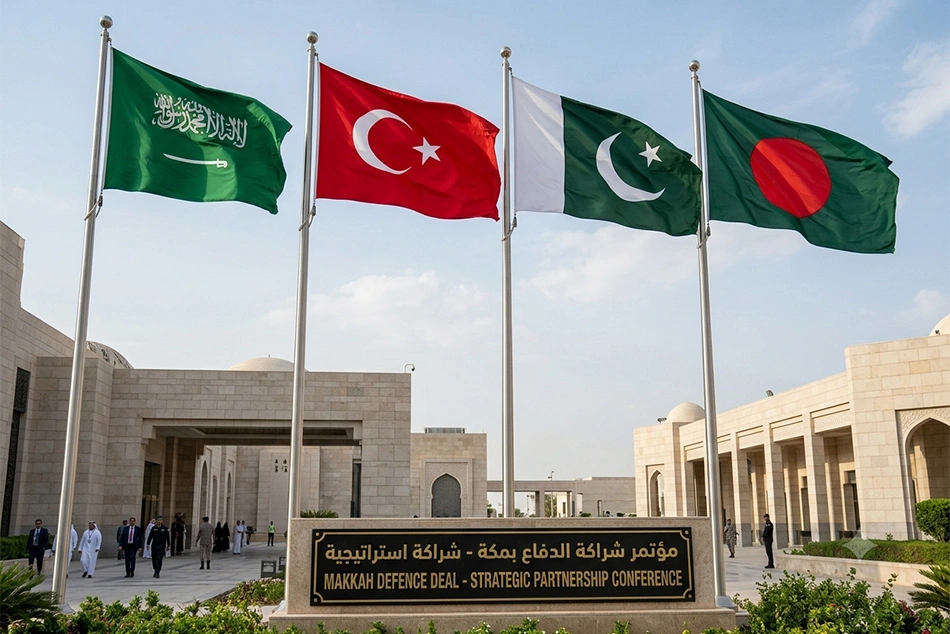

Bangladesh Says National Interest Will Guide Any Decision
Bangladesh has signalled openness to potentially joining an economic or defence framework involving Pakistan, Saudi Arabia and Türkiye, marking a notable development in Dhaka’s evolving regional diplomacy.
Prime Minister Tarique Rahman’s Foreign Affairs Adviser Humaiun Kobir said Bangladesh maintains a positive approach towards the possibility of becoming part of such a framework.
However, he stressed that any decision would depend on Bangladesh’s national interests and changing global economic and trade conditions.
Kobir made the remarks in an interview with Bangladesh’s state-run news agency, Bangladesh Sangbad Sangstha.
He said the government was following a “Bangladesh First” foreign policy, aimed at maintaining balanced international relations while placing national interests at the centre of major diplomatic decisions.
The remarks do not mean Bangladesh has formally applied to join the Makkah Joint Defence Agreement.
Instead, they indicate that Dhaka is willing to consider participation if the arrangement aligns with its strategic and economic priorities.
The development comes as Bangladesh expands engagement with several major regional powers while seeking to avoid excessive dependence on any single country.
Makkah Pact Treats Attack on One Member as Attack on All
Pakistan, Saudi Arabia and Türkiye signed the Makkah Joint Defence Agreement on August 7, 2026, during a summit at Al-Safa Palace in Makkah.
The agreement was signed by Prime Minister Shehbaz Sharif, Saudi Crown Prince and Prime Minister Mohammed bin Salman and Turkish President Recep Tayyip Erdoğan.
Under the agreement, an armed attack against any one of the three countries will be regarded as an attack against all three.
The pact is intended to strengthen collective deterrence and expand defence cooperation between the member states.
Turkish Foreign Minister Hakan Fidan later described the mutual-defence provision as technically similar to NATO’s Article 5.
He stressed, however, that the agreement was not directed against Iran or any other particular country.
Türkiye has also expressed support for expanding the framework, with Egypt identified as one possible future participant.
Pakistan has similarly said the pact could expand.
Deputy Prime Minister and Foreign Minister Ishaq Dar said on August 9 that the agreement remained open to countries willing to support its basic principles.
Dar described the pact as defensive and said it did not replace Pakistan, Saudi Arabia or Türkiye’s existing bilateral or multilateral agreements.
The possibility of Bangladesh joining would therefore fit with the three founding countries’ publicly stated willingness to expand the framework.
Any accession, however, would require further diplomatic negotiations and agreement between the parties.
Bangladesh-Pakistan Relations Gain Momentum
Kobir’s comments also come as Bangladesh seeks closer working relations with Pakistan.
He said Dhaka was strengthening its bilateral relationship with Islamabad as part of normal diplomatic engagement.
The focus includes expanding trade and people-to-people connectivity between the two countries.
Bangladesh’s government has presented this approach as part of a broader policy of maintaining constructive relations with multiple international partners.
Under its “Bangladesh First” strategy, Dhaka says it wants a flexible foreign policy based on mutual respect, sovereign equality and national interest.
Bangladeshi officials have also emphasised stronger economic diplomacy with the United States, European Union, China and other major partners.
The potential defence relationship with Pakistan, Saudi Arabia and Türkiye could therefore become one part of a wider shift in Bangladesh’s regional engagement.
Dhaka already maintains particularly close ties with Saudi Arabia.
Earlier this month, Bangladesh also confirmed its participation in a Saudi-led maritime security arrangement aimed at addressing threats to shipping linked to Houthi activity.
Kobir’s latest remarks suggest Bangladesh is prepared to examine additional security partnerships, although no final decision on joining the Makkah pact has been announced.
For now, Dhaka has kept the door open while making clear that any future commitment will be assessed through the lens of its own economic, security and diplomatic interests.

