
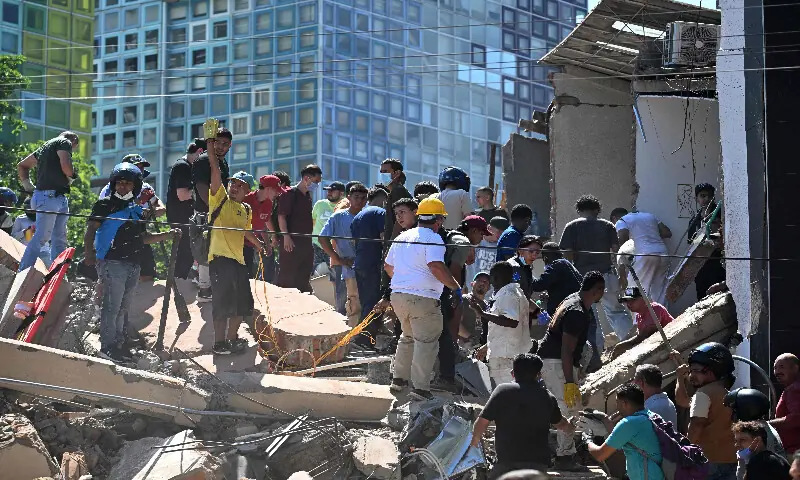

A powerful 7.4-magnitude earthquake has killed 132 people in western Colombia, while more than 570 others suffered injuries.
However, officials have warned that the death toll could rise as rescue teams continue searching damaged buildings.
The earthquake struck early Monday near San José del Palmar in the northwestern department of Chocó.
Authorities described it as the most powerful earthquake to hit Colombia during the current century.
The epicentre was located roughly 250 miles, or 400 kilometres, west of the capital Bogotá.
Earthquake Damage Spreads Across Western Colombia
The powerful tremor affected several cities and towns across western Colombia, including Cali, Pereira, Quibdó and Manizales.
Buildings collapsed in affected areas, while a regional airport also suffered damage during the disaster.
Meanwhile, residents became trapped beneath rubble as emergency crews rushed to affected communities.
Officials have reported damage to more than 1,600 buildings across the affected regions.
The scale of destruction has raised concerns about the situation in remote communities that remain difficult to reach.
Aftershocks Add to Rescue Challenges
The United States Geological Survey recorded the earthquake at a depth of about 66 miles, or 107 kilometres.
Tremors from the powerful earthquake were also felt in Ecuador, Panama and Venezuela.
At least 21 aftershocks followed the initial earthquake within several hours.
Consequently, emergency crews have faced additional challenges while searching damaged buildings and helping affected residents.
Authorities continue to assess the extent of destruction as rescue teams reach more communities.
Hard-Hit Regions Report Heavy Losses
Several regions have recorded significant casualties following the earthquake.
Risaralda department, which includes the city of Pereira, has reported some of the heaviest losses.
Valle del Cauca, home to Colombia’s third-largest city Cali, has also suffered major casualties.
Several children were reportedly among those killed in the affected regions.
Additional deaths have been confirmed in Chocó, close to the earthquake’s epicentre.
Caldas and Antioquia have also reported fatalities following the powerful tremor.
In the town of El Cairo, officials estimate that almost 80 percent of the community has been affected.
President Orders Emergency Response
The disaster has created the first major crisis for Colombia’s newly inaugurated president, Abelardo de la Espriella.
He took office only days before the earthquake struck the country.
Following the disaster, he convened an emergency committee to oversee rescue operations.
He also declared a national state of emergency and ordered government resources towards affected areas.
“The first priority is rescuing the people trapped under the rubble,” de la Espriella said in a national address.
He also pledged that the government had deployed its full capabilities to protect lives and provide assistance.
Meanwhile, international support has started arriving as leaders from the Americas, Europe and the Middle East offer assistance.
Remote Chocó Faces Additional Difficulties
The earthquake’s epicentre lies along the Pacific “Ring of Fire”, a seismic belt surrounding the Pacific Ocean.
The region experiences a significant share of the world’s earthquakes.
Chocó is among Colombia’s poorest and most remote regions, with many rural communities surrounded by jungle.
Several areas remain accessible mainly by boat or aircraft, potentially complicating efforts to assess the full damage.
As a result, authorities may need additional time to reach isolated communities and determine the extent of the disaster.
Colombia Remembers Previous Major Earthquake
Moderate earthquakes frequently occur across central and western Colombia. However, earthquakes exceeding magnitude 6.0 remain relatively uncommon, according to the supplied information.
The last comparable disaster occurred in 1999, when a magnitude 6.2 earthquake near Armenia killed more than 1,100 people.
The latest earthquake has once again placed the country’s emergency response capabilities under intense pressure.
For now, search-and-rescue operations remain underway across the affected regions.
Officials have cautioned that both the death toll and injury figures could increase as rescuers reach more affected communities.

