



NAB Amendments
ISLAMABAD: On October 31, a larger bench led by Chief Justice of Pakistan (CJP) Qazi Faez Isa will consider the federal government’s intra-court appeal challenging the Supreme Court’s decision to annul amendments to the accountability law.
A three-member larger bench of the Supreme Court, headed by then Chief Justice Umer Ata Bandial and including Justice Ijaz Ul Ahsan and Justice Syed Mansoor Ali Shah, had, on September 15, restored corruption cases against public office-holders, overturning some of the amendments made by the PDM government to the National Accountability Ordinance (NAO) 1999 by a 2-1 majority.
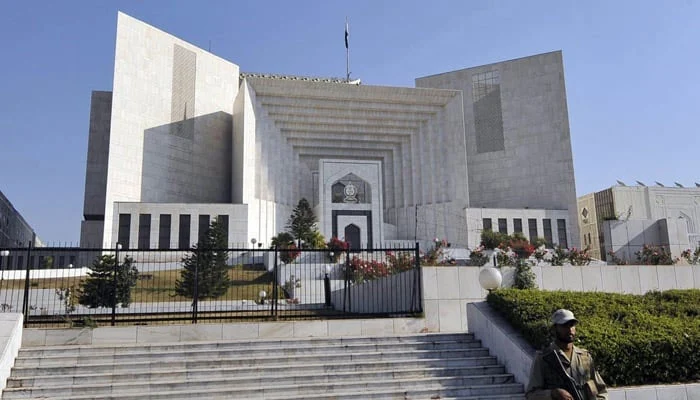
They deemed these amendments contrary to public interest rights enshrined in the Constitution. Subsequently, the federal government filed an appeal under Section 5 of the Supreme Court (Practice and Procedure) Act 2023 against the Supreme Court’s order.
A five-member larger bench, headed by CJP Qazi Faez Isa and including Justice Amin-Ud-Din Khan, Justice Jamal Khan Mandokhail, Justice Athar Minullah, and Justice Hasan Azhar Rizvi, will hear the government’s appeal. The top court has also issued notices to lawyers.
The government argued that the Supreme Court overstepped its powers by setting aside the law passed by parliament and amending the NAB law. It contended that parliament was competent to legislate and had enacted a law amending the NAB law.
The government further contended that if a piece of legislation violates citizens’ fundamental rights, the court can set it aside, but the amendments made to the NAB law did not infringe upon the fundamental rights of citizens.
After the verdict, the NAB reopened cases against political figures, including former prime ministers.
In June of the previous year, Pakistan Tehreek-e-Insaf Chairman Imran Khan filed a petition in the Supreme Court under Article 184(3) of the Constitution, seeking the annulment of the amendments for being “ultra vires to the Constitution.”
The court invalidated the amendments to the NAB law, including the one limiting NAB’s jurisdiction to cases involving over Rs500 million and one allowing the accused to claim the amount of plea bargain deposited after being acquitted.
The judgment authored by former CJP Bandial declared Imran Khan’s petition maintainable, citing violations of Articles 9, 14, 24 (protection of property rights), and 25 (equality of citizens) of the Constitution and their impact on the public at large, as the unlawful diversion of state resources from public development projects to private use leads to poverty, declining quality of life, and injustice.
