
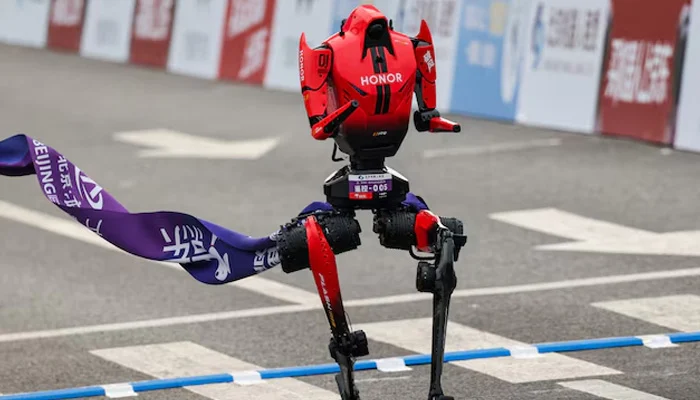

Beijing Games Shift Focus From Speed to Real-World Robot Skills
China’s humanoid robots are proving they can run faster than the world’s quickest human athletes. But the more important question for the robotics industry is whether those machines can perform ordinary jobs reliably.
That challenge is taking centre stage at the 2026 World Humanoid Robot Games in Beijing, where robots are being tested not only in running, weightlifting and other sports but also in factories, restaurants, offices and emergency-response scenarios.
The five-day competition began on August 22 and features 51 events, including 30 sports competitions and 21 scenario-based challenges designed to imitate real working environments.
More than 40% of the competitions require robots to operate fully autonomously, according to Huawei, one of the technology partners involved in the games.
The event is increasingly being viewed as a testing ground for whether humanoid robots can move beyond eye-catching demonstrations and become useful workers.
China’s robotics companies have already demonstrated machines capable of running, jumping and performing complex athletic movements.
However, handling a poorly positioned cable, picking up an irregular package or correcting a mistake without human assistance can present a much harder technical challenge.
Robots Run Faster Than Usain Bolt but Still Struggle to Stop
The sporting events have produced some of the most dramatic demonstrations of China’s rapid advances in humanoid robotics.
On Saturday, two robots completed the 100-metre sprint faster than Usain Bolt’s human world-record time of 9.58 seconds.
Tiangong Ultra, developed by the Beijing Humanoid Robot Innovation Center, won the event in 9.39 seconds.
Another robot, Lightning, finished in 9.47 seconds, also beating Bolt’s benchmark. Lightning had previously recorded an even faster 9.32-second time during a preparatory test.
The results represented a major improvement over 2025, when the winning robot required more than 20 seconds to complete the same distance.
Yet the race also exposed an important weakness.
Stopping proved much harder than accelerating.
Several robots struggled to brake after crossing the finish line and crashed into protective mats placed several metres beyond it.
The incidents highlighted a broader challenge facing humanoid robotics: impressive speed does not automatically mean the machine has human-like control, balance or adaptability.
A humanoid based on the same high-performance platform also completed the 400 metres in 39.7 seconds.
That time was quicker than the men’s human world record of 43.03 seconds, set by South Africa’s Wayde van Niekerk.
Robotics investor Xu Qiaosheng said the greater intensity of this year’s competition was placing considerably more pressure on battery management and thermal systems.
Running at extreme speeds requires powerful motors while also generating significant heat, meaning engineers must balance performance with battery life, cooling and mechanical durability.
Plugging In a Cable May Be Harder Than Running 100 Metres
While sprint records attract headlines, industry experts say simpler-looking tasks may reveal much more about whether humanoid robots are ready for commercial deployment.
One competition requires robots to connect cables.
To a human, plugging in a cable may appear trivial.
For a robot, however, it requires several systems to work together.
The machine must visually identify the cable and socket, determine their exact positions, move its hands accurately, align the connector and apply the correct amount of force.
If the cable is slightly tilted or the socket is not where expected, the robot must recognise the problem and correct its movement without help.
Similar difficulties arise in warehouse operations.
A box may shift while being lifted. An object may be positioned slightly outside the expected location. A package may have a different size or shape.
Successful robots need to recognise those imperfections and adapt immediately.
These capabilities are crucial if humanoid machines are eventually expected to work alongside humans in factories, warehouses and other unpredictable environments.
Lumos Robotics CEO Yu Chao said competitions can help manufacturers improve their hardware and demonstrate technological progress.
But he argued that the long-term value of humanoid robots will depend on whether they can solve actual problems.
Running and jumping may demonstrate engineering capability, but they do not necessarily improve productivity in a factory or warehouse.
Robots Tested in Restaurants, Factories and Emergency Situations
The Beijing competition therefore includes numerous practical challenges.
Humanoids will be tested in electric vehicle charging, restaurant work, emergency response, industrial assembly and material loading.
Other events focus on hand dexterity and precision.
These tasks require robots to combine artificial intelligence with physical coordination.
A robot operating in a restaurant, for example, must recognise objects, move safely around people and handle items without dropping or damaging them.
An industrial robot performing assembly work must repeatedly position components with high accuracy.
An emergency-response robot may have to operate in an unpredictable environment where obstacles change and predetermined movements are insufficient.
Such challenges are closer to the environments robotics companies hope their machines will eventually enter commercially.
Chinese manufacturers recently demonstrated similar applications at Beijing’s World Robot Conference, where humanoid machines were shown sorting parcels, packing smartphones and performing household tasks.
Companies are increasingly trying to prove their robots can work reliably rather than simply perform spectacular demonstrations.
Robot Tennis, Tai Chi and Weightlifting Add to Spectacle
The games still contain plenty of entertainment.
Humanoid robots are competing in tug-of-war and weightlifting, while traditional Chinese activities including Tai Chi and pitch-pot have also been adapted for robotic contestants.
Pitch-pot requires participants to throw narrow sticks into a small-necked container, creating another demanding test of robotic accuracy and coordination.
Beijing-based robotics company Galbot has also announced an autonomous humanoid tennis demonstration.
Robots are expected to attempt both singles and doubles competition, requiring them to track moving balls, position themselves on court, serve and return shots without direct human control.
These events combine public entertainment with technical testing.
A tennis robot, for example, must process the speed and trajectory of a ball in real time before deciding where and when to move.
Such demonstrations provide developers with data about weaknesses in vision systems, movement control and artificial intelligence.
China Wants Robots to Move From Demonstrations to Workplaces
China has made humanoid robotics a strategic emerging industry and has invested heavily in developing the necessary artificial intelligence, motors, batteries, sensors and manufacturing supply chains.
Robot competitions that were once largely academic events have evolved into major national showcases involving technology companies, investors and government-backed research institutions.
The 2026 games represent another stage in that transformation, with greater emphasis on precision-hand tasks and commercial applications rather than simply athletic demonstrations.
Humanoid manufacturers are now facing growing pressure to demonstrate that their machines can deliver real economic value.
Although robots can already perform impressive movements, broad commercial adoption remains limited.
Businesses ultimately need machines that can complete repetitive jobs safely, consistently and cheaply enough to justify their cost.
Industry executives therefore argue that the decisive competition will happen after robots leave exhibition halls and enter customers’ workplaces.
Zeroth Chief Marketing Officer Hua Rong said the real measure of success will be whether robots can solve users’ problems after they are sold.
For China’s humanoid industry, beating a world sprint record is a powerful technological demonstration.
But successfully plugging in a cable, packing hundreds of boxes or completing an eight-hour factory shift without human intervention could prove far more important.

