

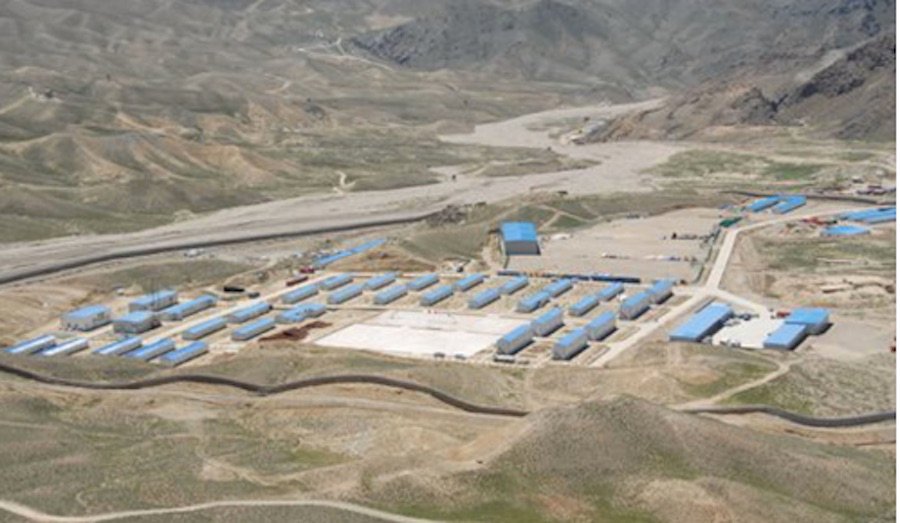

Chinese engineers and the Taliban government have officially launched a major project to extract copper from Afghanistan’s second-largest deposit.
At a ribbon-cutting ceremony on July 24 at Mes Aynak, located about 40 kilometers southeast of Kabul, Taliban officials joined Chinese businessmen and diplomats to kick off construction of a road leading to the mining site. A $3 billion deal signed in 2008 granted the Chinese state-owned China Metallurgical Group Corporation (MCC) a 30-year concession for the mine, but fighting between NATO forces and Taliban insurgents stalled progress for 16 years.
With violence declining since the Taliban’s takeover in 2021 and the withdrawal of foreign troops, the Taliban government is eager to exploit Afghanistan’s rich mineral resources. “The time wasted on this project must be made up with swift action,” said Deputy Prime Minister for Economic Affairs Abdul Ghani Baradar at the ceremony.
Taliban officials estimate it will take at least two years before MCC extracts its first copper, while Chinese diplomats hailed the development as a sign of strengthening relations between Beijing and Kabul. “The economic and trade relations between our countries are becoming increasingly close,” stated China’s ambassador to Afghanistan, Zhao Xing.
Since assuming power, the Taliban has faced the challenge of rebuilding a nation ravaged by decades of conflict. However, the regime’s economy has been stifled by Western sanctions and international isolation, which has hindered access to financial support.
China has emerged as a key partner for the Taliban, promising deeper cooperation shortly after the group regained control of Kabul. Beijing is particularly focused on tapping into Afghanistan’s vast mineral wealth, including oil, gas, and rare-earth metals.
Mes Aynak stands out as an attractive opportunity for Chinese companies, containing an estimated 11.5 million tons of copper ore, essential for electronics and increasingly valuable due to its applications in electric vehicles, renewable energy, and data centers.
According to a Brookings Institute report, Afghanistan possesses around 2.3 billion metric tons of iron ore and 1.4 million metric tons of rare-earth minerals, with the U.S. Geological Survey estimating that the country holds $1 trillion in untapped minerals, including iron, gold, and lithium—an essential component in rechargeable batteries and other technologies.
Amir Mohammad Musazai, a retired professor from Kabul Polytechnic University’s Department of Geology and Mines, told RFE/RL’s Radio Azadi that mining Mes Aynak could yield copper ore worth significantly more than the $3 billion mining rights deal, especially since nearby areas contain substantial copper reserves not included in the original plans.
While the groundbreaking ceremony signals a move forward for Chinese resource projects in Afghanistan after years of delays, security concerns remain a significant obstacle to larger initiatives, which typically require the presence of Chinese engineers and other staff.
The July 24 event was heavily guarded by armed personnel, and Taliban officials assured attendees of their protection at the mining site. Chinese workers have increasingly been targeted in the region, with incidents including a suicide attack in Pakistan in March that killed five Chinese engineers and a 2021 bombing at a dam project that claimed 13 lives, including nine Chinese workers.
In Afghanistan, at least five Chinese nationals were injured in 2022 when gunmen attacked a Kabul hotel frequented by Chinese businessmen.
