
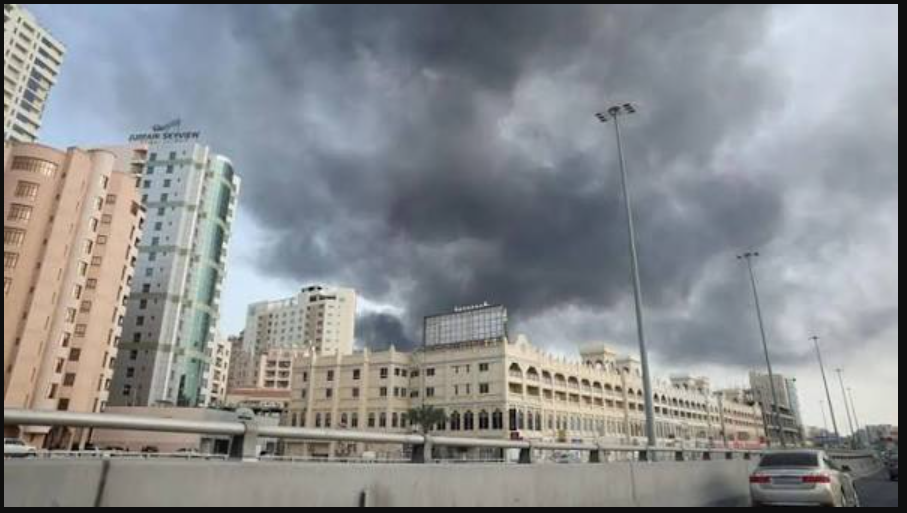

Bahrain issued two security alerts on Sunday after Iran claimed responsibility for attacking an American military installation in the Gulf country. The warnings marked Bahrain’s first such alerts since September, adding to concerns over regional security.
The latest developments come as Washington and Tehran continue struggling to reach an agreement to end their nearly nine-month-old conflict. Meanwhile, uncertainty surrounding diplomatic negotiations has raised concerns about further military escalation across the Gulf.
Iran’s Islamic Revolutionary Guard Corps (IRGC) said it had targeted a US military base in Bahrain. The announcement followed what Tehran described as retaliation for “hostile US actions”.
Iran Claims Drone Attack on US Military Base in Bahrain
Iran’s Revolutionary Guards reportedly launched six drones targeting an American air-defence radar at the Al Rifaa helicopter base in Bahrain.
However, neither US nor Bahraini authorities immediately confirmed the reported attack.
Bahrain hosts the US Navy’s Fifth Fleet, making the country an important part of Washington’s military presence in the Gulf. Consequently, any reported attack on American installations there raises wider regional security concerns.
Following the latest warnings, Bahrain’s Interior Ministry urged citizens and residents to remain calm. It also advised people to proceed to the nearest safe location.
However, the ministry did not provide further details about the potential threats behind Sunday’s alerts.
Previous Iranian Attack Claims Raise Security Concerns
The latest announcement follows another claim by Iran’s Revolutionary Guards two days earlier. At that time, the group said it had targeted an American early-warning radar in Bahrain.
The US military rejected the claim that the radar had been damaged. Instead, American officials said their forces intercepted two Iranian drones without sustaining any damage.
The latest allegations have therefore renewed attention on the security of American military installations across the Gulf.
US-Iran Peace Negotiations Remain Uncertain
Meanwhile, diplomatic efforts to end the conflict have yet to achieve a breakthrough. Although Washington and Tehran have avoided direct attacks recently, tensions remain unresolved.
The war began on February 28 following US and Israeli strikes against Iran. Subsequently, the conflict spread across the region as Tehran launched missile and drone attacks against American military bases in Gulf countries.
US President Donald Trump recently indicated that Washington might delay further attacks on Iran. He reportedly told advisers that the decision would depend on whether Tehran or Iran-backed Houthi forces in Yemen initiated new provocations.
However, Trump also indicated that the United States would maintain its naval blockade against Iran.
These developments highlight the uncertainty surrounding diplomatic efforts and the possibility of renewed military confrontation.
Saudi Arabia Reports Fresh Houthi Missile and Drone Attacks
Elsewhere in the region, fighting between Yemen’s Houthis and the Saudi-led coalition has continued despite wider diplomatic efforts.
On Sunday, the coalition announced that its forces had intercepted two Houthi ballistic missiles targeting Saudi Arabia’s capital, Riyadh.
It also reported intercepting three drones over the kingdom’s oil-rich Eastern Province.
The latest interceptions demonstrate that security tensions extend beyond the immediate US-Iran confrontation. Furthermore, continued attacks and military responses risk complicating efforts to stabilise the wider region.
With Bahrain issuing fresh security warnings, Iran maintaining its military claims and diplomatic negotiations still unresolved, Gulf security remains under pressure.
For the latest updates, visit and follow The Truth International website (www.thetruthinternational.com) and subscribe to the YouTube Channel.

