

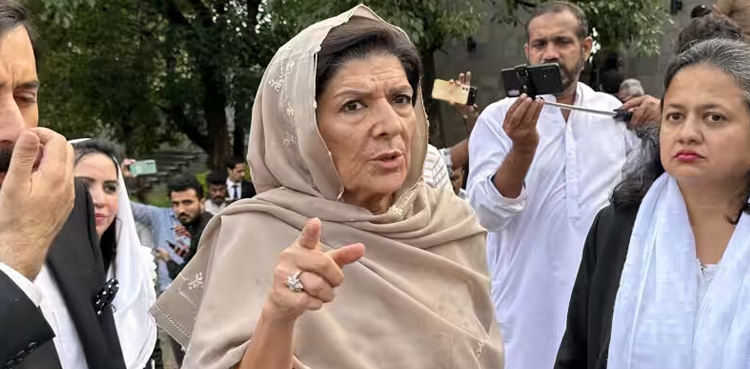

Aleema Khan
The National Cyber Crime Investigation Agency (NCCIA) has issued formal summons to Aleema Khan, the sister of Pakistan Tehreek-e-Insaf (PTI) founder Imran Khan, along with three other individuals, in an ongoing inquiry into allegations of anti-state propaganda disseminated via social media platforms.
According to official sources, the NCCIA launched the investigation on May 27 and subsequently served notices to Aleema Khan, political activist Sanam Javed, Falak Javed, and prominent television anchorperson Aftab Iqbal.
The notices cite concerns over content allegedly shared by these individuals during the recent Pakistan-India conflict, which authorities claim involved negative propaganda targeting state institutions.
The NCCIA alleges that the social media activity in question could undermine national unity and compromise the morale of key state organs during a sensitive geopolitical period.
The agency emphasized that any attempts to malign the country’s armed forces or other national institutions through coordinated online campaigns will be dealt with seriously under cybercrime and national security laws.
All four individuals have been directed to appear in person at the NCCIA’s Lahore office on June 5 to respond to the allegations and assist with the ongoing probe. The agency’s notice states that failure to comply could result in further legal action, including potential arrest or prosecution under relevant sections of the Prevention of Electronic Crimes Act (PECA) and other national security legislation.
This development marks a significant escalation in the state’s crackdown on what it describes as “coordinated online misinformation efforts,” particularly in politically charged contexts. Critics, however, argue that such actions may infringe on freedom of expression and are often selectively enforced against opposition voices or government critics.
As the date of appearance approaches, legal observers and political analysts are closely monitoring how the inquiry will unfold, given the high-profile nature of those involved and the broader implications for digital rights and political discourse in Pakistan.
