

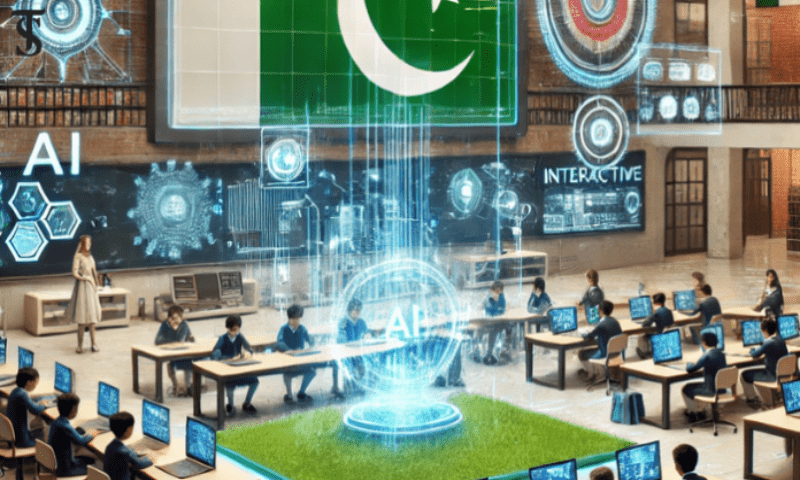

In Pakistan, artificial Intelligence is no longer a distant concept. It has already entered Pakistan’s classrooms, assisting students with writing, research, language learning, and even solving math problems. Tools such as ChatGPT, Grammarly, and Google Bard have quietly become study companions for many.
While these tools offer undeniable benefits, a pressing question is emerging: How can AI be used in education without undermining students’ original thinking and creativity?
Countries around the world are addressing this challenge head-on. Finland, known for its forward-thinking education system, has introduced AI literacy at the school level, teaching students how to use and question AI responsibly. Singapore is experimenting with AI in classrooms but maintains strict oversight, ensuring assignments still require personal reflection. Similarly, Japan has made “AI ethics” a key component of its digital literacy curriculum.
In contrast, Pakistan has embraced AI tools without a policy framework in schools or colleges. Students are experimenting with powerful technologies before learning about responsible use, leading to growing concerns over passive learning and diminished critical thinking skills.
“I use AI only when I get stuck,” said Zara Batool, a 10th-grade student, noting that it explains topics better than her textbooks. Areeba Bibi, a Margalla College student, added that AI “saves time during back-to-back hectic assignments.” Others, like Fatima Khan, admitted it boosts their performance but struggled to answer how dependence on AI could impact their creativity.
AI in Pakistan’s Classrooms
Teachers are already observing worrying trends. “Students now submit assignments they didn’t write,” warned Arshad, a history teacher. Rabia, a science teacher, added, “Students no longer ask questions in class. They expect AI to answer everything.”
Experts believe Pakistan must act swiftly. Professor Ramzan, who has extensive teaching experience in Saudi Arabia, suggests introducing AI literacy in schools to teach students how AI works, where it helps, and where it harms. He recommends redesigning assessments to reward creativity and critical thinking — qualities AI cannot easily replicate — and adopting tools like AI-writing detectors to uphold academic integrity.
He further emphasizes training educators to guide students in using AI as a thinking partner rather than a replacement, while public institutions must be given infrastructure and internet access to avoid widening the digital divide.
If Pakistan embraces AI as a tool for deeper learning instead of a shortcut, experts believe it could build a generation that uses technology creatively and critically. Without such measures, however, the unchecked reliance on AI could weaken the very skills education seeks to develop.
With the right policies and vision, AI could help unlock a more curious, innovative, and empowered Pakistan.
Top Google search trends about Pakistan
Best gaming phone in Pakistan, bestselling car in Pakistan, most selling car in Pakistan, New range rover price in Pakistan, shortest day of the year in Pakistan, best cigarettes in Pakistan, how to get Luxembourg visa from Pakistan, Nathia Gali from Islamabad, Mercedez Jeep price in Pakistan, 14 August Pakistan independence day, 14 Aug holiday, Italy visa apply from Pakistan, Toyota Crown hybrid price in Pakistan, 2nd marriage law in Pakistan, fashion trends in Pakistan, 20k solar system price in Pakistan, causes of terrorism in Pakistan, MacBook price in Pakistan, Galaxy S26 Series, Xiaomi 16, Snapdragon 8
