
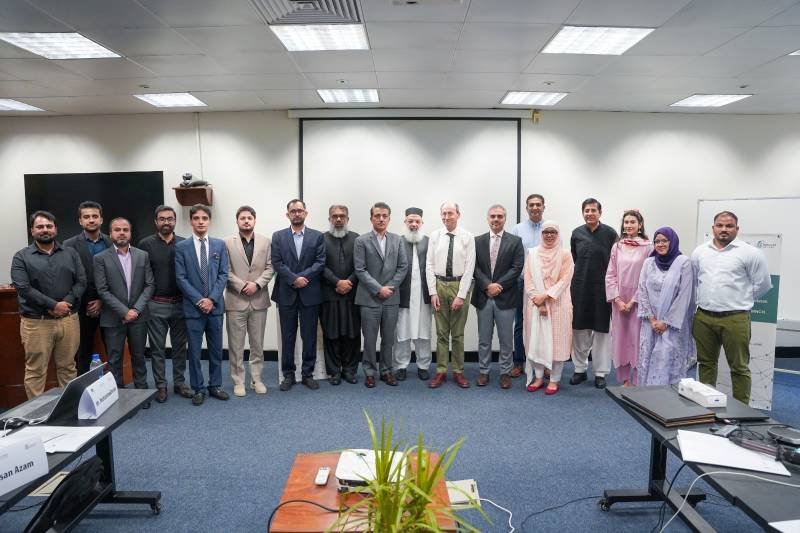

The Government of Balochistan has joined hands with LUMS to explore how artificial intelligence can improve healthcare across the province. The two sides signed a Memorandum of Understanding (MoU) with a focus on maternal, newborn and child health. The partnership will combine AI, digital innovation and evidence-based planning.
The collaboration aims to address persistent healthcare challenges affecting women and children across Balochistan. It will also explore practical technology-based solutions that fit the province’s unique needs.
Balochistan Signs MoU With National AI Hub
The Government of Balochistan and the National AI Hub for Maternal, Newborn and Child Health signed the agreement at Lahore University of Management Sciences (LUMS).
The National AI Hub is based at LUMS and focuses on responsible AI use in healthcare. Under the new partnership, both sides will identify areas where technology can strengthen health systems.
The collaboration will also explore ways to improve healthcare delivery and support better policy decisions. Locally relevant data will play an important role in this process.
Participants discussed Balochistan’s maternal, newborn and child health priorities during the signing ceremony. They also examined the province’s evolving digital health system.
The discussions focused on opportunities to use AI and local data to improve health services. The partners also considered the practical challenges of delivering healthcare across Balochistan.
LUMS Highlights AI’s Potential in Healthcare
The signing ceremony brought together government officials, university leaders, researchers and public health experts.
The Balochistan delegation was led by Health Secretary Mujeeb-ur-Rehman. It included senior officials from the Health Sector Reforms Unit and the Balochistan Health Management Information System.
Representatives from the Health Department, WHO, the Poverty Eradication Initiative and UNICEF Balochistan also participated. UNICEF joined the ceremony virtually.
Dr. Tariq Jadoon, Provost and Acting Vice Chancellor of LUMS, highlighted the potential of the partnership.
“This partnership with the Government of Balochistan presents an exciting opportunity. Through the National AI Hub, we are leveraging computer science, artificial intelligence, and machine learning to improve people’s health, and we are pleased to contribute to this important work.”
Dr. Walter Schwarzacher, Dean of the Syed Babar Ali School of Science and Engineering at LUMS, also welcomed the collaboration.
“The work being done by the National AI Hub provides a way to take the fundamental research carried out at LUMS and apply it in ways that bring real benefits. This is an area in which we can demonstrate that AI can make a tangible difference to people’s health and lives.”
Partnership Will Focus on Local AI Solutions
Dr. Maryam Mustafa, Director of the National AI Hub and Associate Professor of Computer Science, stressed the importance of developing solutions around Balochistan’s specific circumstances.
She said the province should play an active role in designing the technologies rather than simply receiving them after development.
“Balochistan should not be seen merely as a deployment site. We want to understand what home-grown, localised, and contextualised tools for Balochistan, built in Balochistan, should look like. By involving partners from the design phase, we can help ensure that what is built is adopted, has longevity, and serves the province’s needs.”
This approach could help researchers create tools that match local infrastructure and healthcare realities. It could also improve the chances of long-term adoption across the province.
Local languages and public health priorities will also influence the development process. As a result, the partnership aims to create solutions that work within existing systems.
Government Sees AI as Healthcare Opportunity
Speaking for the Balochistan government, Health Secretary Mujeeb Ur Rehman described the partnership as an important initiative.
“This is not just another project for us. It is a project through which we hope to improve maternal, newborn, and child health indicators. LUMS brings the technology and expertise, and we bring the commitment to address the challenges we face. Together, this partnership can deliver the results we are seeking.”
The statement reflects the government’s focus on improving maternal, newborn and child health outcomes. It also highlights the importance of combining technological expertise with local knowledge.
The partnership will therefore bring together two different strengths. LUMS will contribute research and technical expertise, while Balochistan will provide knowledge of local health needs and service delivery.
AI Research to Support Health Services
The partnership will cover collaborative research and capacity building. Both sides will also work on developing, testing and evaluating AI-enabled solutions.
Researchers will conduct rigorous evaluations before potential solutions move toward wider implementation. The process will help generate evidence for future health policies and programmes.
Several areas could benefit from the collaboration. These include digital health, health information systems and predictive analytics.
Clinical decision support is another potential area of work. The partners may also develop health tools in local languages.
Responsible AI for public health will remain another key focus. This could help ensure that technology supports healthcare workers and patients without overlooking ethical considerations.
Solutions Will Be Designed for Balochistan
A major feature of the partnership is its emphasis on local development.
The partners want to create solutions with Balochistan rather than simply deploy existing technologies in the province. This approach could help address challenges linked to infrastructure, language and healthcare access.
It could also connect research with practical implementation. Evidence generated through pilot projects can guide future improvements and responsible expansion.
The approach may prove particularly important in areas where healthcare systems face unique geographical and logistical challenges. Locally designed digital tools could potentially respond more effectively to those realities.
National AI Hub Expands Digital Health Work
The National AI Hub for MNCH serves as a national platform for responsible AI and digital innovation in Pakistan’s healthcare sector.
The Hub works with governments, universities, healthcare providers and development partners. Its goal is to translate research into practical solutions that can strengthen health systems.
The platform also focuses on improving equitable access to quality healthcare. Partnerships such as the new agreement with Balochistan can help connect research with real-world health needs.
The collaboration could therefore contribute to both provincial and national digital health goals.
Balochistan Partnership Marks New Step
The new agreement marks an important step toward using emerging technology to address healthcare challenges in Balochistan.
However, the partnership goes beyond simply introducing AI into existing health services. Its central focus is developing evidence-based tools that reflect the province’s own needs and circumstances.
By involving local stakeholders from the design stage, the initiative could create solutions with stronger long-term value. The partners can also use research and evaluation to determine which approaches deserve wider adoption.
The collaboration ultimately places technology alongside local expertise, public health priorities and evidence-based planning. If successfully implemented, it could provide a model for using responsible AI to strengthen healthcare services in other parts of Pakistan as well.

