

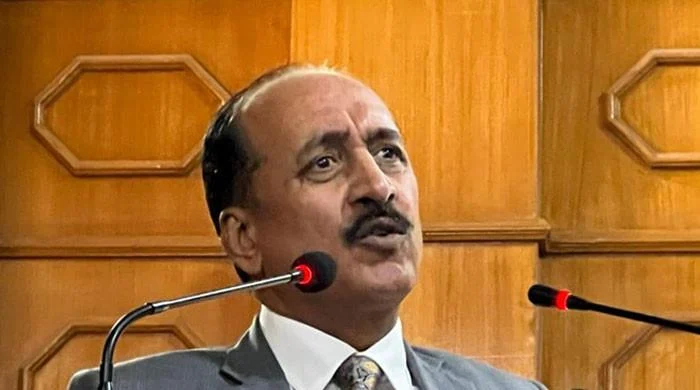

ISLAMABAD: On Wednesday, the Pakistan Bar Council (PBC) elected Ahsan Bhoon as the new member of the Judicial Commission of Pakistan (JCP) for a two-year term.
The election took place during a meeting of the bar council at the Supreme Court, which was chaired by Attorney General Mansoor Usman Awan, the council’s chairman, according to a statement.
The meeting’s agenda was to select a representative from the bar council to serve on the JCP.
In the vote, 14 members supported Bhoon, 4 voted for Tahir Faraz Abbassi, and 1 abstained. The vote was conducted by show of hands.
The chairman and Returning Officer announced Bhoon’s appointment as a JCP member for a two-year term, effective from February 26, 2025, to February 25, 2027.
Bhoon’s election came shortly after senior advocate Akhtar Hussain resigned from his position, citing concerns over the controversies surrounding judicial appointments. Hussain submitted his resignation to the JCP chairman, Chief Justice Yahya Afridi, and expressed his discomfort with the current situation regarding judicial appointments.
In his resignation letter, Hussain, who had been nominated three times by the Pakistan Bar Council (PBC), stated: “The Pakistan Bar Council unanimously nominated me thrice as a member of the Judicial Commission of Pakistan, and I have endeavored to fulfill my duties to the best of my abilities. However, due to the ongoing controversies surrounding judicial appointments, I find myself unable to continue and hereby resign from my position as a member of the JCP. I am also forwarding this resignation to the Pakistan Bar Council for the nomination of a new member, as mandated by the Constitution.”
Recently, the JCP appointed six new judges to the Supreme Court despite a boycott by lawmakers from Pakistan Tehreek-e-Insaf (PTI) and two senior Supreme Court judges.
Earlier this month, the judicial commission requested nominations from all high courts, asking each to submit a list of five senior judges.
The Islamabad High Court (IHC) initially nominated three judges—its Chief Justice Aamer Farooq, Justice Mohsin Akhtar Kayani, and Justice Miangul Hassan Aurangzeb—while two other judges, Justice Tariq Mehmood Jahangiri and Justice Babar Sattar, were excluded because they did not meet the minimum requirement of five years of service.
However, following a transfer of Justice Sarfraz Dogar from the Lahore High Court to the IHC, along with two other judges from the Sindh and Balochistan High Courts, the IHC revised its seniority list. Justice Dogar, now designated as the senior puisne judge, was subsequently nominated to the JCP.
In response to this transfer, five IHC judges raised concerns regarding the seniority list and submitted a representation to the IHC Chief Justice, copying Chief Justice Afridi. The judges argued that transferred judges should take a fresh oath under Article 194 of the Constitution, which would place them at the bottom of the IHC’s seniority list and render them ineligible for immediate consideration as IHC Chief Justice.
The JCP, responsible for approving judicial appointments, was restructured under the 26th Constitutional Amendment, which introduced significant changes to the judiciary. The 13-member body is headed by the Chief Justice of Pakistan and includes two senators, two members of the National Assembly, three senior-most Supreme Court judges, the most senior judge of the constitutional bench, the federal minister for Law and Justice, the Attorney General for Pakistan, and an advocate with at least 15 years of practice in the apex court, nominated by the Pakistan Bar Council for a two-year term.
The JCP’s role includes appointing judges to the Supreme Court, high courts, and the Federal Shariat Court, overseeing the performance of high court judges, and preparing their annual performance evaluations.
Earlier, Opposition Leader in the National Assembly, Omar Ayub, one of the four lawmakers nominated to the JCP, also tendered his resignation.
