

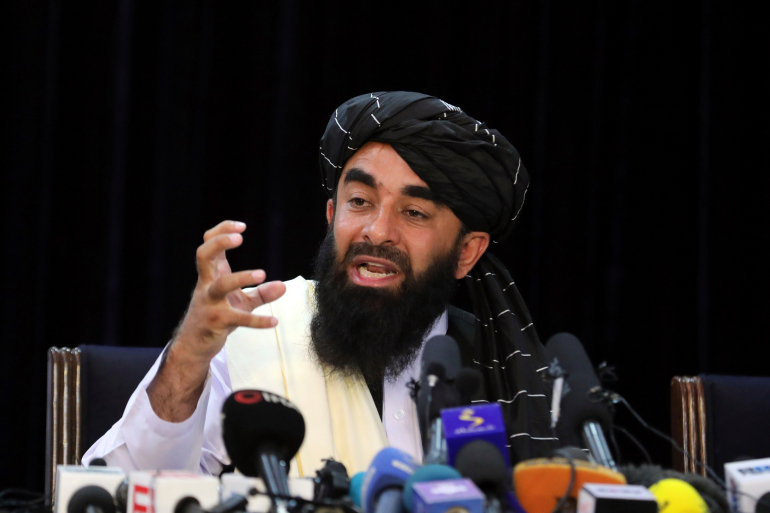

KABUL: Afghanistan has underscored the importance of maintaining ties with Pakistan, deeming it essential to foster improved relations with all neighboring nations. Zabihullah Mujahid, spokesperson for the Afghan government, urged the new Pakistani administration to demonstrate flexibility in handling the deportation of Afghan refugees.
Mujahid stressed that the Islamic Emirate has consistently pursued amicable relations with all neighboring countries, including Pakistan, which has recently undergone a change in government.
He reiterated Afghanistan’s need for positive relations with Pakistan, urging for collaboration and problem-solving between the two nations.
Notably, the caretaker government led by Anwaar-ul-Haq Kakar announced plans last year to expel 1.1 million undocumented foreigners residing in Pakistan.
Acting Prime Minister of Afghanistan, Mullah Mohammad Hasan Akhund, condemned what he described as the “harsh treatment” of Afghan refugees by Pakistani authorities, emphasizing that such actions exacerbate rather than resolve issues.
Mujahid called for flexibility from Pakistan concerning migrants, recognizing Pakistan’s long-standing hosting of Afghan refugees and urging considerations for Afghanistan’s relationship with Pakistan until the migrants can safely return home.
Furthermore, Mujahid highlighted various concerns requiring Pakistan’s attention, including the expansion of bilateral relations, addressing challenges encountered by Afghan traders, and matters concerning the Durand Line.
Meanwhile, the UN Development Programme (UNDP) pointed out how ongoing limitations on women and girls’ rights continue to hinder their fundamental freedoms and impede economic growth.
The United Nations Development Programme (UNDP) has reported that the Afghan economy, particularly the regions impacted by the devastating earthquakes in October last year, is still experiencing significant challenges. As restrictions on women and girls persist, hindering basic rights and economic progress, the situation remains dire.
Kanni Wignaraja, Director of UNDP’s Regional Bureau for Asia and the Pacific, shared her recent observations after visiting Afghanistan. She stated that 69% of the population is “subsistence insecure,” meaning they lack adequate basic resources. Wignaraja also highlighted the severe consequences of continuous natural disasters on the country, with many regions facing a “dramatic” scarcity of water, further impeding development efforts.
Since the Taliban took control in 2021, Afghanistan’s economy has contracted by 27%, leading to economic stagnation. Unemployment rates have doubled, and now only 40% of the population has access to electricity.
In various sectors, including finance, the economy has faced significant challenges, with limited economic activities like exports and public spending. Small and medium enterprises (SMEs) and farmers now serve as the backbone for this struggling economy.
