


On Tuesday, Pakistan strongly condemned the Indian government’s move to label multiple political parties in Indian-administered Kashmir as “unlawful associations.”
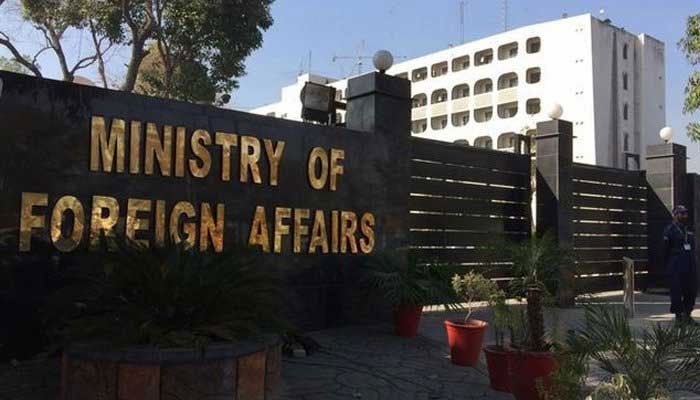
The Foreign Office released a statement expressing their disapproval, specifically mentioning the Jammu and Kashmir Peoples Freedom League (JKPFL) and four factions of Jammu and Kashmir Peoples League (JKPL) as being targeted by this decision.
Previously, there was a condemnation of the decision to prolong the prohibition of the Jammu and Kashmir Liberation Front (JKLF) led by Mohd. Yasin Malik for another five years. Last week, India’s home ministry classified the Yasin Malik-led JKLF faction as an “unlawful organization” and banned the JKPFL for five years due to their involvement in promoting secession, as reported by Times of India.
Additionally, the ministry declared four factions of the JKPL—led by Mukhtar Ahmed Waza, Bashir Ahmad Tota, Ghulam Mohammad Khan, and Aziz Sheikh under Yaqoob Sheikh’s leadership—as “unlawful associations” due to their alleged roles in inciting terrorism in the region. This decision was made just before the announcement of the Lok Sabha election dates and was executed under the Unlawful Activities Prevention Act (UAPA).
Today, the Foreign Office (FO) declared that with the recent notifications, a total of 14 political parties are now outlawed in the Indian Illegally Occupied Jammu and Kashmir (IIOJK).
The statement also mentioned that the affiliates of these parties are facing persecution. The FO remembered that a death penalty was sought for Malik, the JKLF chief, who received a life sentence in 2022.
Despite these oppressive actions, the FO asserts that the Kashmiri people’s aspirations for the realization of their inalienable right to self-determination, as stated in the relevant United Nations Security Council resolutions, cannot be suppressed. The organization further claims that India’s ongoing efforts to stifle dissent in (IIOJK) violate international human rights and humanitarian law, as well as democratic principles.
Previously, the Foreign Office (FO) criticized India’s classification of the Tehreek-i-Hurriyat Jammu and Kashmir (TeH) as an “unlawful organization” for five years. Shortly after, India prohibited the Muslim League Jammu Kashmir (Masarat Alam faction), or MLJK-MA, labeling it as an “unlawful association” as well.
In response, the FO has called upon the Indian government to remove restrictions on banned political parties, free all political leaders, including Malik, and adhere to the United Nations Security Council (UNSC) resolutions concerning India-occupied Kashmir.
