

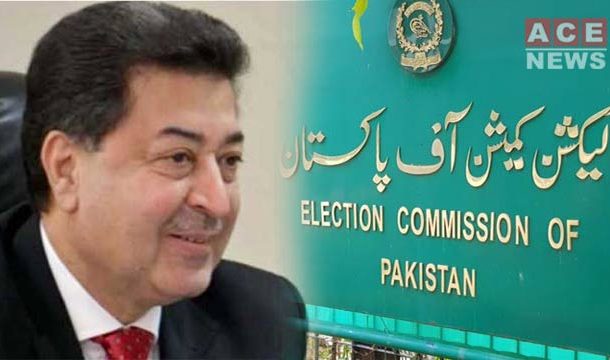

ISLAMABAD: Sikandar Sultan Raja, the Chief Election Commissioner of the Election Commission of Pakistan (ECP), has embarked on an official trip to Russia at the invitation of the Moscow government to observe the Russian presidential elections of 2024.
Scheduled from March 15 to 17, the presidential elections in Russia will witness Sikandar Sultan Raja’s participation alongside other observers. He has been invited by the Russian government to serve as an observer.
In the remote northwestern region of Russia, members of the local electoral commission are traversing the frozen Lake Onega to deliver ballot boxes to isolated communities, facilitating early voting in the presidential election.
The incumbent President Vladimir Putin is widely anticipated to secure another six-year term despite the internal upheaval stemming from Russia’s involvement in Ukraine.
The upcoming presidential election in Russia, spanning from Friday to Sunday, is expected to grant President Vladimir Putin another term despite the turmoil arising from Russia’s actions in Ukraine.
Here are five key points to understand about the election:
- Boris Nadezhdin and Yekaterina Duntsova, the sole opposition candidates who voiced opposition to Russia’s involvement in Ukraine, were denied candidacy despite garnering substantial support.
- Apart from Putin, three candidates are officially registered:
- Nationalist conservative Leonid Slutsky, Communist Party candidate Nikolai Kharitonov, and businessman Vladislav Davankov, all of whom have expressed support for Russia’s actions in Ukraine.
- Critics of the Kremlin suggest that these candidates serve to absorb dissent and create an illusion of diversity in the election process amid significant opposition suppression.
- Independent observers have raised concerns regarding potential manipulation of results through methods such as vote tampering, ballot stuffing, and leveraging state employees to maintain the status quo.
- Yulia Navalnaya has encouraged supporters to gather at polling stations on Sunday at 0900 GMT to protest by voting for candidates other than Putin or by spoiling their ballots with “Navalny” inscriptions.
While the election outcome appears predetermined, the government is vigorously campaigning to bolster Putin’s domestic and international legitimacy.
Putin’s position is fortified by Russia’s advancements in Ukraine and wavering Western support for Kyiv, coupled with the resilience of the Russian economy amidst severe sanctions.
In recent weeks, Putin has intensified public appearances, engaging with students, touring factories, and even participating in a flight aboard a nuclear bomber. However, he has never participated in a debate since assuming power nearly 25 years ago and will not do so now.
In his recent State of the Nation address, Putin outlined a comprehensive governmental program extending until at least 2030, pledging substantial budget allocations for education, infrastructure, poverty alleviation, environmental protection, and technological advancement.
Despite the economy’s relative stability, many Russians express concerns about escalating prices, particularly for food, and the overall instability precipitated by the conflict in Ukraine.
The labor market faces challenges due to the loss of young men in the conflict and the exodus of individuals opposing the war or evading military conscription.
The authorities have responded harshly to demonstrations by the spouses of conscripted soldiers, demanding their return from the front lines.
Patriotic propaganda has inundated the country, urging Russians to participate in the electoral process.
