

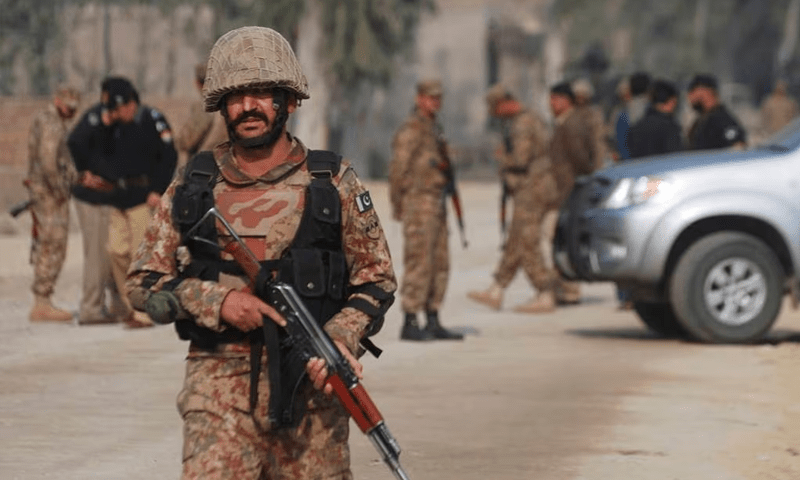

RAWALPINDI: On Tuesday, the Inter-Services Public Relations (ISPR) reported that intelligence-based operations conducted by the Pakistan Army in Dera Ismail Khan and Waziristan resulted in the elimination of three terrorists.
The first operation occurred in the Kulachi area of Dera Ismail Khan on Monday, where two terrorists were killed in a heavy exchange of fire. The second operation took place in Kot Azam, South Waziristan, resulting in the death of another terrorist.
All three terrorists, according to the ISPR, were actively involved in various terrorist activities against both security forces and innocent civilians. Weapons and ammunition were also recovered during these operations.
Unfortunately, in a separate incident, an army official lost his life in Gharyoum, North Waziristan, due to a blast from an Improvised Explosive Device (IED). The official, identified as 26-year-old Sepoy Shahzeb from Rawalpindi, was martyred in the attack.
The ISPR stated that ongoing sanitization operations are being conducted to identify and neutralize any other terrorists who may still be hiding in the area.
IMF Executive Board to approve staff-level agreement on Dec 7
Meanwhile, the International Monetary Fund (IMF) Executive Board is tentatively set to approve the Staff-Level Agreement (SLA) with Pakistan on December 7, paving the way for the first review of the $3 billion Stand-By Arrangement (SBA) and the disbursement of approximately $700 million on December 8.
As per the end-of-mission statement from the IMF, the Staff-Level Agreement between the IMF staff and Pakistani authorities was reached on November 15 in Islamabad. This agreement allows Pakistan access to SDR 528 million (around $700 million), bringing the total disbursements under the nine-month $3 billion SBA to nearly $1.9 billion.
Following this, Caretaker Finance Minister Dr. Shamshad Akhtar announced the postponement of a $1.5 billion Eurobond launch due to unfavorable global financial conditions. The minister also committed to ongoing adjustments in electricity and gas rates to prevent the further accumulation of circular debt.
The IMF mission urged authorities to return to a market-determined exchange rate and highlighted potential risks stemming from geopolitical tensions, rising commodity prices, and challenging global financial conditions. The IMF advised continued efforts to enhance resilience, emphasizing the importance of timely disbursement of external support to support the government’s policy and reform initiatives.
