

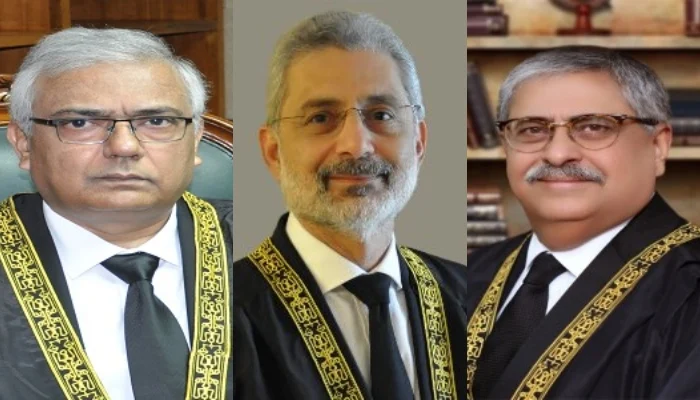

ISLAMABAD: On Monday, Chief Justice of Pakistan (CJP) Qazi Faez Isa expressed that it was “not possible” to meet the 90-day deadline for holding elections and criticized the petitioners for their lack of preparation.
The CJP made these observations while presiding over petitions seeking timely elections within 90 days of the dissolution of the assemblies. The CJP headed a three-member bench, along with Justice Athar Minallah and Justice Amin-Ud-Din Khan, to address this matter.

The pleas were filed by the Supreme Court Bar Association and Pakistan Tehreek-e-Insaf (PTI) to ensure that elections in Pakistan would adhere to the stipulated time frame.
CJP Isa began the hearing by questioning when the SCBA had filed the petition and why it hadn’t been promptly listed for a hearing. He urged the lawyer to present factual arguments and lamented the petitioners’ lack of readiness.
When the SCBA lawyer, Abid Zuberi, mentioned the 2017 census, CJP Isa criticized the counsel for not sticking to factual arguments and questioned why raised concerns about the census after its completion.
Zuberi clarified that he wasn’t disputing the 2023 census’s accuracy. When asked about the 90-day deadline’s completion, he confirmed that it would end on November 3.
CJP Isa then questioned whether it would be possible to hold elections within 90 days if the court issued such an order. Zuberi admitted that even with a court order, holding elections within 90 days would not be feasible.
The CJP suggested amending the petition and inquired about the possibility of issuing a notice to the President if he did not set a date. Zuberi responded that the President has immunity, and CJP Isa stated that if anyone violated the Constitution, Article 6 would be applied.
The lawyer mentioned that the Supreme Court ordered elections in Punjab and Khyber Pakhtunkhwa, to which CJP Isa agreed but asked why they hadn’t filed a contempt petition if no one was complying.
CJP Isa also inquired about a letter that one of the lawyers had written to the President requesting an election date. Lawyer Munir Ahmed, a petitioner, mentioned that they hadn’t received a response.
CJP Isa then pointed out that the delay in elections was being attributed to the President. Justice Minallah interjected, stating that the census was a constitutional requirement, which could cause delays in elections. He advised the lawyer to focus on the issue of holding elections within 90 days.
The hearing concluded with lawyer Anwar Mansoor Khan stating that after President Arif Alvi’s letter, it was the Election Commission of Pakistan’s responsibility to set a date for the polls. The CJP challenged this argument, questioning whether the court should base its decision on a tweet.
CJP Isa asked the SCBA president who should be responsible for setting an election date, and the president replied that it was the President’s prerogative. The CJP pressed the issue further, asking whether the lawyer wanted action taken against the President, to which the SCBA president emphasized that holding elections within 90 days was a constitutional requirement.
CJP Isa expressed that the case should focus on elections, not constitutional interpretation, and noted that if they discussed the constitution, a constitutional bench might be required. The two key questions for the bench were identified as determining who was responsible for announcing the election date and whether elections could be held within 90 days.
The CJP adjourned the hearing until November 2 and issued written orders stating that the petitioners claimed that the census was used as an excuse to delay the elections and emphasized the constitutional requirement to hold elections within 90 days.
The court also issued notices to the Election Commission of Pakistan and the federal government in the case.
Background
The National Assembly was dissolved on August 9 by the Shehbaz Sharif-led government. Sindh and Balochistan assemblies were also dissolved prematurely to allow elections to be held within 90 days.
If the assemblies had been dissolved on time, elections would have been constitutionally required to take place within 60 days. However, the Election Commission of Pakistan (ECP) chose not to hold polls within that period due to the approval of the 7th Population and Housing Census 2023 by the Council of Common Interest (CCI).
The CCI’s approval mandated that elections be conducted following new delimitations based on the census results. Consequently, the ECP announced the schedule for new delimitations in light of the CCI-approved census.
Multiple petitions were filed in the Supreme Court against the delay in polls, with all petitioners seeking to ensure elections were held within 90 days. These petitions were filed during the tenure of former Chief Justice Umar Ata Bandial but had not been scheduled for a hearing at that time.
