

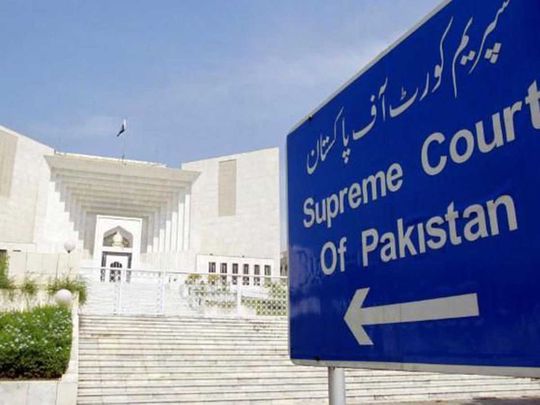

ISLAMABAD: On Monday, the Supreme Court announced that it would hear 1,090 petitions regarding fuel price adjustments on October 16 and make a decision on the case.
The case was heard by a three-member bench of the apex court, with Chief Justice of Pakistan Qazi Faiz Isa presiding.
The court announced that it would hear arguments and make a decision on October 16. It also mentioned that there would be no video link facility available on that day, and all parties involved must be present in Islamabad to present their arguments.
Earlier, when the Attorney General requested more time, CJP Qazi Faez Isa declined the request, stating that the Attorney General should prepare for the case within half an hour.
Aamir Rehman, the Additional Attorney General, requested time on behalf of the Attorney General. He highlighted that the AG had not received prior notice in this case and expressed his intention to present the arguments.
However, CJP responded by saying that it was acceptable if Aamir Rehman himself stated in writing that he was ineligible to present arguments. The Chief Justice noted that they did not intend to be impolite and considered Aamir Rehman an eligible lawyer capable of presenting arguments before the court.
The CJP also observed that there was a backlog of cases related to power prices. Justice Faez Isa instructed the Additional Attorney General (AAG) to formulate arguments for the case within thirty minutes and declared that the court would convene to hear the case after 11:30 am.
Power Protests
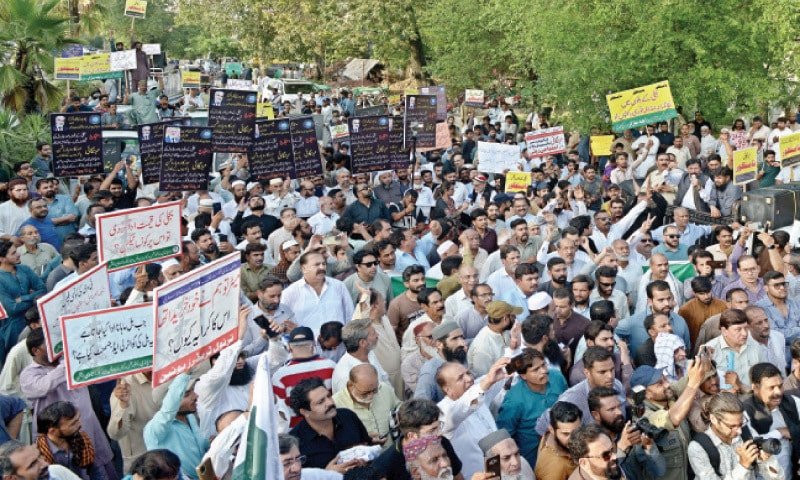
Inflated power bills recently sparked nationwide protests from Karachi to Khyber, some of which turned violent. In Karachi, people protested against high bills issued by K-Electric, the city’s sole power supplier. Citizens expressed their dissatisfaction with bills exceeding their salaries.
In Peshawar, a significant number of people took to the streets, vowing not to remain silent against this perceived injustice. Traders in Ganj Bazaar and Lahore Square set fire to their power bills as a form of protest. In Rawalpindi, protesters at Committee Chowk burned bills while demanding the government’s abolition of fuel adjustment charges and electricity-related taxes.
