

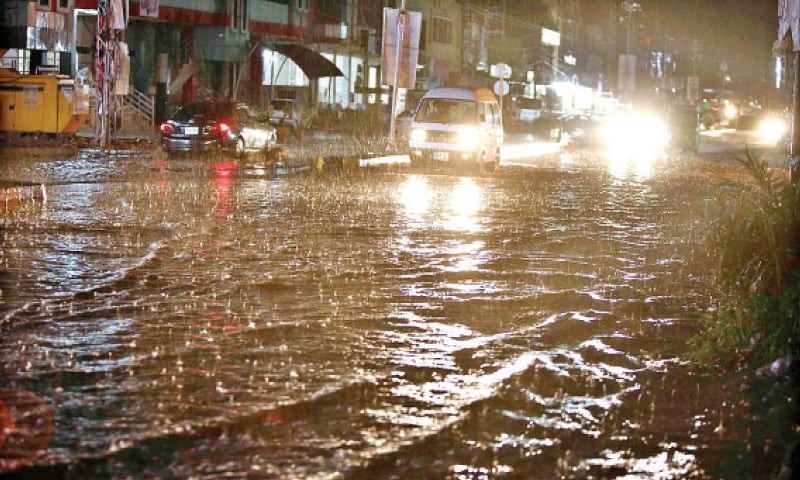

ISLAMABAD: The Pakistan Meteorological Department has declared July 2023 as the ninth wettest month within the last 63 years. Rainfall across the country exceeded 70% of the average, resulting in this notable distinction. The recorded data indicates that the previous record for the highest national rainfall in July was 177.80mm, registered in 2022.
Specifically, the most intense rainfall during July occurred on July 23, with Lahore experiencing 206mm of rainfall. Therefore, it became the wettest location for the month, accumulating a total monthly rainfall of 668.7mm.

In terms of climatic impact, the rain in the past month contributed 21.3% to the national annual total and 44.9% to the monsoon. Throughout July 2023, the country underwent four to five instances of widespread heavy to very heavy rainfall.
In the regions, Gilgit Baltistan recorded rainfall largely above average at 44.30mm (+233%). Balochistan observed 62.70mm (+111%), and Sindh recorded 146.0mm (+143%). Punjab received 152.80mm (+47%), AJK 27.70mm (+31%), and KP 127.30mm (+19%), all registering above-normal rainfall.
Noteworthy amounts of rainfall were also noted in various areas: Balakot at 477mm, Islamabad Zero Point at 453.9mm, Kasur at 442.0mm, Kakul at 427mm, Sialkot Cantt at 422.4mm, Murree at 415.5mm, Rawalpindi at 408mm, Rawalakot at 400.9mm, Muzaffarabad Airport at 392.1mm, Gujranwala Cantt at 386.5mm, Muzaffarabad City at 379mm, Chakwal at 365.9mm, Jhelum at 346.4mm, Padidan at 327.6mm, Malam Jabba at 319mm, and Mandi Bahauddin at 296mm.
Nokkundi was the sole station that remained dry, without any recorded rainfall throughout the month. The national mean monthly temperature for July 2023 in Pakistan was 30.70°C, which was 0.52°C cooler than the average of 31.22°C. Maximum daytime temperatures averaged 36.25°C, 1.01°C cooler than the country’s average of 37.26°C. Furthermore, nighttime minimum temperatures averaged 25.08°C, which was 0.06°C cooler than the national average of 25.13°C.
The highest recorded temperature of the month was 47.5°C in Balochistan’s Dalbandin on July 2. Nokkundi experienced the same extreme temperature range from July 1 to 3. Balochistan’s Dalbandin also claimed the title of the warmest location for the month. Its mean monthly maximum temperature was 43.6°C.
Similarly, the coldest temperature of 6.5°C during the month was registered in GB’s Bagrote on July 8, 2023. Kalam in Khyber Pakhtunkhwa (KP) emerged as the coldest place with a mean monthly minimum temperature of 11.4°C.
On a regional scale, GB at 24.06°C (-1.96°C), KP at 28.14°C (-0.86°C), Punjab at 31.75°C (-0.77°C), AJK at 25°C (-0.42°C), and Balochistan at 31.57°C (-0.31°C) all experienced cooler than average temperatures. Sindh was the only region that slightly deviated with slightly warmer than average temperatures, at 32.56°C (0.05°C).
