

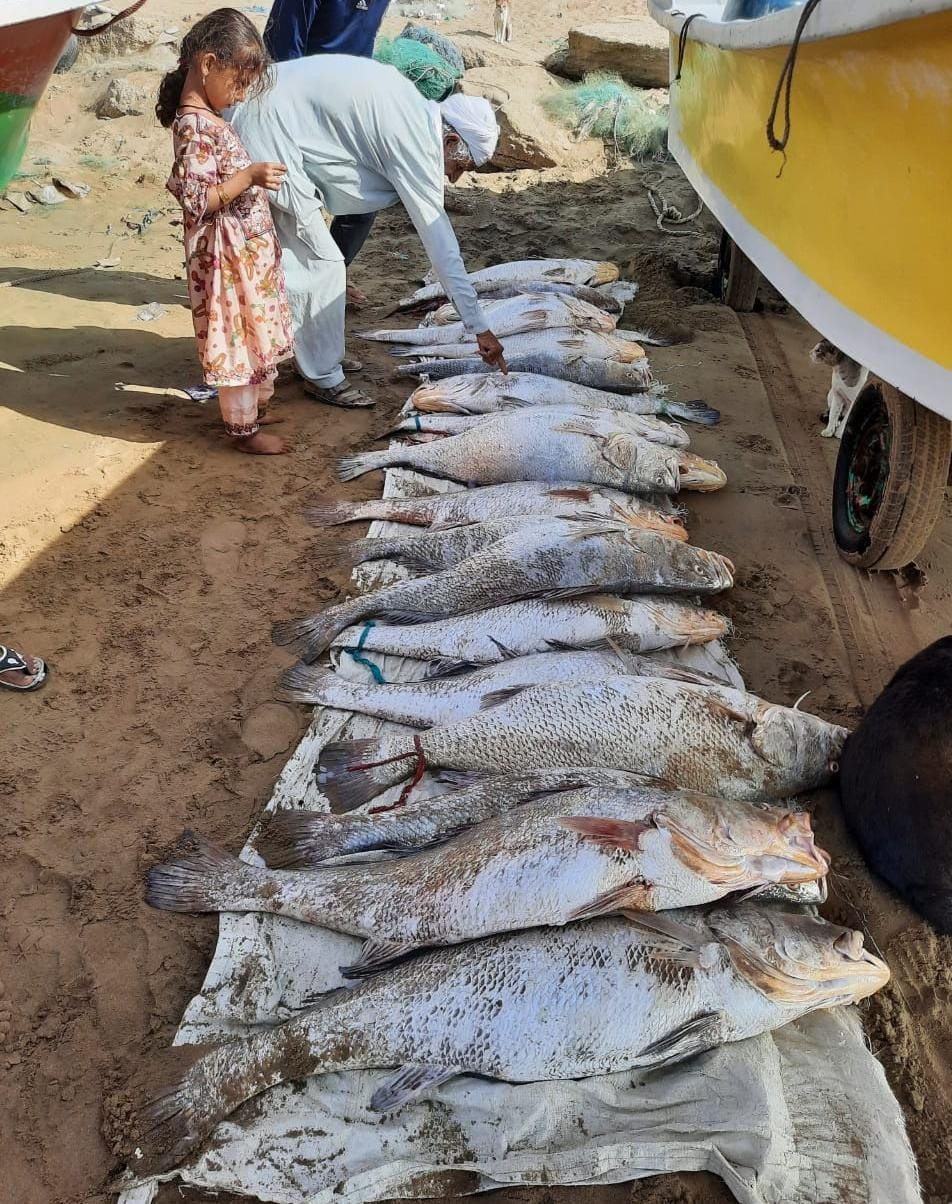

KARACHI: A fishing boat working in the waters around Jiwani captured 18 huge croakers (called Kir in Balochi) and docked with its prized haul at Gunz in Balochistan.
The catch’s largest specimen sold for Rs500,000, while the lesser ones are estimated to sell for roughly Rs100,000.
The skipper of the boat, Sajad Umer, was overjoyed with the catch, which was produced using bottom-set gillnets and earned a total of roughly Rs800,000 during the one-day voyage.
Spotted croakers and Japanese meagre are two types of huge croakers found in Pakistan that have recently fetched prices in the millions of rupees.
The key reason for the fish’s high price is its huge swim bladder, which these fish use for buoyancy and communication and is used in soups supposed to relieve pregnancy-related discomfort and heal joint problems, among other maladies.
In the marketplaces of Hong Kong and Guangzhou, a single swim bladder may cost up to Rs0.5 million per kilogramme.
Because of the exceptional quality of its flesh, the huge croaker has been collected in Pakistan for decades. Its swim bladder export from Pakistan began some 170 years ago when dried fish maws were shipped to Europe for clarifying of wine and beer.
However, dried fish maws are typically sold in Chinese marketplaces because of the high prices provided and the availability of substitutes for clarifying.
Vast croakers are local migratory, according to World Wildlife Fund-Pakistan Technical Advisor Muhammad Moazzam Khan, and form large spawning aggregations known locally as “Aáranga” in Balochistan and “Pinn” in Sindh.
He stated that these aggregations were commonly recorded in the coastal seas off Jiwani, Gwadar, Ormara, and the Sonmiani Bay, but that they have recently become rare in Pakistani waters.
Increased demand for fish maws in Chinese markets has reduced huge croaker supplies worldwide, and certain species, such as yellow croakers in China and totoaba in Baja California, are threatened.
Khan cautioned that the spotted croaker (Protonibea diacanthus) and Japanese meagre (Argyrosomus japonicas) are threatened, and that giant croakers may go locally extinct unless suitable management measures are implemented.
Sudheer Ahmed, a Research Associate at WWF-Information Pakistan’s Centre in Jiwani, claimed that spawning aggregations had been documented often in the Daran-Jiwani area during the previous four years. In 2019 and 2020, fishermen snagged many huge croakers in the vicinity.
He also expressed concern that unrestricted fishing of croakers in the area might lead to their local extinction, emphasising the importance of taking early action to safeguard the species, which could be achieved by designating the area as a Marine Protected Area.
