

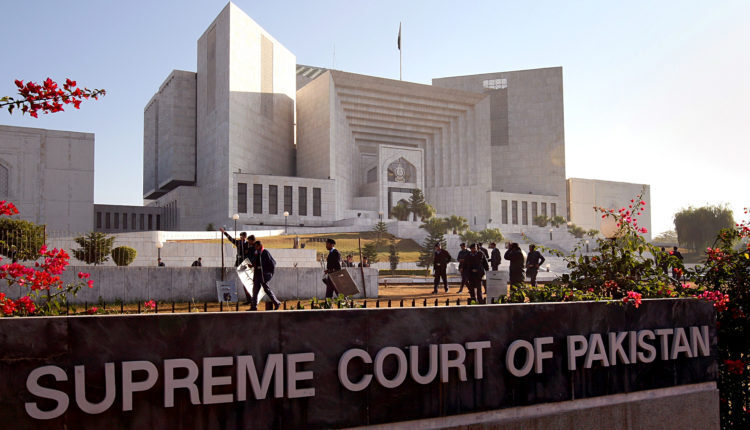

The Supreme Court of Pakistan said the votes of defecting lawmakers will not be counted. The apex court gave this ruling on a presidential reference seeking interpretation of Article 63-A of the Constitution which is related to the status of defecting lawmakers.
The verdict by the larger bench of the apex court was a 3-2 split decision, with a majority of the judges not allowing lawmakers to vote against party line in four instances outlined under Article 63-A.
These four instances are the election of prime minister and chief minister; a vote of confidence or no-confidence; a Constitution amendment bill; and a money bill.
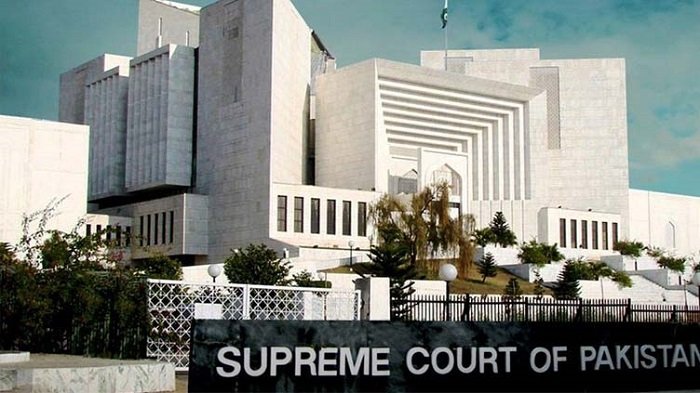
Chief Justice of Pakistan (CJP) Umar Ata Bandial, Justice Ijazul Ahsan and Justice Munib Akhtar gave the majority verdict while Justice Mazhar Alam Khan Miankhel and Justice Jamal Khan Mandokhail were the dissenting judges, who said that giving an opinion on the presidential reference was akin to “rewriting the Constitution”.
In the reference, President Arif Alvi had asked four main questions from the apex court.
Q: Should Article 63-A have a limited or a broad, purpose-oriented interpretation?
A: Broad interpretation; Article 63 to be read with Article 17
Q: Will the defecting members’ vote be counted, given equal weightage?
A: Votes will be disregarded.
Q: Will the defectors be disqualified for life?
A: “High time” for parliament to legislate on this.
Q: Measures that can be taken to prevent defection, floor crossing and vote-buying
A: Returned unanswered for being too vague.
Question 1: Should Article 63-A have a limited or a broad, purpose-oriented interpretation?
The short order said that the first question was related to the proper approach to be taken for the interpretation and application of Article 63-A, Dawn.com reported this evening.
“In our view, this provision cannot be read and applied in isolation and in a manner as though it is aloof from, or indifferent to, whatever else is provided in the Constitution,” the verdict stated,
It said that Article 63-A was an “expression in the Constitution itself of certain aspects of the fundamental rights that inhere in political parties under clause (2) of Article 17,” adding that the two provisions were “intertwined”.
The verdict went on to say that defections were “one of the most pernicious ways” in which political parties could be destabilised, noting that they could also delegitimise parliamentary democracy.
“Defections rightly stand condemned as a cancer afflicting the body politic. They cannot be countenanced,” the order said, adding that 63-A must be interpreted in a “purposive and robust manner”.
“The pith and substance of Article 63-A is to enforce the fundamental right of political parties under Article 17 […] It must therefore be interpreted and applied in a broad manner, consistent with fundamental rights,” the verdict said.
If there is a conflict between the fundamental rights of the collectivity and an individual member, the former must prevail, it added.
Question 2: Will the defecting members’ vote be counted, given equal weightage?
Giving its stance on the second question, the verdict said that the vote of any member of a parliamentary party in a house “that is cast contrary to any direction issued by the latter in terms of para (b) of clause (1) of Article 63-A cannot be counted and must be disregarded, and this is so regardless of whether the party head, subsequent to such vote, proceeds to take, or refrains from taking, action that would result in a declaration of defection.”
Question 3: Will the defectors be disqualified for life?
The court also observed that a declaration of defection could could result in disqualification under Article 63 if parliament passed an appropriate law.
“While it is for parliament to enact such legislation, it must be said that it is high time that such a law is placed on the statute book. If such legislation is enacted it should not amount to a mere slap on the wrist but must be a robust and proportionate response to the evil that it is designed to thwart and eradicate,” the order stated in response to the third question.
Question 4: Measures that can be taken to prevent defection, floor crossing and vote-buying
The verdict refrained from giving an opinion on the fourth question, deeming it to be “vague, too broad and general”. It subsequently returned the question unanswered.
Attorney general presents arguments
A five-member bench headed by Chief Justice Umar Ata Bandial, and comprising Justice Ijazul Ahsan, Justice Mazhar Alam Khan Miankhel, Justice Munib Akhtar and Justice Jamal Khan Mandokhail, had completed proceedings of the case earlier today.
The first hearing of the case took place on March 21 by a two-member bench, after which CJP Bandial constituted a larger bench to hear the matter, which took over news and public discourse in the country after at least a dozen members of the then ruling PTI, who were staying at Islamabad’s Sindh House, came out in open defiance of their party on the issue of the no-confidence motion submitted by the joint opposition against then-premier Imran Khan.
During today’s hearing, PML-N lawyer Makhdoom Ali Khan submitted his detailed response to the court and asked for more time to present his arguments. He maintained that the situation had changed and he needed more time to seek instructions from his client.
Newly appointed Attorney General for Pakistan Ashtar Ausaf (AGP) also completed his arguments during today’s hearing. At the last hearing, Justice Bandial had expressed his disappointment over the AGP’s absence.
Taking the rostrum, Ausaf said that questions pertaining to public interest or the law could be raised in a presidential reference.
“Is the question asked [under] Article 186 not related to the formation of the government?” the chief justice asked. Article 186 is related to the advisory jurisdiction of the apex court.
The AGP replied that the president had never sent such a reference in the past over similar incidents, and urged the court to also view the reference within the context of the past.
Justice Ahsan remarked that the president did not need to seek legal advice from the attorney general before filing a reference. According to Article 186, the president can send a reference when a legal question arises, he pointed out, asking whether the AGP was disassociating himself from the presidential reference.
“I haven’t received any instructions from the government,” Ausaf replied, adding that he would aid the court in his capacity as AGP.
At one point, Justice Ahsan asked whether the AGP was trying to imply that the presidential reference was not admissible. “Are you suggesting that the reference be sent back without providing an answer?”
Justice Akhtar also recalled that the former AGP had declared the reference to be admissible. However, as the AGP, you can also present your stance, he said.
The AGP said that the reference was filed on the advice of former prime minister Imran Khan. He also clarified that he was presenting his stance, adding that the former government’s lawyers were present to do the same for them.
Ausaf stated that President Arif Alvi should have sought the opinion of legal experts before filing the reference. “If the opinions differed, then the president could have sent the reference,” he said.
Here, CJP Bandial said that several hearings had been dedicated to hearing the presidential reference. Articles 17 and 63 of the Constitution both talk about the rights of political parties while the latter protects these rights, he observed.
The CJP pointed out that the reference was filed in March and the court had been hearing it for a month-and-a-half. “Don’t focus on technical matters because things have proceeded beyond the point of whether or not the reference is admissible,” he told the AGP.
AGP said that this was a constitutional, not a technical matter. He also argued that the apex court had to keep in mind the rights of workers and political parties.
He explained that the procedure for taking action against dissident members was underlined in Article 63-A, adding that the appeal against the sentence would be taken up by the apex court.
He also argued that a lawmaker was not automatically de-seated when disqualified under Article 63(1). The lawmaker is issued a show-cause notice and asked to provide an explanation, he said. “If the party head is not satisfied, he can send a reference against the dissident lawmaker,” Ausaf added.
At one point, Justice Mandokhail asked whether the president had ever raised this issue during his annual speech in parliament. He also wondered whether any political party had ever taken steps to seek the interpretation of or amend Article 63-A.
The attorney general replied that after facing defeat in the Senate elections, the former prime minister (Imran Khan) did not issue any instructions to lawmakers.
He went on to say that Imran had issued a statement before seeking a vote of confidence from lawmakers in March 2021, in which he said that lawmakers should make a decision based on their conscience.
Imran Khan said that if he does not secure the trust vote, he would go back home, the attorney general said.
Justice Ahsan observed that issuing directions was up to the party head. “He (Imran) was also the prime minister when the no-confidence vote took place,” he said.
Ausaf responded by saying that the former prime minister had backtracked on his earlier stance, which led to Justice Ahsan asking whether it was unheard of for the prime minister to change his instructions.
“The prime minister has taken an oath under the Constitution. He can’t backtrack on his statement,” the attorney general said.
He went on to say that a lawmaker is elected by the people for a period of five years, following which lawmakers vote to elect the prime minister. “Lawmakers are answerable to the people,” he said.
The AGP also argued that lawmakers could vote to change the prime minister if the latter failed to fulfil the promises made with the people.
