

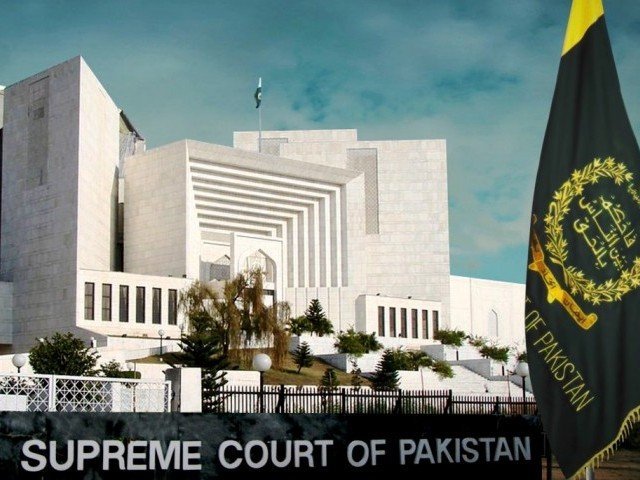

ISLAMABAD: Chief Justice of Pakistan Justice Umar Atta Bandia said that the court was not convinced to intervene in the proceedings of the National Assembly.
The CJP stated this while hearing a petition filed by the SCBA President Ahson Bhoon. In today’s hearing, the SCBA counsel said National Assembly Speaker Asad Qaiser has convened the session on March 25 , 17 days after the opposition submitted the no-confidence motion against Prime Minister Imran Khan while, according to Article 95, the session has to be summoned within 14 days.
He further said the no-confidence resolution would be moved in the NA on March 25 while it could not be adjourned indefinitely before voting on the motion.
The Chief Justice of Pakistan said that this was the assembly’s “internal matter”, and also stated that it would be “better if the assembly’s fight was fought inside the assembly”.
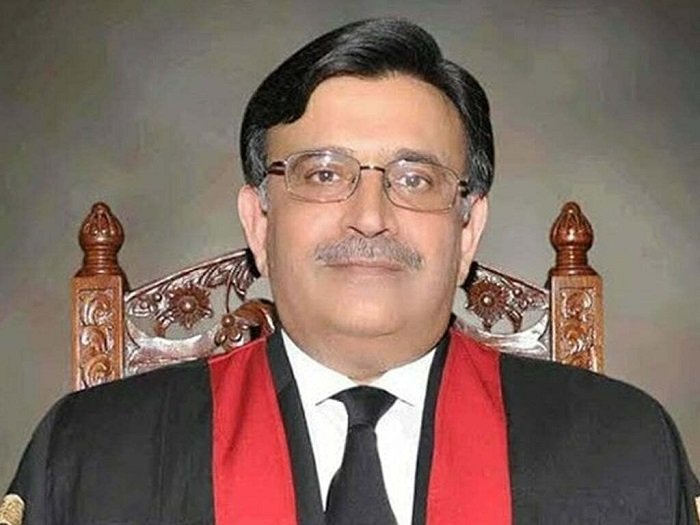
The CJP said, “The court has to ensure that nobody’s right is affected [and] nobody is deprived from voting because of any event. Voting is a constitutional right of the members.”
The Supreme Court has to decide in accordance with the law and the Constitution, Justice Bandial said, adding that the court has not yet been “convinced to interfere in the assembly’s proceedings”.
All the points raised in court could be taken to the NA speaker, he observed.
The SCBA, in its plea, had sought the court’s directions for all state functionaries “to act strictly in accordance with the Constitution and the law and they be restrained from acting in any manner detrimental to and unwarranted by the Constitution and the law”.
It had also demanded that the government officials responsible to maintain law and order in Islamabad must “prevent any, gathering, public meetings and/or processions, which could hamper the assembly proceedings or participation of members in the session”.
Meanwhile, the Supreme Court Justice Munib Akhtar said that after joining a political party, a member’s individual vote was considered a “collective right”.
He said that according to Article 95(ii), which deals with the procedure to bring in a no-confidence motion against the prime minister, a member’s individual vote had no “status”, adding that the court had previously made similar observations in cases related to former prime ministers Benazir Bhutto and Nawaz Sharif.
After joining a political party, a member’s vote was considered a “collective” right, he added.
He made the observation during the hearing of a plea filed by the Supreme Court Bar Association (SCBA), seeking the top court’s intervention to prevent “anarchy” and direct all state functionaries to act in accordance with the Constitution and the law ahead of the no-trust vote against Prime Minister Imran Khan.
A two-judge bench, comprising Chief Justice of Pakistan Umar Ata Bandial and Justice Akhtar, heard the petition.
Opposition leaders — PML-N president Shehbaz Sharif, PPP Chairman Bilawal Bhutto-Zardari and JUI-F chief Maulana Fazlur Rehman — were also present during the hearing.
On Saturday, the court had issued notices to the ruling PTI, PML-N, PPP, JUI-F, Balochistan National Party (Mengal) and the Awami National Party through their respective secretary generals, though they will be represented by their legal counsel.
The court had sought assistance from the six political parties including the proponents of the no-trust motion in the National Assembly and ordered the Islamabad police chief to come up with a comprehensive report regarding Friday’s breaching of Sindh House by PTI activists.
The court also issued notices to the respondents for their assistance in ensuring a smooth, lawful and peaceful completion of the process under Article 95 of the constitution, related to the no-confidence vote against the prime minister.
The federal government through the interior and defence secretaries, the prime minister, leader of the opposition in the National Assembly, National Assembly speaker and secretary, Islamabad chief commissioner and deputy commissioner and Inspector General of Police are respondents in the case.
During the hearing today, Justice Bandial said the bar wanted that MNAs be allowed to vote for whoever they wanted, remarking that if the SCBA went into too much detail, Justice Akhtar’s observation would become an “obstacle”.
“The question is whether individual choice can be different from the party’s stance,” the chief justice said.
The bar’s counsel, Mansoor Usman, argued that parliamentarians should have the right to vote in their individual capacities at which Justice Akhtar asked which article allowed that.
The counsel mentioned Article 66 — related to members’ privileges — at which Justice Akhtar again asked how it gave the right to vote in individual capacity.
Article 66 protects parliamentary proceedings, the judge observed, adding, “According to Article 63, the case of a member’s vote can be brought to the court.”
The chief justice added that any member’s right to vote was “not absolute”.
The petition
The SCBA’s petition, a copy of which is available with Dawn.com, comes amid a heated political situation with the government and opposition trading barbs at each other and threatening to flex muscles in roadshows ahead of a crucial vote later this month that would decide the fate of Prime Minister Imran.
The two sides have announced to hold rallies in the capital ahead of the parliament session, prompting fears of political instability and anarchy that the SCBA expressed in its petition.
In the plea filed with the Supreme Court, the SCBA cited statements from the prime minister wherein he had said “I will fight against them until [my last breath]. I will face them and I am completely prepared for whatever [they throw my way]”.
It also included statements by Information Minister Fawad Chaudhry, telling lawmakers that they would have to pass through a million PTI supporters to enter the National Assembly on the day of the vote.
Likewise, the petition also quoted statements from opposition leaders including JUI-F chief Maulana Fazlur Rehman when he appealed to his workers to converge in Islamabad before the session “and stay on the Constitution Avenue till voting on the no-trust resolution and … provide safe passage to members to the Parliament House”.
The petition says circumstances involving confrontation between the government and the opposition could trigger an “anarchic situation” in the country.
“It is evident from the political history of our country that preventing the constitutional process from taking its course has produced dire consequence for democracy and rule of law,” the petition says.
The SCBA sought the court’s directions for all state functionaries “to act strictly in accordance with the Constitution and the law and they be restrained from acting in any manner detrimental to and unwarranted by the Constitution and the law”.
It also demanded that officials tasked with the responsibility to maintain law and order in Islamabad must “prevent any assembly, gathering, public meetings and/or processions that could hamper the assembly proceedings or participation of members in the session”.
The plea also urged the court to bar authorities from taking any “coercive measures against, and including arrest and detention of the, members of the National Assembly”.
