

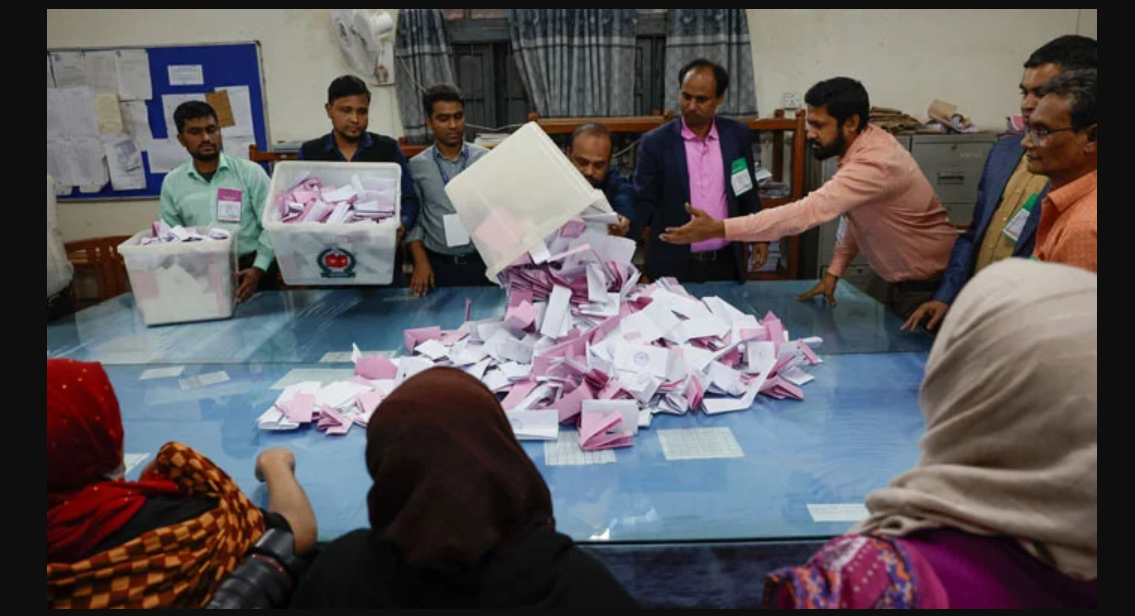

Early counting in Bangladesh’s 13th general election shows the Bangladesh Nationalist Party (BNP) ahead of Jamaat-i-Islami after a strong nationwide turnout. Tens of millions of voters cast ballots in what observers describe as a crucial political moment for the country of 175 million people.
This election follows the 2024 youth-led uprising that led to the removal of long-time prime minister Sheikh Hasina. Therefore, analysts believe a clear result is essential for restoring political stability and economic confidence. Months of unrest previously disrupted daily life and affected major industries, including the garment sector.
Counting began shortly after polling stations closed. Election officials indicated that clear trends would emerge by midnight, with final results expected by Friday morning.
BNP and Jamaat in Direct Contest
The race primarily features two coalitions led by former political allies, BNP and Jamaat-i-Islami. Early television projections showed BNP leading in 50 seats, while Jamaat secured early leads in 18 constituencies. Bangladesh’s parliament, the Jatiya Sangsad, has 300 seats, and a simple majority requires 151 seats.
BNP announced on its official platform that party chief and prime ministerial candidate Tarique Rahman won one of the two seats he contested. However, election authorities had not yet formally confirmed the result. Supporters gathered outside the party office in Dhaka and celebrated as early trends favored their candidate.
Meanwhile, voter turnout appeared significantly higher than the 42 percent recorded in the 2024 election. Local media estimated that more than 60 percent of registered voters participated in this vote.
Awami League Absent as Hasina Rejects Process
The Awami League remains banned, and Sheikh Hasina continues to stay in self-imposed exile in India. Consequently, the political landscape has shifted considerably. In a written statement, Hasina described the election as illegitimate and demanded its cancellation. She called for the restoration of political activities for her party and urged the formation of a neutral caretaker government.
Despite her criticism, authorities reported no major incidents of violence during polling. Nearly 958,000 members of police, army, and paramilitary forces were deployed nationwide to maintain order. Security personnel remained stationed outside most polling stations throughout the day.
Referendum on Constitutional Reforms
Alongside the general election, voters also participated in a referendum on constitutional reforms. Proposed changes include establishing a neutral interim government during election periods, restructuring parliament into a bicameral legislature, increasing women’s representation, strengthening judicial independence, and limiting the prime minister to two terms.
More than 2,000 candidates and at least 50 parties contested the election, marking a record level of participation. Voting in one constituency was postponed after the death of a candidate.
Public Sentiment and Regional Reactions
Long queues formed outside polling stations, reflecting public enthusiasm. Many voters expressed optimism about the fairness of the process. Some described the atmosphere as freer and more festive compared to previous elections.
Outside a polling station in Dhaka, mounted police displayed banners encouraging citizens to vote without fear. In addition, regional leaders extended their wishes for a peaceful and democratic process.
As counting continues, the outcome is expected to shape Bangladesh’s political and economic direction in the coming years. Therefore, both domestic observers and international stakeholders are closely watching the final results.
