

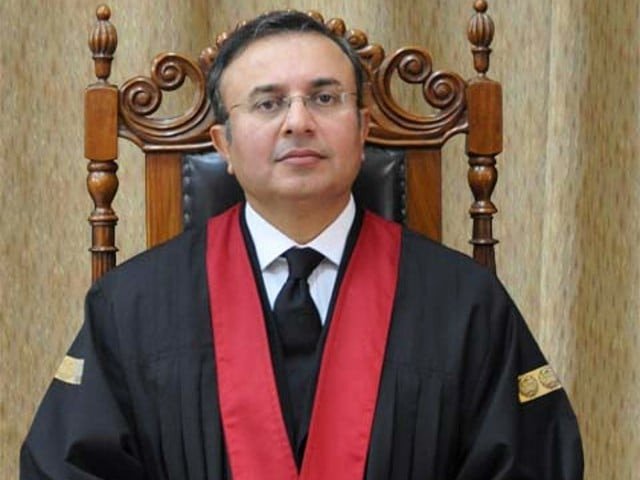

Former Supreme Court judge Syed Mansoor Ali Shah has formally announced the commencement of his legal practice, focusing on international and domestic arbitration, mediation, and strategic legal consultancy, while continuing his engagement in legal education.
According to his LinkedIn profile, Justice Shah resigned from the Supreme Court of Pakistan on November 13, 2025, citing a matter of constitutional principle. He stated that his decision was taken in fidelity to the Constitution, judicial independence, and the rule of law.
In his resignation letter, he observed that continuing to serve in a court deprived of its constitutional jurisdiction would amount to acquiescence in a constitutional wrong, and that stepping aside was the only honest way to honour his judicial oath.
Justice Shah noted that he was in line to assume office as the 45th Chief Justice of Pakistan but was superseded following the controversial 26th Constitutional Amendment, which altered the seniority structure of the Supreme Court. The amendment remains under judicial challenge.
Despite being the senior puisne judge, he was excluded from constitutional benches and continued to raise concerns regarding judicial independence until his resignation after the 27th Constitutional Amendment.
His profile states that he is currently serving as a Distinguished Professor of Practice at LUMS, with upcoming teaching roles at Yale Law School in 2026 and as Bok Professor at the University of Pennsylvania Carey Law School in 2027. He has also made himself available for appointment as an arbitrator and mediator.
During more than sixteen years on the bench, Justice Shah authored over 450 reported judgments and decided more than 5,000 cases, contributing significantly to constitutional, commercial, and rights-based jurisprudence.
He was part of several landmark benches, including decisions on reserved seats, lifetime disqualification of lawmakers, and the continuation in office of Justice Qazi Faez Isa.
His decision to begin legal practice has drawn mixed reactions within the legal fraternity, reflecting broader divisions over recent constitutional changes and the future of judicial independence in Pakistan.
