

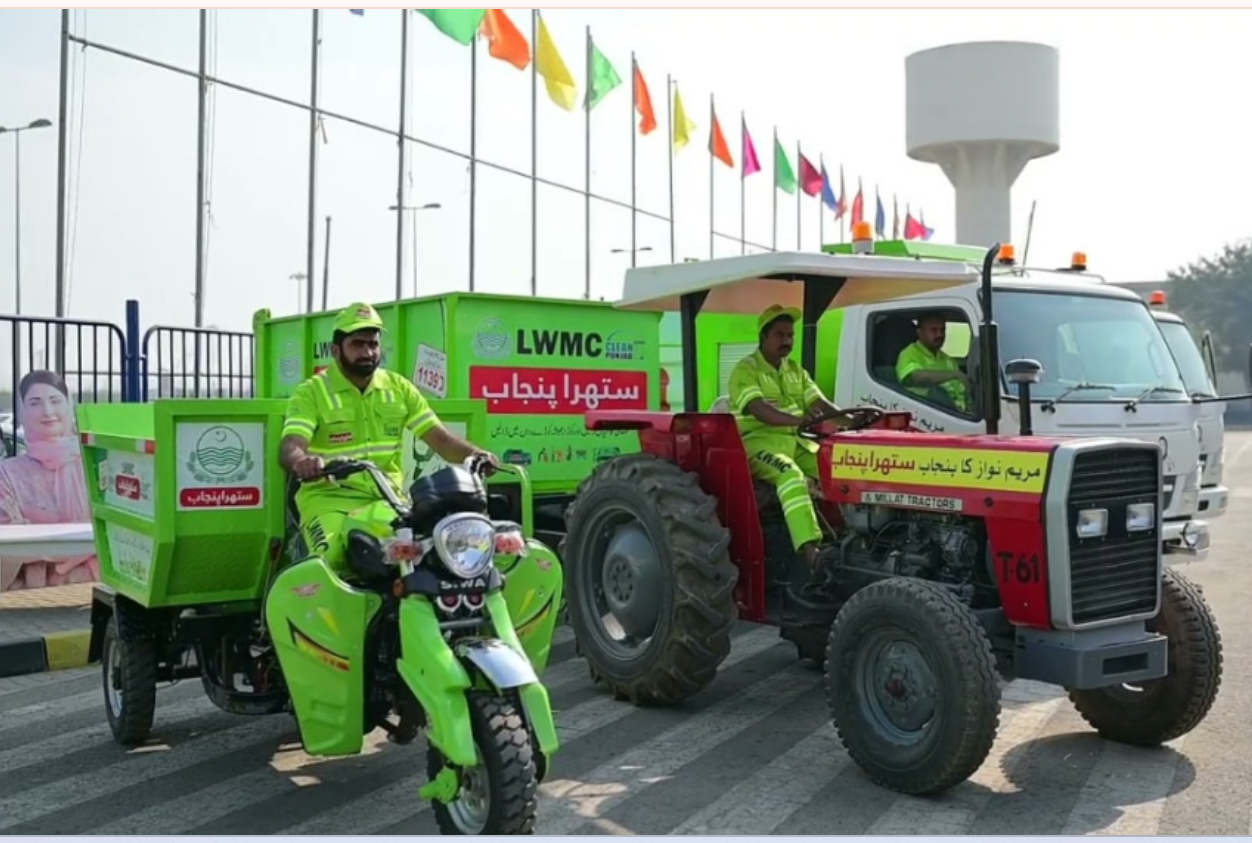

Punjab has once again drawn international attention due to its ambitious urban reform initiative, Suthra Punjab.The program has gained recognition from another major international English newspaper, strengthening its global profile.This acknowledgment adds to earlier global mentions, reinforcing Punjab’s growing reputation for large-scale governance reforms.As a result, Suthra Punjab is increasingly viewed as a benchmark for urban cleanliness initiatives.
World’s Largest Unified Waste Management System
Suthra Punjab has established the world’s largest unified waste management system.It has transformed how a province of more than 100 million residents manages urban sanitation.The system processes over 50,000 tons of waste daily through a single integrated framework.Moreover, the approach relies heavily on technology to ensure efficiency and accountability.
Operations are supported by 30,000 vehicles and a sanitation workforce of 150,000 employees.In addition, 6,600 geo-tagged waste enclosures operate across urban centers.These assets are monitored through RFID-enabled weighbridges, IP cameras, and AI-powered tracking tools.Consequently, waste collection and disposal remain measurable and transparent.
Data-Driven Governance and Transparency
Punjab has replaced traditional contractor models with KPI-based performance evaluations.This shift has improved service delivery while strengthening transparency across districts.At the same time, contractor payments are now directly linked to measurable outcomes.This reform reduces inefficiencies and discourages misuse of public resources.
Citizens also play an active role through a centralized Complaints Management System.They can report sanitation issues directly, ensuring faster responses and oversight.As a result, public participation has become a key pillar of the program’s success.
Job Formalization and Worker Safety
The initiative has formalized 150,000 sanitation jobs across the province.Workers now receive fair wages, standardized uniforms, and safety equipment.More importantly, compliance with occupational safety standards has improved working conditions.This step has elevated sanitation work from informal labor to a recognized public service.
Turning Waste Into Economic Value
Suthra Punjab is converting waste into environmental and economic assets.Several projects support this transition, including a 25 MW waste-to-energy plant.Composting facilities further reduce landfill pressure while supporting sustainable agriculture.
In addition, a 5 MW solar park has been developed on a rehabilitated dumpsite.The province has also introduced carbon-market-ready landfills with international technical support.These combined efforts reduce between 60,000 and 90,000 tons of CO₂-equivalent emissions annually.
Locally Built, Globally Verified System
Most machinery and digital systems used in Suthra Punjab are locally manufactured.This approach supports domestic industry while lowering operational costs.The system meets ISO compliance standards and has undergone independent verification.As a result, Punjab has earned recognition as a data-driven circular economy model.
Overall, Suthra Punjab demonstrates how large-scale urban reform can blend technology, sustainability, and governance into a single effective framework.
