

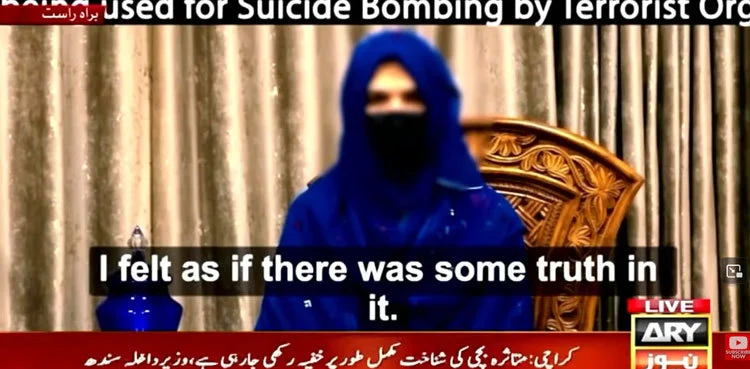

KARACHI: Sindh Home Minister Zia Lanjar on Monday confirmed that security forces rescued a Baloch schoolgirl who had been taken to Karachi after being targeted for a suicide attack. Authorities disclosed the development during a press conference in Karachi. Senior security officials attended the briefing. The rescued girl and her mother were also present, adding emotional weight to the disclosure.
Officials stated that timely intelligence and swift action prevented a potential tragedy. Security agencies traced the radicalisation process to online platforms. As a result, the girl was safely recovered before any harm could occur.
Social Media Exposure Gradually Fueled Radical Thinking
During the press conference, officials played a recorded statement from the rescued girl. In her message, she explained how extremist influence entered her life through social media. Initially, she encountered hateful material online. Soon after, algorithms repeatedly pushed similar content toward her. Consequently, the constant exposure made the messages seem normal.
Over time, communication with unknown individuals increased. Gradually, she began receiving links, videos, and recorded speeches. These materials promoted violence through emotional language. As the interaction deepened, the false narrative started to feel real. Eventually, she found it difficult to distinguish truth from manipulation.
Meanwhile, the individuals contacting her closely monitored her personal life. When they learned her father was not present at home, they used sympathy as a tool. Under the guise of care, they exploited her vulnerability. As a result, their influence strengthened.
Extremist Groups Were Glorified Through Messaging Apps
The girl revealed that WhatsApp groups played a key role in the process. In these groups, activities of the banned Baloch Liberation Army were glorified. Violence was portrayed as courage. Sacrifice was framed as honor. Later, she realised this portrayal was deliberate deception designed to recruit young minds.
At the same time, her education suffered. She lost focus on her studies. Gradually, extremist messaging reshaped her thinking. Recruiters pushed the idea that giving one’s life was the highest purpose. Because of constant reinforcement, this belief began to feel unquestionable.
She admitted that she started making excuses to leave home. However, with hindsight, she now understands the destruction ahead of her. That realization came too late, she said, but security intervention changed her path.
Security Checkpoint Triggered Fear and Realisation
She also recalled a tense moment at a security checkpoint. When officials questioned her, anxiety overwhelmed her. In that moment, fear replaced false confidence. She said the experience forced her to confront reality.
“I am Baloch, and our traditions teach respect and dignity for women,” she stated firmly. Therefore, she rejected the narrative imposed on her.
In her message to the public, she strongly warned against extremist recruitment. She stressed that sacrificing women and girls does not reflect Baloch culture. Moreover, she urged families to closely monitor online activity. She also advised young people to question messages that glorify violence.
She concluded with a clear warning. Those who recruit individuals in the name of sacrifice are not helpers. Instead, she described them as predators who exploit emotional pain.
Sindh Home Minister Zia Lanjar praised the security forces for their swift response. He emphasized that online extremism remains a serious threat. Consequently, he called for collective vigilance by parents, educators, and communities to protect vulnerable youth.
