

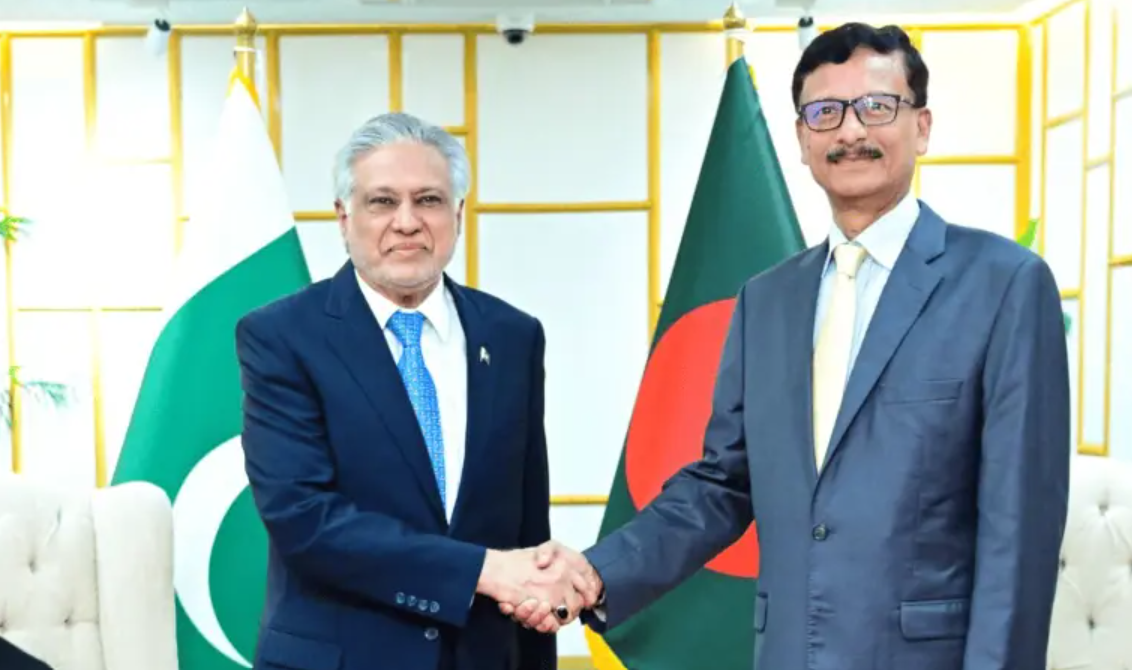

Bangladesh’s Foreign Affairs Adviser, Touhid Hossain, indicated that Dhaka could potentially join a regional grouping with Pakistan without including India. He clarified, however, that such an arrangement would not be feasible for Nepal or Bhutan.
Hossain emphasized the strategic possibilities for Bangladesh while highlighting limitations for other regional countries. “It is possible for us strategically, but not possible for Nepal or Bhutan to form a grouping with Pakistan excluding India,” he explained.
Improving Islamabad-Dhaka Relations
Relations between Bangladesh and Pakistan have gradually improved following the ouster of former Prime Minister Sheikh Hasina. Since her departure and subsequent relocation to India, the new government in Dhaka has maintained a relatively frosty stance toward India, allowing both Pakistan and Bangladesh to rebuild ties slowly.
High-level engagements have further strengthened bilateral interactions. Last year, Pakistan’s Prime Minister Shehbaz Sharif met Bangladesh’s Yunus on the sidelines of the 79th UN General Assembly session. Additionally, Deputy Prime Minister and Foreign Minister Ishaq Dar held meetings with Bangladesh’s chief adviser in August 2025, focusing on enhancing regional cooperation and bilateral relations.
Trilateral Initiatives and Diplomatic Developments
Pakistan and Bangladesh have also agreed in principle to provide visa-free entry for holders of diplomatic and official passports, a move expected to facilitate smoother diplomatic engagement. Moreover, Hossain referenced remarks by DPM Dar during the “Islamabad Conclave,” noting that a trilateral initiative involving Pakistan, Bangladesh, and China has commenced.
He further quoted Dar as saying that “at some point this could see some progress,” hinting at potential developments in regional diplomacy. However, Hossain refrained from commenting extensively, clarifying that his insights were primarily based on media reports.
Geopolitical Implications
This potential Pakistan-Bangladesh alignment could alter regional geopolitics in South Asia. Analysts suggest that such cooperation may create new diplomatic pathways and economic opportunities while reshaping strategic calculations among neighboring countries.
While discussions are still preliminary, Bangladesh’s openness to regional alliances beyond India signals a nuanced approach to foreign policy. The country appears willing to explore strategic partnerships to strengthen its regional presence and international standing.
Bangladesh’s adviser remarks underscore a cautious yet notable shift toward engaging with Pakistan independently of India. As diplomatic interactions continue, the prospect of a Pakistan-Bangladesh regional grouping remains a developing story that could influence South Asian geopolitics in the coming years.
