

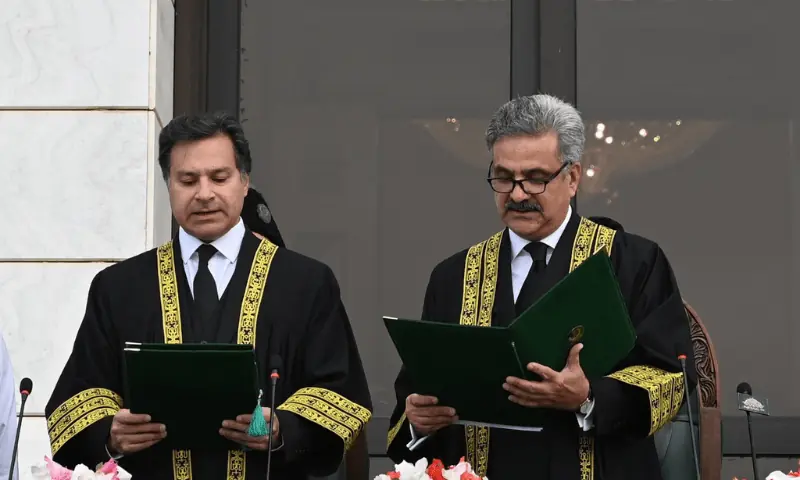

The Judicial Commission of Pakistan (JCP) on Tuesday elevated Justice Miangul Hassan Aurangzeb to the position of permanent judge of the Supreme Court (SC).
The meeting, presided over by Chief Justice of Pakistan (CJP) Yahya Afridi, was the first convened following the passage of the 27th Constitutional Amendment and the establishment of the Federal Constitutional Court (FCC). Justice Aurangzeb had previously been serving as an acting SC judge since February, following his elevation from the Islamabad High Court (IHC).
In addition to Justice Aurangzeb’s elevation, the JCP approved the appointments of Justice Zafara Ahmed Rajput as chief justice of the Sindh High Court (SHC) and Justice Kamran Mullahkhail as chief justice of the Balochistan High Court (BHC).
The appointments were made after considering the three senior-most judges of each respective high court. For the SHC, the candidates included Justices Rajput, Muhammad Iqbal Kalohoro, and Mahmood A. Khan, while for the BHC, the shortlist comprised Justices Mullahkhail, Iqbal Ahmed Kasi, and Shaukat Ali Rakhshani.
The establishment of the FCC, which includes four SC judges — Justices Aminuddin Khan, Syed Hasan Azhar Rizvi, Aamer Farooq, and Ali Baqar Najafi — along with the resignations of Justices Syed Mansoor Ali Shah and Athar Minallah, has reduced the total strength of the SC to 18 judges from 24.
The meeting was attended by key judicial and government representatives, including FCC Chief Justice Aminuddin Khan, Justices Munib Akhtar and Rizvi, Attorney General Mansoor Usman Awan, Law Minister Azam Nazeer Tarar, and parliamentary and bar council members.
The JCP also constituted a committee to draft rules under clause 20 of Article 175A for annual performance evaluations of high court judges and remedial measures for underperformance.
Following the 27th Amendment, significant changes were made to Pakistan’s judicial bodies. Justice Jamal Khan Mandokhail was included in the Supreme Judicial Council (SJC) and the Practice and Procedure Committee, while FCC’s Justice Farooq became a member of the JCP.
The SJC also constituted a committee to draft procedural rules and provisionally adopted the Supreme Judicial Council Procedure of Inquiry, 2025. These reforms aim to strengthen judicial accountability, transparency, and the appointment process within Pakistan’s superior judiciary.
