

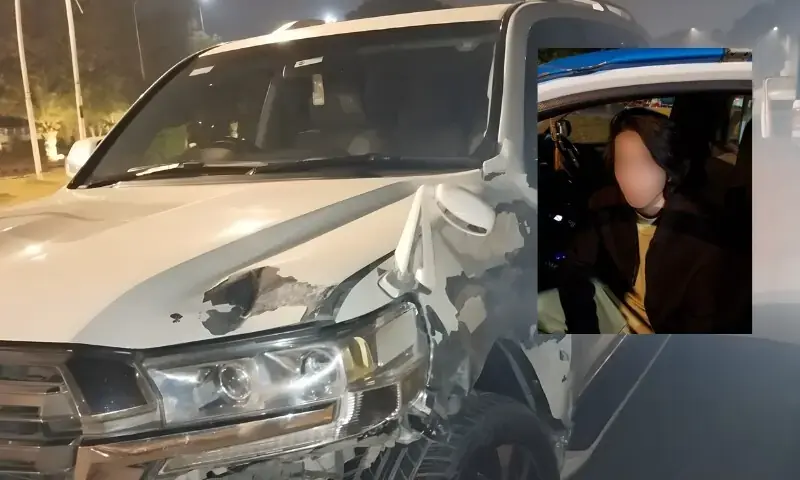

A judicial magistrate in Islamabad on Tuesday granted police physical remand of the teenage son of Islamabad High Court (IHC) Justice Mohammed Asif. The underage driver is accused of hitting and killing two young women in a late-night road accident near the Pakistan National Council of Arts (PNCA).
Fatal Collision Near PNCA Sparks Outrage
According to the FIR filed at Secretariat Police Station, the accident took place on Monday night when a black SUV, allegedly driven by the judge’s son, struck two women riding a scooter. Both victims worked at the PNCA and reportedly died on the spot due to the severity of the impact.
The SUV fled the scene immediately after the crash. Police traced the vehicle using its registration number, eventually locating the suspect at a private hospital where he had been taken for treatment.
Investigators took him into custody and collected forensic samples. The SUV was also impounded for technical inspection. The FIR includes sections 279 (rash driving), 322 (manslaughter), and 427 (causing damage) of the Pakistan Penal Code.
Court Approves Physical Remand for Investigation
The investigating officer informed the court that more time was needed to verify the suspect’s medical report, record eyewitness statements, and finalize the vehicle examination. Magistrate Shaista Khan Kundi reviewed the case record and approved the physical remand.
The victims’ bodies were moved to the Pakistan Institute of Medical Sciences (PIMS) for autopsy. Police said they are also collecting CCTV footage to confirm whether speeding, negligence, or distraction contributed to the deadly crash. Officials assured the families that the investigation will proceed strictly on merit.
This case has renewed public attention due to similar past incidents. In 2022, a hit-and-run case involving the daughter of a Lahore High Court judge caused nationwide controversy. That investigation stalled for months until 2024, when the Islamabad police chief confirmed that the SUV involved belonged to a Supreme Court justice. Earlier this year, a local court acquitted the accused, Shanzay Malik, prompting widespread debate about accountability.
