

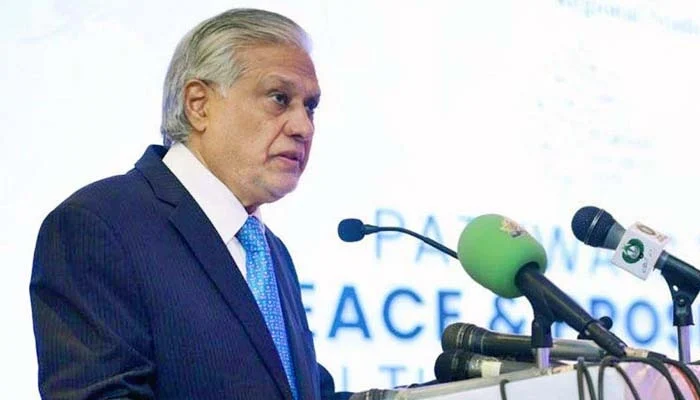

Deputy Prime Minister and Foreign Minister Ishaq Dar said on Saturday that Pakistan is prepared to contribute troops to the proposed Gaza International Stabilisation Force (ISF) — but made it clear the country will not take part in any mission aimed at disarming the Palestinian resistance group Hamas. He stressed that Pakistan supports peacekeeping, not “peace enforcement”.
Pakistan Signals Readiness to Join ISF
The ISF is a central component of the US-brokered Gaza Peace Agreement, recently endorsed by a UN Security Council (UNSC) resolution. The force is expected to comprise troops mainly from Muslim-majority countries.
Senior government officials, speaking on condition of anonymity, said Islamabad’s internal deliberations were at an “advanced stage”, and that the federal government may announce its final decision soon.
The UNSC resolution — backed by 13 members including Pakistan, with Russia and China abstaining — endorses former US President Donald Trump’s 20-point Gaza plan, which also authorises the formation of the ISF for stabilisation and reconstruction efforts.
However, Hamas has rejected the resolution, objecting to any international force whose mandate includes disarming Palestinian factions.
Dar Rejects Any Role in Disarming Hamas
Speaking at the Ministry of Foreign Affairs, FM Dar revealed that the topic of Hamas’ disarmament first surfaced during a meeting in Riyadh. He reiterated firmly that Pakistan will not participate in such an action.
“We are not ready for that. This is not our job,” he said. “Disarmament is the responsibility of Palestinian law enforcement agencies. Our role is peacekeeping, not peace enforcement.”
Dar added that Pakistan was willing “in principle” to contribute troops, and Prime Minister Shehbaz Sharif had already expressed support after consultations with the army leadership. But the final decision depends on the ISF’s mandate and detailed terms of reference.
He also stated that Indonesia — which has offered 20,000 troops — shares similar reservations if disarmament becomes part of the force’s duties.
UN Envoy and Defence Minister Echo Concerns
Pakistan’s Permanent Representative to the UN, Ambassador Asim Iftikhar Ahmad, previously said the ISF must operate under a clear UN-consistent mandate. He stressed that any disarmament must result from a negotiated political process under a unified Palestinian National Authority.
Last month, Defence Minister Khawaja Asif strongly dismissed statements suggesting Pakistan would help disarm Hamas, publicly condemning such interpretations.
Resolution Outlines Gaza Demilitarisation and Reconstruction
The UNSC resolution authorises the ISF to support Gaza’s demilitarisation, decommission weapons, and dismantle militant infrastructure.
It also outlines the creation of a “Board of Peace” to oversee reconstruction and recovery. Trump’s 20-point plan has been attached to the resolution.
Despite the diplomatic push, the Gaza Strip remains devastated after two years of Israeli bombardment. Israel has rejected any political arrangement that may pave the way for Palestinian statehood, despite the resolution noting that “conditions may finally be in place” for a credible roadmap for self-determination.
Pakistan Avoided Kinetic Action Against Afghanistan at Qatar’s Request
FM Dar also spoke extensively on deteriorating ties with Afghanistan. He revealed that Pakistan was close to taking “kinetic action” against terrorist sanctuaries following attacks by Afghan nationals.
Qatar intervened urgently, contacting him “every hour” to prevent escalation. Dar said he persuaded PM Shehbaz Sharif and the army chief to hold off, agreeing to give mediation a chance.
However, he expressed frustration that negotiations facilitated by Qatar and Türkiye yielded little progress.
Dar warned Kabul that the world — Muslim and non-Muslim states alike — was losing patience with Afghan-based terrorism. He urged the Taliban regime to acknowledge its internal divisions and weak governance.
He also highlighted cross-border incidents, including attacks on Chinese workers in Tajikistan and the killing of two US guards by an Afghan national.
Dar said efforts are underway to restore humanitarian aid deliveries to Afghanistan at the UN’s request, with army approval already secured and the prime minister’s final nod pending.
Progress on GSP+ Review and EU Delegation Visit
Discussing the ongoing visit of a seven-member European Union delegation reviewing Pakistan’s GSP+ status, Dar said that “nearly all matters” were progressing positively.
Six items remain pending, but he expects three key legislative measures to be completed during the current parliamentary sessions.
He expressed confidence that the EU review mission will produce a favourable assessment.
UAE Visa Restrictions and Crime Concerns
Addressing concerns over UAE visa denials and mass offloading of passengers, Dar said Pakistan had repeatedly raised the issue.
He noted that Emirati authorities presented data showing Pakistanis ranked highest among foreign nationals involved in criminal activity in the UAE.
He acknowledged that, at one stage, even officials’ and ministers’ visas were refused.
Dar stressed that such problems stem from organised begging rackets and other criminal networks involving Pakistanis in the Gulf, including Saudi Arabia.
“These issues must be resolved at their root,” he said, adding that he had forwarded detailed reports to Interior Minister Mohsin Naqvi and would continue pursuing corrective measures.
