

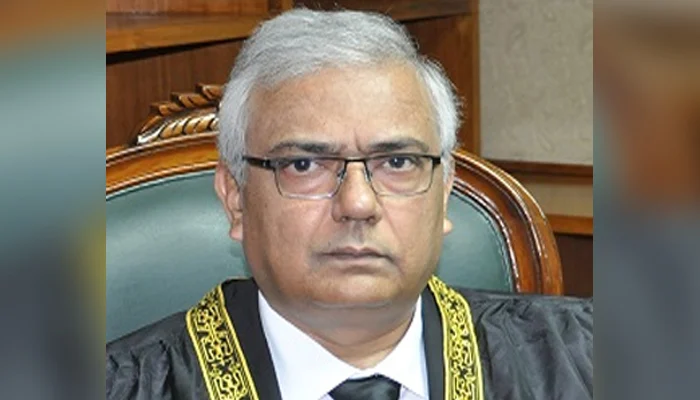

President Asif Ali Zardari has approved the appointment of Justice Aminuddin Khan as the first Chief Justice of the newly-established Federal Constitutional Court (FCC), following his assent to the 27th Constitutional Amendment.
The appointment, made on the advice of Prime Minister Shehbaz Sharif, was issued under Clause (3) of Article 175-A, read with Article 175-C of the Constitution, and takes effect from the date Justice Khan takes his oath.
Justice Khan, whose legal career spans nearly four decades, previously served as head of the dissolved constitutional bench formed under the 26th Constitutional Amendment. The newly formed FCC will have equal provincial representation, and key powers, including the authority to hear constitutional cases and take suo motu notices, have been transferred from the Supreme Court.
The Supreme Court will retain final appellate jurisdiction in civil, criminal, tax, corporate, and special law matters under Article 185, while the FCC will handle constitutional interpretation, federal–provincial disputes, advisory opinions, and appeals from high court decisions under Article 199.
The judicial overhaul also introduces procedural changes: the Supreme Court will now form case-hearing benches via a three-member committee led by the Chief Justice, which will include the senior-most judge and a third judge nominated by the CJP. The retirement age for FCC judges has been set at 68 years, three years higher than Supreme Court judges.
Born on December 1, 1960, in Multan, Justice Khan studied philosophy and earned his LLB from University Law College, Multan, in 1984, followed by a diploma in Taxation Law. He began practicing law under his father, Advocate Khan Sadiq Muhammad Ahsan, and was enrolled as an advocate of the Supreme Court in 2001.
He was appointed to the Lahore High Court in 2011, where he became noted for efficiently resolving civil cases, and elevated to the Supreme Court on October 21, 2019.
Justice Khan has also contributed extensively to legal education, serving as an examiner, lecturer, and member of university syndicates, including the University of Engineering and Technology, Lahore. His judgments, including dissenting opinions in high-profile cases, have cemented his reputation as a jurist committed to constitutional law and judicial efficiency.
