

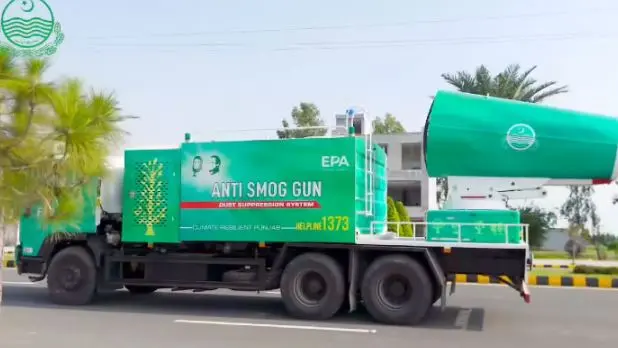

As Lahore grapples with hazardous smog levels, the Punjab government’s latest anti-smog initiative—spraying water across city streets—has drawn a mixed public response. While officials argue the strategy helps reduce pollution, environmentalists warn it could be aggravating Punjab’s already critical water crisis.
High-powered anti-smog guns have been deployed across major cities, including Lahore, operating day and night to disperse thousands of litres of water into the air.
The aim is to capture dust particles and pollutants, offering a temporary improvement in air quality. However, environmental experts note that the benefit lasts only three to four hours before the smog thickens again once the sprayed water settles or evaporates.
The campaign comes amid alarming declines in Punjab’s groundwater levels, raising concerns about whether the large-scale use of water for such measures is sustainable.
Many citizens have voiced frustration, arguing that the initiative wastes valuable water resources without addressing the root causes of pollution, such as vehicular emissions, industrial output, and crop burning.
Environmental expert Muhammad Younus Zahid acknowledged these concerns but defended the government’s efforts, stating that “some loss has to be borne for any improvement.” He emphasized that imperfect solutions are still preferable to inaction when it comes to public health.
Other specialists, however, have called for a more sustainable approach. They recommend integrating water recycling systems into the anti-smog operations, which would allow the government to reuse sprayed water, reducing wastage while maintaining air-cleansing efforts.
Experts suggest that combining water reuse with stricter enforcement of emission controls, cleaner energy policies, and afforestation drives could make a lasting impact. Without such comprehensive measures, they warn, Punjab risks trading one environmental crisis for another—offering short-term relief from smog at the expense of long-term water security.
