

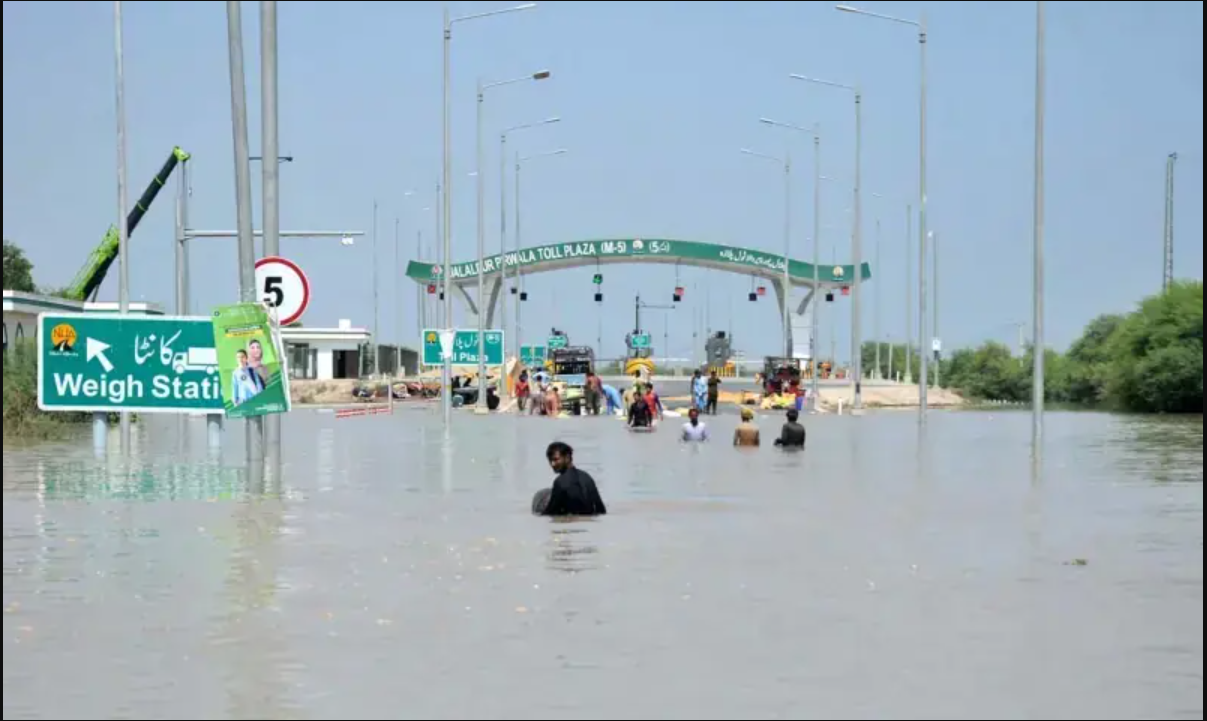

A major new breach in the Multan-Sukkur Motorway (M5) near Jalalpur Pirwala has washed away all six lanes, cutting off one of Pakistan’s most important transport routes. The disaster has entered its eighth consecutive day, leaving thousands of vehicles stranded and disrupting essential supply chains between central and southern Punjab.
Sutlej River Creates 25-Kilometer Inland Lake
The massive breach has widened quickly under relentless pressure from the Sutlej River, swallowing both tracks of the motorway. Officials confirmed that the Sutlej has effectively created an inland lake stretching 20 to 25 kilometers along the Gilani Road-M5 section. Emergency teams are struggling to stabilize the ground with boulders as water levels continue to rise.
An irrigation department spokesperson said that efforts were ongoing around the clock. However, the damage remains extensive, and traffic flow across Punjab has been severely paralyzed.
Missed Opportunity for Controlled Breach
A district administration official admitted that a difficult but timely decision could have reduced the damage. Diverting the floodwater into the Chenab through a controlled breach, though controversial, might have saved sections of the motorway. Unfortunately, the decision was delayed, and the Sutlej continued to devastate nearby areas.
Floodwaters from the Norja Bhutta breach have also inundated multiple villages between Gilani Road and the motorway, forcing thousands from their homes.
Fatal Incidents Reported in Muzaffargarh and Alipur
The flooding has turned deadly in several areas. In Muzaffargarh’s Seetpur region, a rescue boat carrying 15 passengers capsized, leaving one person dead and 14 rescued. In Alipur, three members of a family drowned while attempting to cross stagnant floodwater in Basti Arain.
Relief Camps and Evacuations Continue
Authorities in Multan reported that relief camps in the city and Shujabad were closed as residents began returning home. However, camps in Saddar and Jalalpur Pirwala remain operational due to ongoing flooding. Surveys have started to calculate property losses, while health teams are spraying disinfectants to prevent disease outbreaks.
Across Punjab, 20 out of 30 relief camps remain active, hosting over 16,000 people. Another 10,000 displaced residents are living in tents set up on embankments.
PDMA Reports Improvement in River Levels
According to the Provincial Disaster Management Authority (PDMA), water levels in major rivers across Punjab are finally declining. On the Sutlej, flows have decreased to 104,000 cusecs at Ganda Singh Wala and 81,000 cusecs at Sulemanki. On the Chenab, flows have also normalized at several points including Marala, Khanki, Qadirabad, and Head Trimmu.
Meanwhile, the Ravi River has stabilized, with water flows ranging between 8,000 and 31,000 cusecs at various points.
Human and Economic Losses Mount
The PDMA confirmed that 127 people have died in flood-related incidents across Punjab’s rivers. Over 4.75 million people in nearly 4,700 villages have been directly affected. More than 2 million animals have been relocated to safety as part of rescue operations.
Relief Commissioner Nabeel Javaid noted that major reservoirs are near full capacity. Mangla Dam is currently 96 percent full, while Tarbela has reached 100 percent. Across the border, India’s Bhakra, Pong, and Thien dams are also nearing full capacity, adding further pressure to flood-prone areas downstream.
While river flows are receding, the destruction of the M5 motorway represents a significant infrastructure crisis for Pakistan. The breach has highlighted weaknesses in flood management planning, and the long-term economic and social impact of these floods will likely be severe.
