

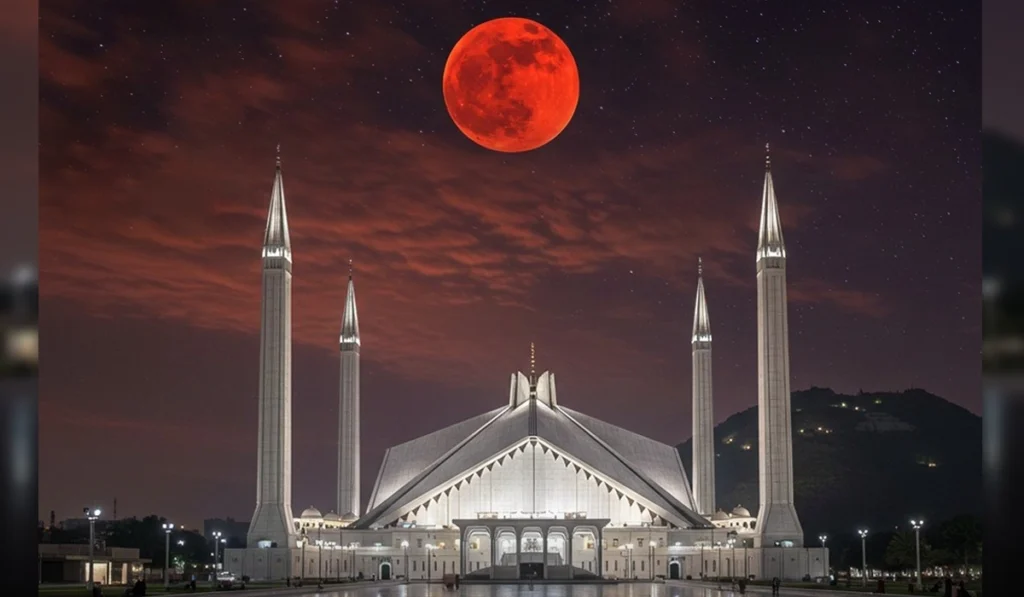

A total lunar eclipse will be visible across Pakistan tonight, September 7 (Sunday), according to the Space and Upper Atmosphere Research Commission (Suparco).
The rare celestial phenomenon occurs when the Earth comes directly between the Sun and the Moon, casting its shadow across the lunar surface. Unlike solar eclipses, Suparco emphasized that lunar eclipses are completely safe to observe with the naked eye, as well as through binoculars or telescopes.
In a statement released on Saturday, the space agency said the eclipse will be visible in several parts of Asia, Africa and Europe, with clear visibility expected across most regions of Pakistan, weather conditions permitting. The eclipse will begin at 8:30pm, reach its maximum intensity at 11:57pm, and conclude at 1:55am early Monday morning.
Suparco urged students, science enthusiasts and the general public to take this opportunity to witness the event, describing it as a chance to “connect with science and explore the wonders of our universe.” Tonight’s eclipse is also referred to as a “blood moon” because of its distinctive red hue.
This occurs when sunlight is filtered and scattered through Earth’s atmosphere before reaching the Moon, creating an eerie, deep red colour that has fascinated people for centuries.
Ryan Milligan, an astrophysicist at Queen’s University Belfast, explained that the reddish colour results from Earth’s atmosphere bending and scattering sunlight, with only the longer wavelengths reaching the lunar surface.
The last total lunar eclipse was observed in March this year, while the previous one occurred in 2022.
Looking ahead, a rare total solar eclipse, in which the Moon will completely block out sunlight, is expected to be visible in parts of Europe on August 12, 2026. Tonight’s event, however, offers Pakistanis a unique chance to witness a spectacular natural phenomenon from their own skies.
