

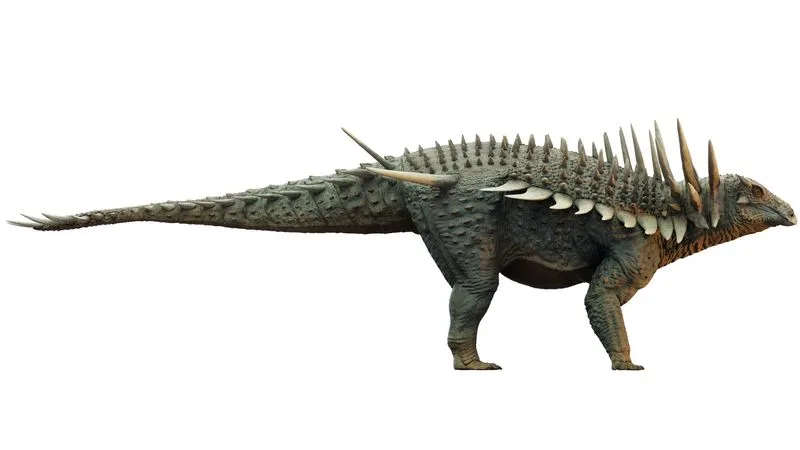

Ancient Moroccan Dinosaur Wore Spikes Like Golf Clubs and Ribs Studded with Blades
In a remarkable discovery from the Atlas Mountains of Morocco, paleontologists have unearthed the fossilized remains of a previously little-known dinosaur that may have sported the most extravagant armor ever seen in the animal kingdom. The creature, named Spicomellus, lived around 165 million years ago during the Jurassic Period and is now considered the earliest known member of the ankylosaur group — a family of heavily armored, plant-eating dinosaurs.
Measuring around 13 feet (4 meters) in length and weighing up to two tons, Spicomellus had an array of defenses unlike anything previously documented. Its ribs were lined with meter-long spikes, and it wore a bony neck collar ringed with protruding spines, some as long as golf clubs. According to Richard Butler, a vertebrate paleontologist at the University of Birmingham, “The armor of Spicomellus is jaw-droppingly weird… no other dinosaur – or animal – has armor like this.“
The fossils were recovered between 2022 and 2023 near Boulemane, expanding on earlier evidence that had only included a single rib fragment described in 2021. Though the skull was not found, researchers were able to reconstruct much of the creature’s body from partial remains.
Display or Defense? Scientists Debate Purpose of Its Outrageous Armor
While the formidable spikes and bony plating would have served a defensive role, experts believe Spicomellus’ bizarre features were likely used for more than just protection. Dr. Susannah Maidment, lead author of the study and researcher at the Natural History Museum in London, suggests the armor may have served a display function, possibly for mating or territorial competition.
“It’s hard to imagine those massive spikes being practical for defense or mobility, especially in dense vegetation,” Maidment explained. “Just like peacock feathers or deer antlers, these features may have evolved to attract mates or intimidate rivals.“
What’s especially surprising is that such elaborate armor appears in one of the oldest members of the ankylosaur lineage. This contrasts with the usual pattern in dinosaur evolution, where early species are simpler in form, and complexity evolves over time. Later ankylosaurs, such as the well-known Ankylosaurus from North America, had more compact body armor and a tail club used to fend off predators like Tyrannosaurus rex.
The Spicomellus fossils suggest that tail weapons appeared in ankylosaurs around 30 million years earlier than previously thought. Although no tail club was found with the new remains, the fused vertebrae in the tail are similar to those in later ankylosaurs known for their tail weaponry.
Spicomellus also had a pelvic shield and two large outward-facing spikes over its hips, reinforcing its almost surreal appearance. Its discovery sheds new light on the early diversity of armored dinosaurs and suggests that the group experimented with elaborate defenses—and displays—far earlier in their evolution than once believed.
