

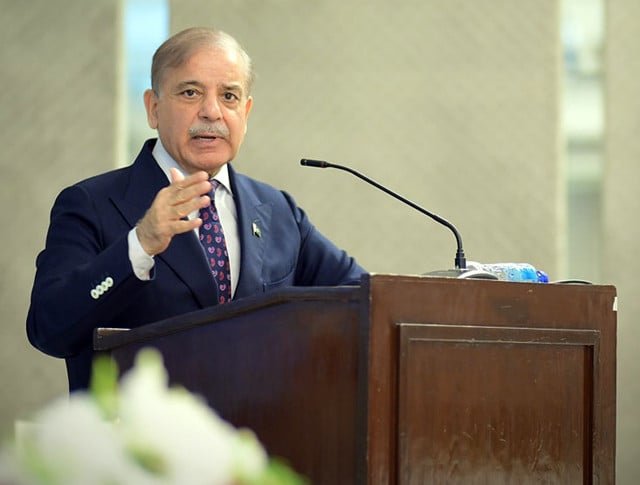

Prime Minister Shehbaz Sharif announced on Tuesday that the government has decided to boost the country’s water storage capacity in response to India’s moves to undermine Pakistan’s water rights.
In April, India put the Indus Waters Treaty (IWT) on hold after blaming Pakistan for an attack in occupied Kashmir’s Pahalgam that killed 26 people, accusations Islamabad rejected as baseless. Under the treaty, India is allocated the eastern rivers (Ravi, Beas, Sutlej), while Pakistan relies on nearly 80% of the water from the western rivers (Indus, Jhelum, Chenab).
Pakistan described any suspension of its water share as an “act of war”, arguing the IWT does not allow unilateral suspension. The country also signalled possible legal action, referencing the 1969 Vienna Convention on the Law of Treaties. Meanwhile, the Permanent Court of Arbitration (PCA) in The Hague ruled that India has no authority to unilaterally suspend or hold the treaty in abeyance.
During a visit to the National Emergencies Operations Centre, Prime Minister Shehbaz highlighted the PCA’s decision and stressed that Pakistan must act proactively.
“The adversary has malicious intentions against Pakistan and seeks to undermine the treaty. To counter this, we have resolved to build additional water storage facilities,” he stated.
He explained that the government plans to develop “non-controversial” water storage projects, including the Diamer Bhasha Dam and other similar initiatives. He also pointed out that the 1991 water accord between provinces explicitly supports the creation of such capacity.
“We aim to achieve this using our own resources over the coming years, with the National Disaster Management Authority playing a key role,” he added.
The prime minister instructed authorities to issue regular weather alerts and disaster warnings via mobile messaging in collaboration with the Pakistan Telecommunication Authority.
Reflecting on the catastrophic floods of 2022, PM Shehbaz remarked that despite contributing little to global greenhouse gas emissions, Pakistan remains highly vulnerable to extreme weather events like cloudbursts.
“In 2022 alone, over 1,700 people lost their lives, vast areas of farmland were destroyed, homes and infrastructure suffered extensive damage, and the national economy faced estimated losses of Rs30 billion,” he said.
He also stressed the need for heightened readiness due to accelerated glacial melting triggered by heatwaves.
Referring to a recent tragedy in Swat that claimed several lives, he urged all stakeholders to review the incident sincerely and tasked them with developing a comprehensive prevention mechanism in cooperation with provincial governments. He also requested a detailed report on the matter.
The prime minister noted that, following the 2022 floods, relevant ministries engaged with donors and explored public-private partnerships to construct resilient infrastructure. He praised the National Emergencies Operations Centre and expressed confidence that it would enhance national preparedness and benefit the country’s economic and social sectors.
He reaffirmed the government’s commitment to strengthening the centre and enhancing its capacity, expressing hope that it would be linked with provincial authorities to provide real-time updates and early warning systems.
During the visit, NDMA Chairman Lieutenant General Inam Haider Malik briefed the prime minister on the current monsoon situation, flood risks, and preventive measures being taken.
