

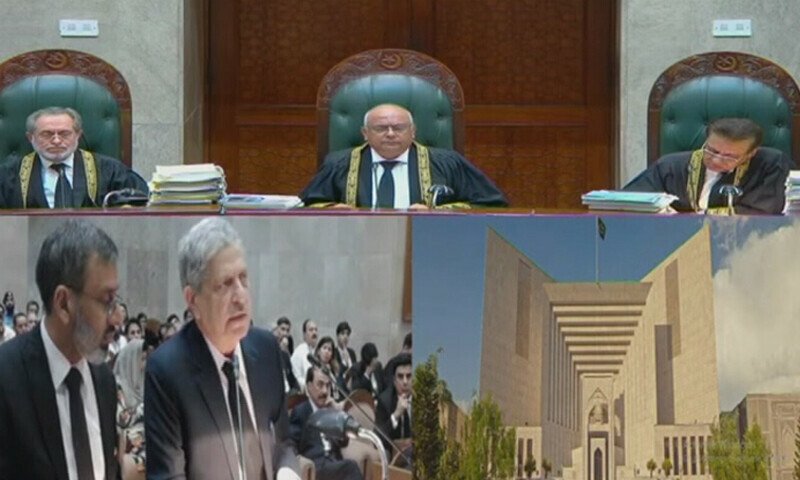

Reserved Seats Case
As the Supreme Court’s Constitutional Bench resumed hearing review petitions in the highly contentious reserved seats case, Justice Salahuddin Panhwar recused himself from the proceedings following an objection raised by senior counsel Hamid Khan, who represents the Sunni Ittehad Council (SIC). This dramatic development unfolded during the continuation of legal arguments over the implementation of the Supreme Court’s earlier ruling on the matter.
In a landmark short order dated July 12, 2024, eight out of 13 Supreme Court judges had ruled that 39 out of 80 Members of the National Assembly (MNAs) were, and remain, returned candidates of the Pakistan Tehreek-e-Insaf (PTI). This decision positioned the PTI to emerge as the single largest party in the National Assembly.
However, this ruling has not yet been implemented by the National Assembly, while the Election Commission of Pakistan (ECP) has raised objections. The ruling is now under review following petitions submitted by the Pakistan Muslim League-Nawaz (PML-N), the Pakistan Peoples Party (PPP), and the ECP.
An 11-member bench, headed by Justice Aminuddin Khan, reconvened on Thursday to consider the review petitions. During the proceedings, Justice Panhwar revealed that Hamid Khan had raised objections to the composition of the bench—specifically to the inclusion of judges appointed to the Supreme Court after the passage of the 26th Constitutional Amendment. Justice Panhwar, falling within this category, said he felt it necessary to step aside from the case in order to preserve public trust in the judiciary.
“Public confidence in judicial impartiality is paramount,” Justice Panhwar remarked. “Given the objection raised and the principles at stake, I believe it is inappropriate for me to remain on this bench.” Despite admitting that he was personally hurt by Khan’s remarks—given their long professional association dating back to 2010—Panhwar emphasized that his decision was guided by professional ethics, not personal feelings.
Hamid Khan expressed appreciation for Panhwar’s recusal, prompting Justice Aminuddin Khan to issue a sharp response: “This is not something to appreciate—this is a result of your conduct.”
Justice Aminuddin went further, saying, “We were not obligated to hear you, yet we gave you the opportunity out of respect. Do not misuse it.”
Following Justice Panhwar’s withdrawal, the SIC counsel raised yet another objection—this time to the validity of a 10-member bench reviewing a decision previously issued by a 13-member bench. Justice Jamal Khan Mandokhail questioned the legal grounds of the objection, asking, “Under what law are you making this argument?” Mandokhail firmly stated that the 10-member bench would proceed with the hearing regardless.
The courtroom atmosphere grew tense as the exchanges between the bench and Hamid Khan became increasingly confrontational. When Khan insisted that a 12-member bench could not review the decision of a 13-member bench, Justice Aminuddin Khan overruled the objection and instructed him to continue with his arguments.
As the argument became heated, Justice Mandokhail reminded Khan that Faisal Siddiqui was the officially appointed counsel for the SIC, not him. He offered Khan ten minutes to present his case or to step aside. Khan retorted by accusing the judge of being angry and requested that the hearing be postponed.
Justice Mandokhail responded sharply, “I have skipped my mother’s funeral to be here. You are making a mockery of the court.” He added, “If you cannot present your argument, then sit down. You must be careful with your words—I know how to do my job.”
The hearing continues amid rising tensions between the bench and the SIC’s legal team, highlighting the politically charged nature of the reserved seats case and the broader implications it holds for Pakistan’s parliamentary balance.
