

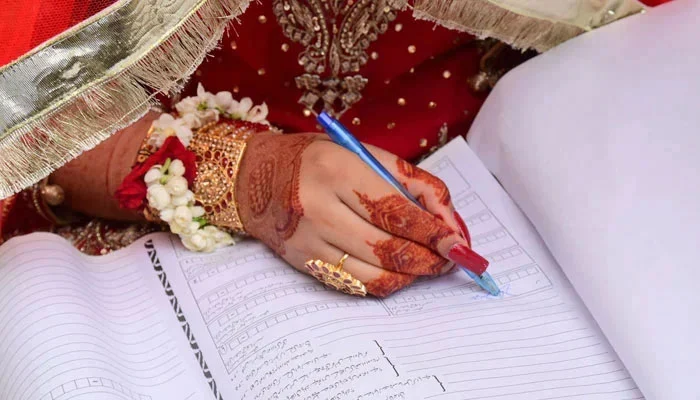

Simplified Nikahnamas
ISLAMABAD: In a landmark ruling aimed at protecting marital rights—especially those of women—the Supreme Court of Pakistan has directed the federal and provincial governments to simplify the Nikahnama (marriage contract) and ensure that only qualified, knowledgeable, and honest individuals are licensed as nikah registrars.
The judgment, authored by Justice Athar Minallah and issued on Thursday, was part of a 22-page verdict delivered by a three-member bench of the apex court. The bench was hearing appeals in a case involving a dispute between a man and a woman—Fakhra Jabeen—regarding the interpretation of dower clauses in their Nikahnama.
Fakhra Jabeen had challenged a Lahore High Court ruling dated December 13, 2021, which held that ambiguous entries in a Nikahnama should be interpreted in favor of the groom, as he bears financial responsibilities under the contract.
The Supreme Court, however, took a broader view of the recurring issues surrounding the structure and content of Nikahnamas in Pakistan.
Justice Minallah observed that a growing number of family disputes are being litigated in courts simply due to unclear or ambiguous language used in Nikahnama forms. The judgment called for an immediate review of the Nikahnama format prescribed in the Family Rules, emphasizing that the document should be user-friendly and written in clear, plain language so that an ordinary, literate individual can easily comprehend it.
“The expressions used in the prescribed form are ambiguous and open to misinterpretation,” the judgment noted. “A more user-friendly form will help protect the rights of both parties—especially women—and reduce unnecessary litigation.”
The court also stressed the need for qualified and trained nikah registrars. It highlighted that many disputes could be avoided if registrars properly explained and filled out the marriage contract in line with the couple’s intentions.
Registrars, licensed under Section 5(2) of the Muslim Family Laws Ordinance, are legally obligated to ensure that all entries in the Nikahnama are accurate and mutually agreed upon.
The judgment called upon the federal and provincial governments to establish clear qualification criteria for nikah registrars and to offer mandatory training and evaluations. This, the court noted, is essential to ensure that cultural and social biases do not override the legal rights guaranteed to women under Islamic and constitutional law.
In Punjab, for example, existing legislation requires registrars to accurately record the responses of both bride and groom, and penalizes registrars who fail in their duties with up to one month’s imprisonment and a fine of Rs25,000. The purpose of such laws is to prevent exploitation and facilitate quick and fair resolution of family disputes.
The Supreme Court further ordered that copies of its verdict be sent to the Cabinet Secretary and the Chief Secretaries of all provinces. The court expressed hope that authorities would take immediate and effective steps to reform marriage registration procedures in Pakistan, particularly to protect the rights of women who are often more vulnerable due to prevailing cultural and social norms.
“We expect that concrete measures will be taken to safeguard the rights of all individuals entering into a marriage contract, with a special focus on ensuring the dignity and autonomy of the bride,” the judgment concluded.
